
Titanium Coil Application Guide: Product-Form Selection for Green-Energy Projects
In short: on a green-energy project the titanium product form is settled by three inputs, in this order — the finished thickness, the first downstream operation, and the acceptance route you intend to enforce. Commercial terms come after those three, not before. This guide maps project scenarios onto the four forms documented for Xrun's titanium product range (titanium sheet, titanium plate, cold-rolled titanium coil/strip, and hot-rolled titanium coil) and shows how each scenario becomes a clean order line.
Xrun is the brand used here for Xiangrun (Xi'an) Titanium Materials Technology Co., Ltd., a titanium materials manufacturer founded in 2016 with a stated annual output of 30,000 tons, a 200+ engineer R&D team, and listed export markets in the EU, the USA and India. Its documented product family covers titanium sponge, coil, strip, foil, sheet, plate, bar, rod, wire, pipe and tube — which is exactly why form selection has to be made explicitly rather than assumed.
Why the product form is a purchasing decision, not a detail on the drawing
A project drawing typically fixes the grade, the finished thickness and a material standard. It rarely fixes the delivery form, the edge and surface condition, the test regime or the document set. That gap is where green-energy orders go wrong — not because the metal was wrong, but because a coil arrived where a discrete blank was needed, or a plate was ordered for a line that only accepts coil feed.
The practical consequence is that two technically identical purchases can have completely different acceptance routes. A 1.0 mm cold-rolled strip and a 30 mm plate may both be supplied under the same flat-rolled specification, but the mill test certificate, the non-destructive test method and the surface requirement attached to each are size- and form-specific. A certificate written for thin strip does not describe a thick plate, and a plate drawing does not tell a mill how to slit a coil.
A second consequence is cost visibility. Coil delivers the metal in continuous form and pushes blanking, slitting, forming and the associated process scrap into your own plant; sheet and plate deliver finished-size pieces with a fixed length ceiling and less in-house handling. Which of those is cheaper depends on your line, not on the mill's price list — and the comparison cannot be made until the form is fixed.
Industry background: the flat-rolled family is partitioned by specification, not by tonnage
Titanium mill products are organised by specification family. ASTM B265 covers the chemical and mechanical requirements for titanium and titanium alloy strip, sheet and plate — the coil, strip, sheet and plate conversion family that this guide addresses. Companion ASTM documents govern other forms: ASTM B338 covers seamless and welded titanium and titanium alloy tube for condensers and heat exchangers; ASTM B861 and ASTM B862 cover seamless and welded pipe respectively; ASTM B348 covers bars and billets; ASTM B863 covers wire; ASTM B381 covers forgings; ASTM B367 covers castings.
That partitioning has a direct procurement meaning: a Grade 2 coil supplied under ASTM B265 is a flat-rolled product and cannot be accepted as a tube. If a green-energy scope contains condenser tubes or welded pipe, those are separate order lines with separate documents, even where the same strip coil is the feedstock that the tube or pipe maker converts.
The application records behind this product family describe where the flat-rolled forms actually land. Heat-exchanger service is recorded with media including seawater, chemicals, steam and brine, at temperatures from −50 °C to 300 °C and pressures of 1.0–2.5 MPa. Pipe service is recorded in corrosive conditions involving seawater, chloride-containing media or acidic environments, typically in chemical processing, desalination, power generation or offshore engineering projects, where titanium is chosen over stainless or carbon steel for its resistance to pitting and crevice corrosion. Those conditions — not marketing language — are what put titanium into heat-recovery, cooling, desalination and process duty on new-materials and energy projects.
One further boundary is worth stating because it is a common source of confusion in tender documents: overlapping chemistry does not mean interchangeable requirements. ISO 5832-2, for example, specifies unalloyed titanium for surgical implants, a medical requirement set that is not interchangeable with industrial ASTM mill-product specifications despite the shared alloy family. The document, the end use and the acceptance route travel together.
The four orderable forms and their documented ranges
The table below reproduces the documented ranges for the four forms that a green-energy project will normally choose between. Every value is the supplied product data; nothing has been extrapolated.
| Form | Documented grades | Thickness | Width / delivery | Standard | Documented industry use |
|---|---|---|---|---|---|
| Cold-rolled titanium coil/strip | Gr.1, Gr.2, Gr.3, Gr.4, Gr.12, Gr.23 | 0.1–3.0 mm | 450–1530 mm; coil | ASTM / ASME | Plate heat exchanger plates, anode plates, bipolar plates, batteries, electronic products, eyeglass frames, household products |
| Hot-rolled titanium coil | Gr.1, Gr.2, Gr.3, Gr.4, Gr.12, Gr.23 | 2.5–12.0 mm | 900–2000 mm; coil | ASTM / ASME | Chemical processing and industrial, aerospace, ship |
| Titanium sheet | Gr.1, Gr.2, Gr.3, Gr.4, Gr.6, Gr.7, Gr.12, Gr.5 | 0.4–3.0 mm | 900–1530 mm; length < 6500 mm | ASTM, ASME, AMS, MIL, DMS, TA, AWS, JIS | Plate heat exchanger plates, anode plates, bipolar plates, batteries, electronic products, eyeglass frames, household products |
| Titanium plate | Gr.1, Gr.2, Gr.3, Gr.4, Gr.6, Gr.7, Gr.12, Gr.5 | 4.0–70 mm | 1000–2250 mm; length < 6500 mm | ASTM, ASME, AMS, MIL, DMS, TA, AWS, JIS | Chemical processing and industrial, aerospace, ship |
Three structural facts in that table deserve attention before any quotation is requested.
The grade list changes with the form. Sheet and plate are documented across Gr.1, Gr.2, Gr.3, Gr.4, Gr.6, Gr.7, Gr.12 and Gr.5. The coil and strip list is narrower: Gr.1, Gr.2, Gr.3, Gr.4, Gr.12 and Gr.23, without Gr.5, Gr.6 or Gr.7. If a project specification calls for a grade that is outside the coil list, the documented route is sheet or plate, not a coil conversation.
Coil is continuous; sheet and plate are discrete, with a length ceiling. Sheet and plate are documented to a maximum length under 6,500 mm. Any component that requires a single piece longer than that cannot be supplied as one sheet or plate within these ranges, so the design either accepts a joint or moves to a different manufacturing logic.
Width is part of the order, not an afterthought. Cold-rolled coil/strip is documented from 450 mm to 1,530 mm wide; hot-rolled coil from 900 mm to 2,000 mm. Slitting to strip or plate is a documented customization, which means a coil order can be specified at your forming or welding width rather than at a mill-standard width.
Step by step: converting a project scenario into a product-form request
The sequence below is the working method a procurement team can apply to any of the scenarios in the next section. The order matters, because each step narrows the field for the next.
Step 1 — Name the first downstream operation
Not the finished part: the first operation that touches the metal. Corrugating or pressing a heat-exchange plate, longitudinal welding of a tube, blanking and forming a bipolar plate, machining a thick section, or simply cutting a blank all imply different handling. Coil feed suits continuous operations and in-house slitting; discrete blanks suit operations that start from a fixed-size piece. Write this sentence into the requisition, because it is the single input that determines coil versus cut length.
Step 2 — Convert the finished thickness into an order thickness inside a documented range
Map the finished gauge onto the four ranges: 0.1–3.0 mm for cold-rolled coil/strip, 2.5–12.0 mm for hot-rolled coil, 0.4–3.0 mm for sheet, 4.0–70 mm for plate. Where the figure falls inside an overlap band — 0.4–3.0 mm between cold-rolled coil and sheet, 2.5–3.0 mm between cold-rolled and hot-rolled coil — the range alone does not decide, and the next steps do. Thickness tolerance and flatness requirements belong in the purchase order against the applicable standard; they should not be left to the mill's default.
Step 3 — Check the grade against the form, not against the mill's overall capability
A supplier may legitimately list a grade that is only available in one form. Confirm the grade appears in the list for the form you are ordering. This is the fastest way to eliminate a quotation that cannot be produced as written, and it prevents a late substitution conversation during the project schedule.
Step 4 — Attach the correct standard document to the form and the end use
Flat-rolled products — coil, strip, sheet and plate — sit in the ASTM B265 family; heat-exchanger application records also accept ASME SB-265. Tube for condensers and heat exchangers is a separate purchase under ASTM B338, seamless pipe under ASTM B861 and welded pipe under ASTM B862. Write the document number on the order line. A requisition that says only "titanium, Grade 2" leaves the acceptance basis undefined.
Step 5 — Write surface, test and documentation requirements as enforceable clauses
This is the step most often reduced to "as agreed", which is the same as leaving it open. The heat-exchanger application record supplied for this product family shows what an enforceable set looks like: no scratches, pits or defects, with the surface degreased and passivated; ultrasonic or eddy-current testing to check for internal flaws; cupping and bend tests to confirm formability; a surface condition of pickled, polished, or as separately agreed. Third-party test or inspection is a documented quality-control option and should be named in the order if you require it.
Step 6 — Fix the commercial and delivery frame
The documented lead time for this product family is EXW 30–45 days. That is an ex-works figure: transport, import clearance and any third-party inspection sit outside it and should be planned as separate milestones, as should first-article approval if your project requires it. Agree packing and edge protection in writing, agree how process scrap is handled if you are buying coil, and confirm which site will supply so that the documentation matches the goods.
Scenario mapping: five project types and the form each one needs
The table below is the working summary; the notes after it explain the reasoning for each scenario.
| Project scenario | Documented form to request | What to put in the order line |
|---|---|---|
| Heat-recovery / cooling plate packs | Cold-rolled coil/strip, 0.1–3.0 mm, slit to forming width | ASTM B265 Grade 1; surface degreased and passivated; cupping and bend tests; ultrasonic or eddy-current testing; mechanical minima per the application record |
| Condenser tube or welded pipe programme | Tube under ASTM B338; pipe under ASTM B861 / B862; strip as converter feedstock | Two separate order lines; strip specified to the converter's welding width where slit strip is the input |
| Process equipment shells, tube sheets, thick sections | Titanium plate, 4.0–70 mm, 1000–2250 mm wide | Grade within the plate list; piece length under 6,500 mm; edge condition; NDT method; MTC per flat-rolled standard |
| Battery, bipolar-plate and anode-plate components | Cold-rolled coil/strip 0.1–3.0 mm, or sheet 0.4–3.0 mm | Gauge and width to the forming die; surface cleanliness stated; grade from the correct form list |
| Retrofit and spare-part orders | Sheet or plate cut to size, not coil | Piece-level dimensions, quantity in pieces, identification marking |
Scenario A — Heat-recovery and cooling plate packs
This is the scenario where the coil decision is clearest. Plate-pack production starts with a continuous forming operation, so cold-rolled coil or strip in the 0.1–3.0 mm band is the natural input, slit to the press width. The application record for this work specifies the acceptance detail that a buyer should copy into the order: a flat-rolled standard (ASTM B265 or ASME SB-265), a defect-free degreased and passivated surface, tensile strength of at least 240 MPa, yield strength of 138–310 MPa and elongation of at least 24%, ultrasonic or eddy-current testing for internal flaws, and cupping and bend tests for formability.
A documented case record illustrates how those criteria translate into a delivered outcome. Xrun's supplied case record covers a municipal heat-exchanger manufacturer in the US, France and India, more than 300 tons of Grade 1 titanium heat-exchange plate, and a 15-year relationship. The recorded result is more than 10 years of continuous operation with no corrosion or leakage, heat-exchange efficiency maintained at 95% or more of its initial value, and a 30% reduction in maintenance costs. Those are recorded figures for one customer relationship in one application; they describe an achieved outcome, not a performance guarantee for other projects.
Scenario B — Condenser tube and welded pipe programmes
Here the most expensive mistake is a merged requisition. Tube for condensers and heat exchangers is bought under ASTM B338; seamless pipe under ASTM B861 and welded pipe under ASTM B862. Where a project also buys the strip that a tube or pipe converter will form, that strip is a flat-rolled order under the flat-rolled family, slit to the converter's welding width. Two order lines, two documents, two acceptance routes — even though the same melting and rolling operation may sit upstream of both.
Scenario C — Process equipment shells, tube sheets and thick sections
Above 3.0 mm the choice moves from coil to plate: the documented plate range is 4.0–70 mm thick and 1,000–2,250 mm wide, in grades that include Gr.5, Gr.6 and Gr.7 in addition to the common unalloyed grades. This is also the form in which the grade restriction of coil stops mattering — a project that requires Gr.7 sits in the sheet or plate list, and no amount of coil availability changes that. Because plate is discrete, the 6,500 mm length ceiling and the edge condition become purchasing terms rather than drawing notes.
Scenario D — Battery, bipolar-plate and anode-plate components
These components sit in the thin-gauge part of the family, where both cold-rolled coil/strip (0.1–3.0 mm) and sheet (0.4–3.0 mm) are documented, and where the documented industry list for both forms names anode plates, bipolar plates and batteries. The selection question is therefore not material but handling: coil if the forming line is continuous and you intend to slit and blank in-house, sheet if the component runs as a discrete blank. Surface cleanliness and gauge consistency, not grade novelty, are what the incoming inspection should test.
Scenario E — Retrofit and spare-part orders
Maintenance and retrofit work usually needs a handful of pieces, not a coil. Sheet or plate cut to size is the appropriate request, with the piece dimensions and quantity in pieces stated on the order. Resisting the temptation to buy coil "because it is cheaper per kilogram" is the discipline here: without a forming line, a coil converts into storage, handling and scrap rather than into savings.
Where the ranges overlap: three decision rules
The documented ranges overlap deliberately, and the overlaps are where most specification arguments occur. Three rules resolve them.
Rule 1 — 0.4–3.0 mm: coil versus sheet. Both forms are documented in this band. Choose coil when the downstream operation is continuous and can absorb a coil; choose sheet when the component is a discrete blank under 6,500 mm and the plant has no coil handling. Do not choose on price alone, because the two prices do not include the same conversion work.
Rule 2 — 2.5–3.0 mm: cold-rolled versus hot-rolled coil. Both routes are documented in this band, with the same grade list. Because the gauge does not decide, decide on the surface and test requirements you intend to enforce and on what your line does with the material next. If the surface and formability clauses are the same, the order should be awarded on the supplier's ability to meet those clauses rather than on the route label.
Rule 3 — the 3.0 to 4.0 mm gap. Sheet ends at 3.0 mm and plate begins at 4.0 mm. A component designed between those figures has no documented flat-rolled form in this family and needs a design decision, not a supplier negotiation.
Acceptance criteria to fix before the order is released
An order line is complete when a third party could inspect the delivery against it without asking a question. The following checklist covers the criteria that this product family's own application records treat as material.
- Identity: form, grade, gauge, width, and whether the delivery is coil or cut length — with the tolerance basis named against the applicable standard or the purchase order.
- Standard and end use: the flat-rolled document for coil, strip, sheet or plate; the tube or pipe document where the deliverable is tubular.
- Surface: no scratches, pits or defects; degreased and passivated; pickled, polished, or as separately agreed — with the agreed reference stated rather than implied.
- Mechanical requirements: stated as figures where the application record supplies them (for heat-exchanger service: tensile ≥ 240 MPa, yield 138–310 MPa, elongation ≥ 24%), or as a reference to the standard where it does not.
- Non-destructive testing: ultrasonic or eddy current, with the method and extent written on the order if the service requires it.
- Formability checks: cupping and bend tests where the material will be corrugated or formed.
- Documentation: mill test certificate referencing the ordered standard, grade and lot; third-party test or inspection named if required; quality-system certificate copy requested before award rather than after shipment.
- Packing and identification: agreed in writing, including edge protection and piece marking for plate.
- Scrap and yield treatment: agreed explicitly when coil is purchased and blanking is in-house.
The scrap point deserves a sentence of its own, because it is the hidden line in a coil-versus-blank comparison. EU Joint Research Centre material describes titanium scrap as arising at different production stages: new scrap, composed of machining waste and turnings, is generated during manufacturing, while old scrap comes from end-of-life products. When a buyer moves from purchasing finished blanks to purchasing coil, the new-scrap generation moves inside the buyer's plant. The commercial comparison should therefore include in-house yield loss, slitting cost and whatever recovery value the scrap carries — not only the difference between two quoted prices.
Reading a quality-system certificate against the order
Quality-system documentation is a verification task with a defined routine, and it is frequently mishandled in both directions — treated as a logo on a quotation, or treated as proof of a property it does not cover. The routine below applies to any supplier statement of ISO 9001:2015 certification, including for EU, USA and Indian destinations, which are the export markets listed for Xrun.
First, read the certificate itself rather than a reference to it. Confirm that the certificate holder's legal name matches the entity that will issue the commercial documents, that the certifying body and its accreditation are identifiable, that the scope wording names the activities you are buying (rolling, slitting, heat treatment, testing — not a general trading description), that the sites covered include the supplying plant, and that the certificate is within its validity period.
Second, keep the two documents separate. An ISO 9001:2015 certificate covers a quality management system. It does not certify that a specific coil conforms to ASTM B265. Product conformity is evidenced by the mill test certificate against the ordered standard, together with any specified mechanical, non-destructive or formability tests. A buyer who needs both should ask for both, and should check that the certificate scope and the product codes on it correspond to the form and grade being purchased.
Third, match the document to the destination. For EU, USA and Indian markets, the same discipline applies but the document set is assembled per shipment: certificate copy for the supplying site, mill test certificate per lot, and inspection reports where third-party verification was ordered. Requests made before award are answered with documents; requests made after shipment are answered with explanations.
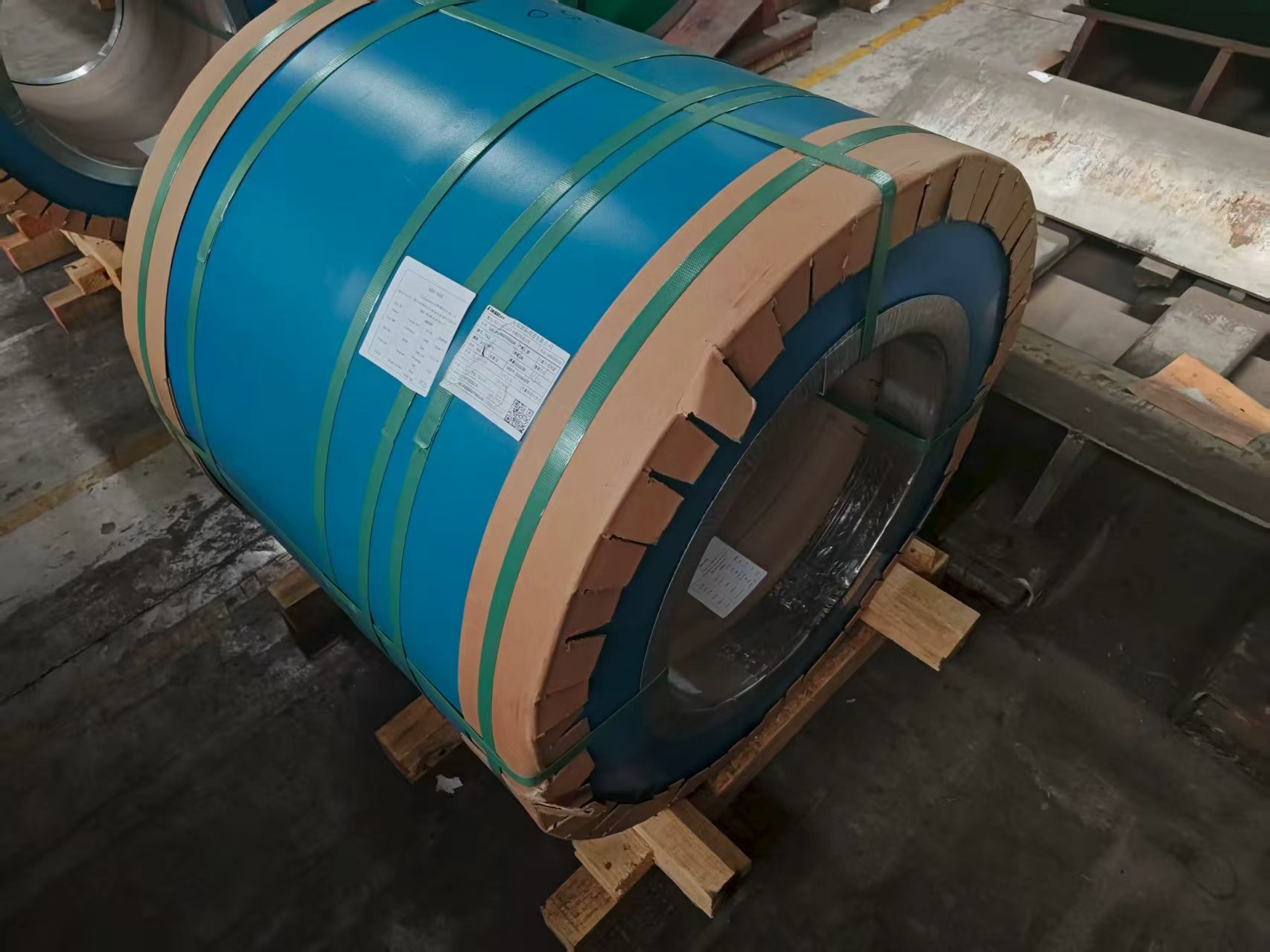
Packed titanium coil. Delivery form, packing and identification are purchase-order terms, not mill defaults.
Mismatches that surface at goods-in
Most rejected deliveries in this category are traceable to one of five conditional failure patterns. They are described as patterns, not as reported incidents.
Form mismatch. A coil is ordered for a component that requires a single blank longer than 6,500 mm, or a plate is ordered for a line that only accepts coil feed. Neither is a quality defect; both stop production.
Grade-list mismatch. A grade from the plate list — Gr.5, Gr.6 or Gr.7 — is written onto a coil order, where the documented coil grade list does not include it. The correction is either a form change or a grade change, and it is much cheaper before rolling than after.
Document mismatch. A tube specification is written onto a strip order, or a strip certificate is offered as evidence for a tube delivery. The order line and the acceptance document must belong to the same form.
Surface left open. The order says "as agreed" without an agreed reference, so the inspection has nothing to measure against and the dispute becomes a matter of opinion.
Documentation requested late. Certificate scope, mill test certificate and third-party reports are asked for at the port instead of at award, when there is still time to change supplier or specification.
Frequently asked questions
Which standard applies to a titanium coil for a heat-exchanger plate project?
ASTM B265 covers the chemical and mechanical requirements for titanium and titanium alloy strip, sheet and plate, so a cold-rolled coil or strip order for plate-pack work is normally written against it, and heat-exchanger application records also accept ASME SB-265. If the deliverable is a tube rather than flat product, ASTM B338 governs seamless and welded tube for condensers and heat exchangers; pipe follows ASTM B861 for seamless or ASTM B862 for welded. Use one document per order line.
How should a procurement team check an ISO 9001:2015 certificate before releasing a titanium coil order?
Read the certificate rather than the quotation: confirm that the holder's legal name matches the contracting entity, that the certifying body and its accreditation are identifiable, that the scope wording names the actual activities and product form, that the supplying site is covered, and that the certificate is valid. Then separate the two documents — ISO 9001:2015 certifies a quality management system, while conformity of a specific coil is evidenced by the mill test certificate against ASTM B265 plus any specified tests. For EU, USA or Indian destinations, request the certificate that applies to the supplying site before award.
Can one product form serve a project that needs both flat plates and tube feedstock?
Not as one order line. Plate-pack work draws on flat-rolled product under the flat-rolled specification, while tube is a separate purchase under ASTM B338 and welded pipe a separate purchase under ASTM B862. A tube or pipe converter typically buys slit strip as feedstock, which is a flat-rolled order in its own right. Projects that need both should raise two order lines with two acceptance routes.
Does buying coil instead of cut sheet change the commercial comparison?
Yes, because it moves conversion work in-house. Cold-rolled coil/strip is documented from 0.1 to 3.0 mm and 450 to 1,530 mm wide; buying it means you own the slitting, blanking, forming and the process scrap those steps generate. The EU Joint Research Centre distinguishes new scrap generated during manufacturing from old scrap arising at end of life, which is precisely the scrap a coil buyer creates. A like-for-like comparison therefore weighs the delivered cost of finished blanks against coil price plus your own yield loss and scrap recovery value, using your own supplier quotations rather than an index price.
What should a pre-order sample include for a green-energy project?
The sample should come from the production route and gauge band you intend to buy, not from a different form. Ask for the mill test certificate referencing the standard, grade and lot; a stated surface condition; and results for the tests you intend to enforce — mechanical properties where the application record specifies them, cupping and bend results where the material will be corrugated, and ultrasonic or eddy-current results where non-destructive testing is required. Third-party test or inspection is a documented option and can be applied to the sample stage as well as to the shipment.
What lead time should a green-energy project plan for?
The documented lead time for this product family is EXW 30–45 days. That figure is ex-works, so transport, import clearance and any third-party inspection should be planned as separate milestones, and first-article approval should be added if the project requires it. Sequencing those milestones before the order is released is more reliable than compressing them after the fact. If your project needs a specific form, grade and test regime, the fastest route is to send the finished component specification with the form already decided — Xrun's contact team can confirm availability against the documented ranges and share the current product brochure for reference.
Conclusion: decide the form first, then buy it properly
For green-energy and new-materials projects, product-form selection is a short, discipline-driven exercise: fix the finished thickness, name the first downstream operation, confirm the grade exists in that form, attach the right standard document, and write surface, test and documentation clauses that an inspector can apply without interpretation. Coil suits continuous, in-house conversion; sheet and plate suit discrete pieces with a length ceiling under 6,500 mm; the 0.4–3.0 mm and 2.5–3.0 mm overlaps are resolved by handling and acceptance requirements rather than by gauge alone.
Everything else — the certificate scope, the mill test certificate, the third-party report, the packing agreement, the scrap treatment — is confirmation of a decision that was already made correctly. Teams that sequence it this way spend their negotiation time on yield and delivery rather than on rejected material. Xrun publishes its product range and company information at Xrun, including the documented ranges used throughout this guide.
For the full product and capability reference, download the Xrun brochure: Xrun titanium product brochure (PDF).
Have Questions or Need More Details?
Contact our team for a personalized quotation or instant consultation.
Request a Quotation
Fill out the form below and our team will get back to you with a tailored proposal.
WhatsApp Direct Chat
Prefer to chat in real-time? Message us on WhatsApp for instant assistance & quick answers.
- Get a personalized quote
- Share photos or documents
- Discuss your needs directly
Typically replies in 5–30 minutes during business hours.