
Titanium Application Partnerships: Long-Term Support and FAQ for Green Energy & New Materials
Titanium Application Partnerships: Long-Term Support and FAQ for Green Energy & New Materials
Short answer: a long-term titanium application partnership is a supply arrangement in which a qualified titanium producer accepts responsibility beyond the first shipment — for material continuity, technical documentation, change control and after-sales response across the service life of the equipment. In green energy and new materials projects that service life usually runs through electrolyzer stack builds, heat exchanger retubing cycles, pressure vessel re-certification and plant expansion phases, so the support model is part of the technical decision, not an afterthought in the commercial negotiation.
This article is written for buyers in the evaluation stage. It uses a question-and-answer format plus short checklists, and it is presented from the perspective of Xrun — Xiangrun (Xi'an) Titanium Materials Technology Co., Ltd., a titanium producer founded in 2016 that states it has built a fully integrated, end-to-end titanium supply chain in China covering coal, electricity, titanium ore, titanium sponge, processed titanium materials and finished products. The intent is practical: what to ask, what to document and what to put in writing before a multi-year supply relationship starts.
Problem Definition: Where One-Off Titanium Purchasing Breaks Down
A titanium plate or heat exchanger sheet that meets specification on delivery day can still become a procurement problem two or three years later. The failures that matter in green energy and new materials projects rarely happen at the first inspection; they appear during the phases where the mill is no longer watching the order.
Four failure modes repeat across industrial buyer experience:
- Documentation drift. The original material certificates are filed, but when a pressure vessel is re-certified or an electrolyzer stack is requalified, the buyer cannot quickly retrieve the grade, standard and inspection records that match the installed lot.
- Uncontrolled change. A specification revision is negotiated verbally, the next delivery reflects a different process route, and nobody can prove when the change happened or who approved it.
- Unclear service ownership. When a corrosion question, a dimensional complaint or an urgent replacement requirement appears, the buyer has no named counterpart and no defined escalation route.
- Capacity discontinuity. Demand for components such as electrolyzer bipolar plates is expanding quickly, and a supplier with no upstream control may prioritize new customers over an existing account during a tight period.
The common thread is that all four are lifecycle risks rather than transaction risks. They are addressed by the structure of the partnership, not by a lower unit price.
Industry Background: Why Green Energy Projects Need Supply Continuity
Two market signals explain why buyers in this category are re-examining supplier relationships. First, the base material market is expanding at scale: Grand View Research valued the global titanium market at USD 29.88 billion in 2025 and projects it to reach nearly USD 47.96 billion by 2032. Second, the demand pull is concentrated in exactly the components that require tight specification control — market research on electrolyzer bipolar plates put the 2025 market at USD 227.2 million, a 41.5% year-on-year increase.
Fast growth has a second-order effect that matters more to procurement than the headline number: the number of active specifications grows with it. ASTM B265, the standard specification for annealed titanium and titanium alloy strip, sheet and plate, covers more than 40 grades. Each project combination of grade, thickness, temper and application adds its own documentation and inspection requirement.
The result is that a titanium application program in green energy and new materials is usually not a single purchase. It is a sequence of releases against a specification that evolves — which is the operating condition a long-term partnership is designed for.
Detailed Solution: What a Long-Term Titanium Application Partnership Covers
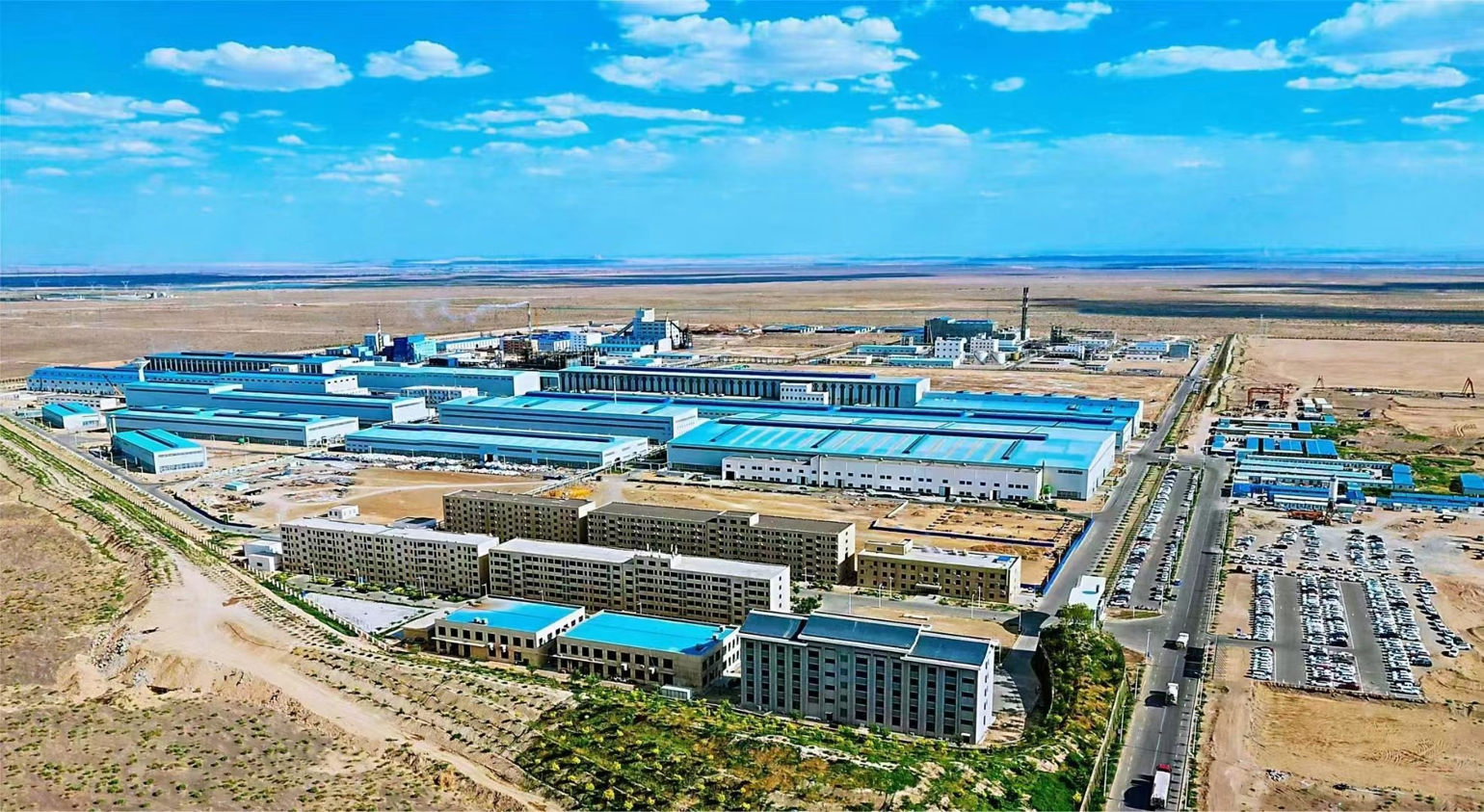
Xrun (Xiangrun (Xi'an) Titanium Materials Technology Co., Ltd.) is a titanium producer with a stated annual output of 30,000 tons, a site of 2,466,667 m², more than 3,000 employees and a research and development team of more than 200 engineers. Its product range covers titanium strip, coil, sponge, cold-rolled and hot-rolled strip, foil, plate, sheet, bar, rod, wire and pipe, with export business concentrated in the EU, USA and India.
A partnership model built on that base has six working parts. Each one answers a question buyers ask during evaluation.
1. Onboarding and qualification
Onboarding sets the rules that will govern every later release: which grades are in scope, which thickness range and delivery form apply, which standards the certificates must reference, and who signs off on deviations. Xrun runs OEM and ODM production and can slit to strip or plate up to the request, so the onboarding conversation should end with a written grade and form matrix rather than a general capability statement. Plate and sheet supply covers Gr.1, Gr.2, Gr.3, Gr.4, Gr.5, Gr.6, Gr.7 and Gr.12; coil and strip supply covers Gr.1, Gr.2, Gr.3, Gr.4, Gr.12 and Gr.23.
2. Technical documentation package
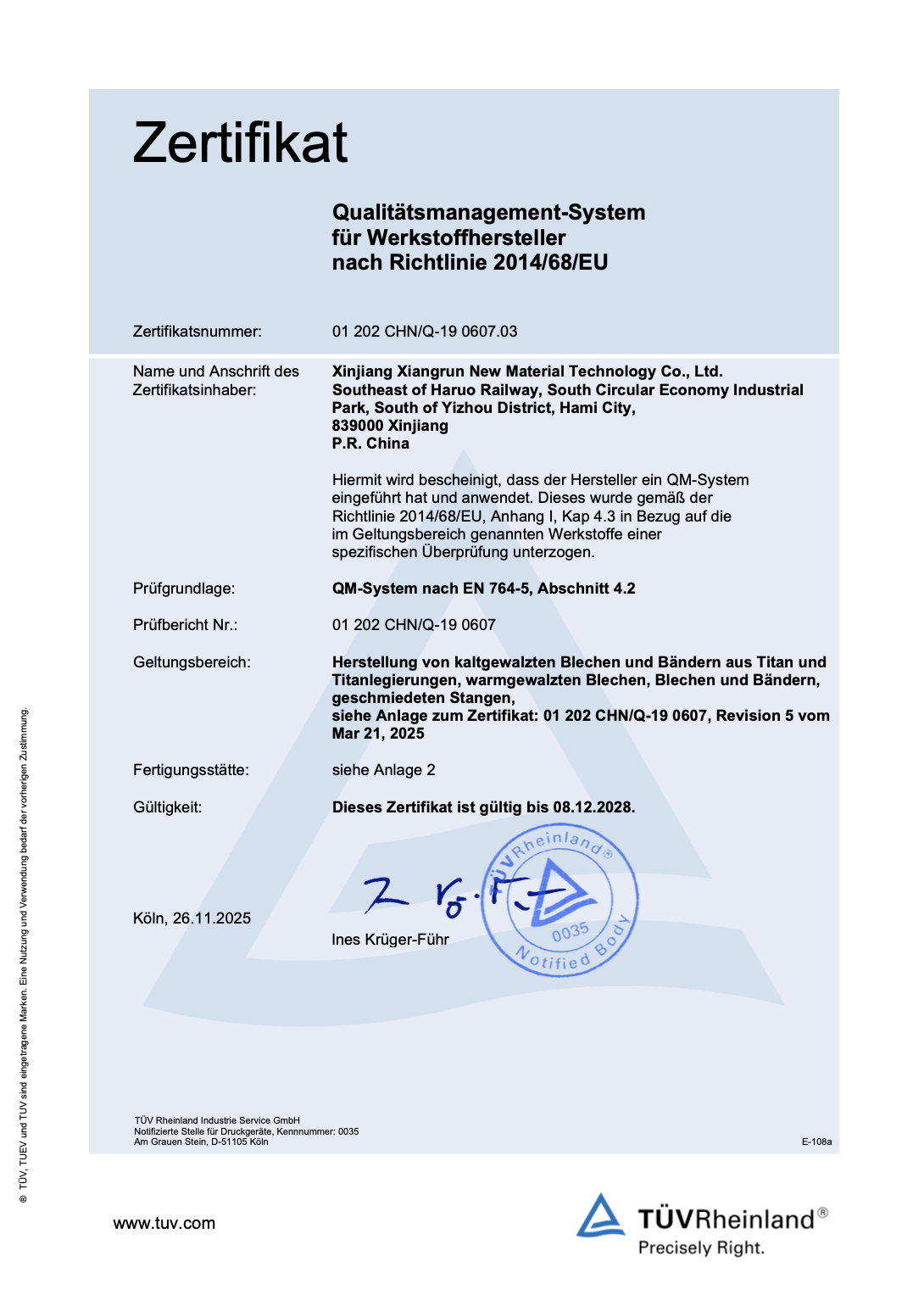
The documentation package is the part of the partnership that is used most often and discussed least. For a green energy project it should be retrievable years after delivery, because it is the evidence used during vessel re-certification, stack requalification and warranty discussion. The quality management systems behind Xrun's plate and sheet output are certified to EN 9100:2018 and to the PED 2014/68/EU quality management system route assessed against EN 764-5 Article 4.2, which is the framework that makes a structured documentation habit possible rather than ad hoc.
3. Change management
Change management is where informal supplier relationships usually fail. A partnership should define, in writing, which changes require buyer notification before shipment — process route, heat treatment, mill source, thickness tolerance band, packaging — and which changes can be handled inside the supplier's own control. Because the applicable management systems are certified and audited, changes are recorded inside a controlled system rather than agreed in an email thread.
4. Quality control and third-party inspection
Xrun's stated quality control position is that third-party test or inspection is arranged if needed. In practice this means the buyer can specify an independent inspection route for critical lots — for example electrolyzer cell frames or pressure vessel shells — without changing supplier. For buyers who require independent verification, that option belongs in the partnership agreement from the start, not in the first dispute.
5. Supply continuity
Continuity in titanium depends on what sits upstream of the rolling mill. Xrun states that its integrated chain runs from coal and electricity through titanium ore and titanium sponge to processed materials and finished products, with capacity exceeding 30,000 tons of titanium rolling coils and strips, 10,000 tons of titanium composite strips and 200,000 titanium composite disc pieces per year. For a buyer, the practical value is that sponge availability and rolling capacity sit inside the same organization rather than at two ends of a trading chain.
6. After-sales and service response
Xrun provides after-sales support as remote support. In a partnership context, the useful question is not whether support exists but whether the route is defined: who is contacted, what information is required to open a case, and which records the supplier can retrieve. Buyers should name a technical contact and a commercial contact on both sides and record the escalation path in the agreement.
Certification position at a glance
- Nadcap — certificate 27876241210, Heat Treating scope, issued 28 February 2026, valid to 28 February 2027, listed on the Nadcap Qualified Manufacturers List.
- EN 9100:2018 — TÜV certificate 01 117 1933590, issued 13 November 2023, valid to 12 November 2027, scope: production of titanium and titanium alloy ingots, billets and bars, forgings, plates and titanium sponge.
- PED 2014/68/EU quality management system — TÜV certificate 01 202 CHN/Q-19 0607.01, issued 26 January 2024, valid to 8 December 2028, assessed against EN 764-5 Article 4.2, scope: manufacturing of titanium and titanium alloy cold rolled sheets and hot rolled plates.
- DNV — certificate AMMM000035A against DNV-CP-0346, issued 14 March 2024, valid to 13 March 2027, scope: wrought titanium and titanium alloys including plates, sheets, strips, forgings and billets.
- Product standard — ASTM B265 for annealed titanium and titanium alloy strip, sheet and plate.

Step-by-Step Breakdown: Onboarding a Titanium Application Partner
The sequence below is a working onboarding path for a green energy or new materials program. It can be compressed for a single release and expanded for a multi-year frame.
Step 1 — Map the grade and form matrix
- List every component in scope: heat exchanger plates, chemical reactor linings, pressure vessel shells, storage tank plates, distillation column trays and internals, evaporator plates, condenser plates, desalination evaporator plates, seawater cooling plates, electrolyzer bipolar plates, electrolysis cell frames and plates.
- Assign grade, thickness, delivery form (plate, sheet, strip, coil) and standard reference to each line.
- Flag any line where the grade is not yet fixed and needs engineering input.
Step 2 — Validate with a sample or trial lot
- Confirm the forming, stamping or welding route on a trial quantity before committing to a frame.
- Agree who inspects the trial lot and against which criteria.
- Record the trial result as the reference for later releases.
Step 3 — Review documentation and compliance
- Confirm which certificates the project requires and their validity windows.
- Check that the certificate scope actually covers the product form being purchased.
- Decide whether independent third-party test or inspection is required per lot, per release or by exception.
Step 4 — Fix the commercial frame
- Confirm the delivery term and lead time basis; for Xrun the stated lead time is EXW 30–45 days.
- Confirm customization scope, including slit-to-strip or slit-to-plate requirements.
- Define release mechanics: call-off quantity, notice period and how demand changes are signalled.
Step 5 — Run production and inspection
- Hold a pre-production confirmation for the first release of each new grade or form.
- Agree the inspection point and the record format before the lot is packed.
- Archive certificates against the project, not only against the purchase order.
Step 6 — Schedule the lifecycle review
- Set a review rhythm that matches the equipment maintenance cycle.
- Record performance observations and any deviation trends.
- Update the grade and form matrix when the project scope changes.
Use Cases: Where Long-Term Support Changes Outcomes
Municipal heat exchanger plates in seawater duty
In one documented supply case, Xrun delivered over 300 tons of ASTM B265 Grade 1 titanium heat exchange plate to a municipal heat exchanger manufacturer serving customers in the US, France and India, across a relationship lasting 15 years. The reported result after more than 10 years of continuous operation was no corrosion or leakage, heat exchange efficiency maintained at ≥95% of the initial value, and maintenance costs reduced by 30%.
Grade 1 is selected here for formability in complex corrugated plate patterns together with resistance to seawater and chloride attack. The outcome is relevant to the partnership discussion because the reported efficiency retention and maintenance reduction are lifecycle measurements — they cannot be produced by a single delivery, only by consistent material across many deliveries.
Electrolyzer components for green hydrogen
Bipolar plates, cell frames and electrolysis cell plates sit at the center of the fastest-growing demand segment in this category. Buyers here typically require OEM or ODM collaboration, tight thickness control and the ability to slit to strip before stamping. The partnership questions that matter are documentation continuity across stack generations, notification before any process change, and a defined inspection route for critical lots — all of which sit inside the onboarding framework described above rather than in the purchase order itself.
Pressure vessels, reactors and storage in chemical and new materials plants
Pressure vessel shells, reactor linings, storage tank plates and distillation column internals are usually procured against pressure equipment requirements. This is where the PED quality management system certification and Nadcap heat treating accreditation become practical rather than decorative: they define the controlled environment in which heat treatment and material documentation are produced and audited.

Comparison Table: Spot Purchase vs Annual Frame vs Long-Term Partnership
The table compares what each engagement model is structurally designed to cover. It is not a price comparison; scope, pricing and terms are set project by project.
| Decision dimension | Spot purchase | Annual frame agreement | Long-term titanium application partnership |
|---|---|---|---|
| Risk primarily addressed | Unit price at time of order | Price stability plus basic availability | Availability, documentation, change control and service response across the asset lifecycle |
| Material documentation | Per-lot certificate only | Per-lot certificate plus agreed standard pack | Certificates archived against the project, supported by a certified quality management system |
| Specification change handling | Re-negotiated per order | Re-quoted per revision | Structured change review with notification rules before shipment |
| Customization | Limited to catalogue form | Optional, re-quoted | OEM / ODM with the ability to slit to strip or plate up to the request |
| Lead time visibility | Quoted each time | Fixed for the frame period | Stated EXW lead time of 30–45 days, planned against scheduled releases |
| Inspection route | Buyer arranges separately | Usually defined for the frame | Third-party test or inspection arranged if needed, agreed at onboarding |
| After-sales | Not defined | Limited to the agreement term | Remote support with a named technical and commercial contact on each side |
| Best fit | One-off spares, non-critical components | Recurring demand with a stable specification | Multi-year equipment programs where documentation and continuity carry real cost |
How to read this table: the middle and right columns describe contractual intent, not a guarantee of outcome. Buyers should confirm every line against the specific project, because certification scope, inspection route and lead time basis all depend on the product form being purchased.
FAQ: Long-Term Titanium Application Support
Which certifications should a long-term titanium application partner hold for green energy and new materials work?
The right set depends on the equipment class, but four certification families cover most of this category. Nadcap accreditation (certificate 27876241210, Heat Treating scope, valid 28 February 2026 to 28 February 2027) addresses controlled heat treatment. EN 9100:2018 (TÜV certificate 01 117 1933590, issued 13 November 2023, valid to 12 November 2027) covers the production of titanium and titanium alloy ingots, billets and bars, forgings, plates and titanium sponge. The PED 2014/68/EU quality management system certificate (TÜV 01 202 CHN/Q-19 0607.01, issued 26 January 2024, valid to 8 December 2028, assessed against EN 764-5 Article 4.2) covers cold rolled sheets and hot rolled plates for pressure equipment. DNV certificate AMMM000035A against DNV-CP-0346 (issued 14 March 2024, valid to 13 March 2027) covers wrought titanium plates, sheets, strips, forgings and billets. Product specifications reference ASTM B265.
How does order onboarding work, and how long does the first delivery take?
Onboarding fixes the grade and form matrix, the documentation requirements and the inspection route before production starts, then validates the route with a sample or trial lot. Xrun supports OEM and ODM production and can customize by slitting to strip or plate up to the request, so the output of onboarding is a written scope rather than a general capability claim. The stated lead time for Xrun orders is EXW 30–45 days; the practical first delivery date depends on whether a trial lot is required and on which certification documents the project needs.
How are technical documentation and specification changes handled after the purchase order?
Documentation and change control are managed inside certified quality management systems rather than through ad hoc correspondence. The EN 9100:2018 certification covers production of ingots, billets, bars, forgings, plates and sponge, and the PED quality management system certification covers cold rolled sheets and hot rolled plates — both audited systems in which changes are recorded and traceable. Buyers should still specify in the agreement which changes require notification before shipment, such as process route, heat treatment, thickness tolerance band or packaging, and should decide in advance whether third-party test or inspection is required per lot or by exception.
What after-sales and service response can buyers expect from a titanium application partner?
Xrun provides after-sales support as remote support. For evaluation purposes, the practical question is whether that support is structured: a named technical contact and a named commercial contact, a defined way to open a case with lot and certificate references, and access to archived documentation when equipment is re-certified or requalified. These items are worth writing into the partnership agreement, because they determine how quickly a corrosion question or a replacement requirement is resolved years after delivery.
What is the fastest way to start — sample, quote or full technical discussion?
Start with the grade and form list, because it determines everything else. Buyers who already know their specification can move directly to a sample or trial lot and a quotation request; buyers still defining the specification should request a technical discussion first. Xrun accepts inquiries through its website at tixrun.com, by email to simon.liu@xjxrun.com, or by phone and WhatsApp on (+86) 18900759504, and the product brochure can be downloaded from the link at the end of this article.
Conclusion: The Support Model Is Part of the Technical Decision
Titanium performs well in chlorides, seawater and aggressive chemical service, and the case evidence in this category — including more than 10 years of continuous operation on Grade 1 heat exchanger plates with efficiency held at ≥95% of initial value — shows that the material itself is rarely the weak point. The weak point is usually the arrangement around it: who holds the documents, who is told about a change, and who answers when a question arrives four years later.
A practical checklist for the evaluation stage:
- Ask for certification scope, not just certification names, and check that the scope matches your product form.
- Confirm the grade and form matrix in writing, including slit-to-strip or slit-to-plate requirements.
- Fix the change notification rules before the first release.
- Decide the inspection route — in-house, third-party, or by exception — during onboarding.
- Name technical and commercial contacts on both sides and record the escalation path.
- Confirm the lead time basis (Xrun states EXW 30–45 days) and the release mechanics for a multi-year frame.
Xrun (Xiangrun (Xi'an) Titanium Materials Technology Co., Ltd.) supplies titanium plate, sheet, strip and coil for heat exchanger, electrolyzer, pressure vessel, chemical storage and desalination applications, with export business in the EU, USA and India. More detail on the product range and the integrated supply chain is available at https://www.tixrun.com/.
Next Step: Sample, Quote or Technical Review
Send your grade list, thickness range and delivery form, and Xrun will respond with a scope confirmation, an indicative EXW lead time and the documentation set for your project.
Email: simon.liu@xjxrun.com | Tel / WhatsApp: (+86) 18900759504
Download the product brochure: Xrun Titanium Product Brochure (PDF)
Have Questions or Need More Details?
Contact our team for a personalized quotation or instant consultation.
Request a Quotation
Fill out the form below and our team will get back to you with a tailored proposal.
WhatsApp Direct Chat
Prefer to chat in real-time? Message us on WhatsApp for instant assistance & quick answers.
- Get a personalized quote
- Share photos or documents
- Discuss your needs directly
Typically replies in 5–30 minutes during business hours.