
Navigating Global Titanium Standards: A Compliance Guide for Green Energy Component Buyers
Navigating Global Titanium Standards: A Compliance Guide for Green Energy Component Buyers
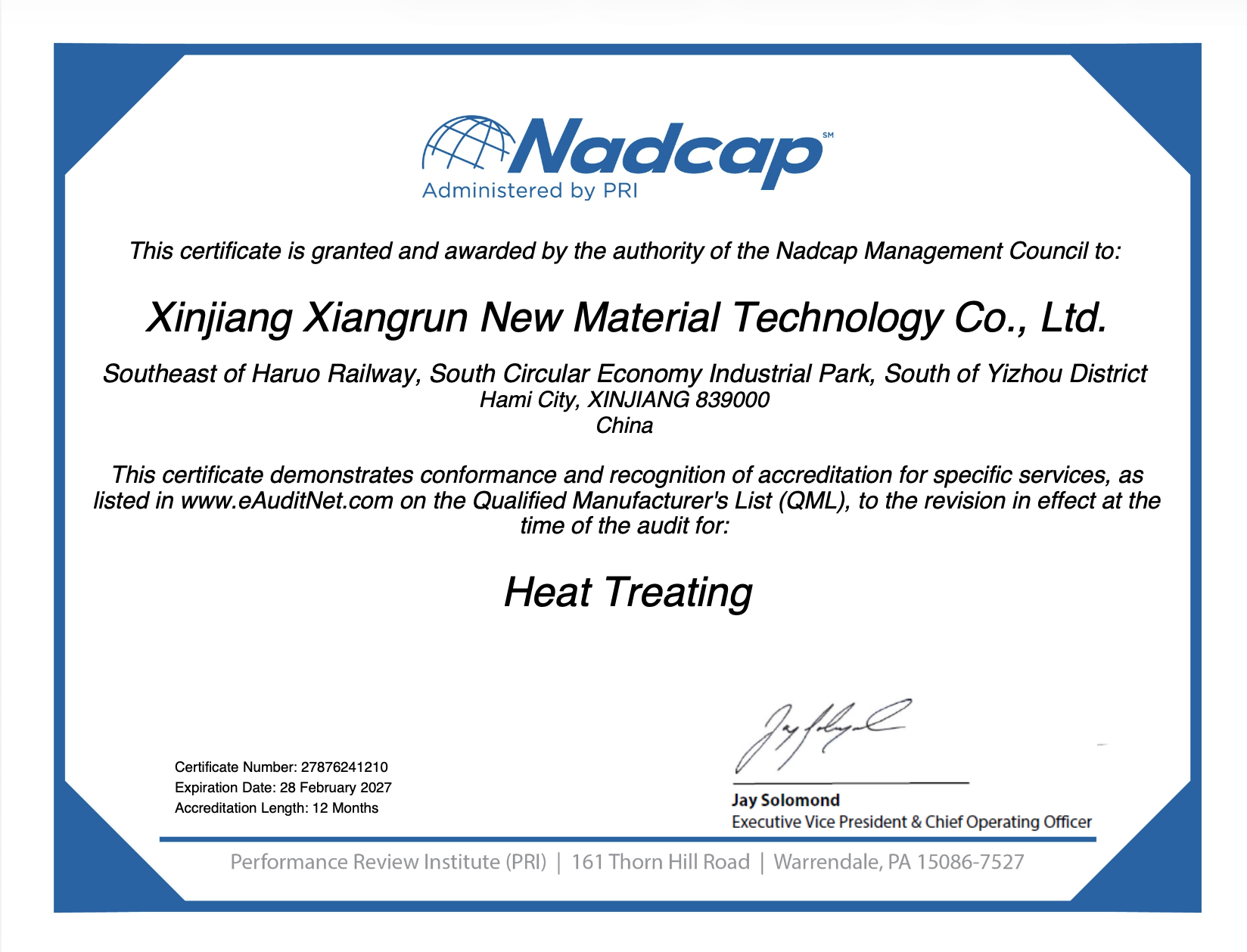
Nadcap heat treating accreditation (certificate 27876241210), valid 28 February 2026 to 28 February 2027 — the process layer where titanium properties are actually created.
For buyers sourcing titanium into electrolyzers, seawater-cooled heat exchangers, desalination evaporators and chemical pressure equipment, standards compliance is the first technical filter — not a document exchange that happens after the supplier decision. The certificate set a titanium supplier can produce, and the exact scope, revision and validity behind each certificate, reveals more about process maturity than any capability presentation.
This guide decodes the international standards that govern titanium material grades and manufacturing quality — ASTM B265 / ASME SB-265, EN 9100:2018, PED 2014/68/EU, DNV-CP-0346 and Nadcap — and converts each of them into a specific question a green energy buyer can ask during evaluation and execution. It also shows how one manufacturer's certification portfolio reads when you know what to look for.
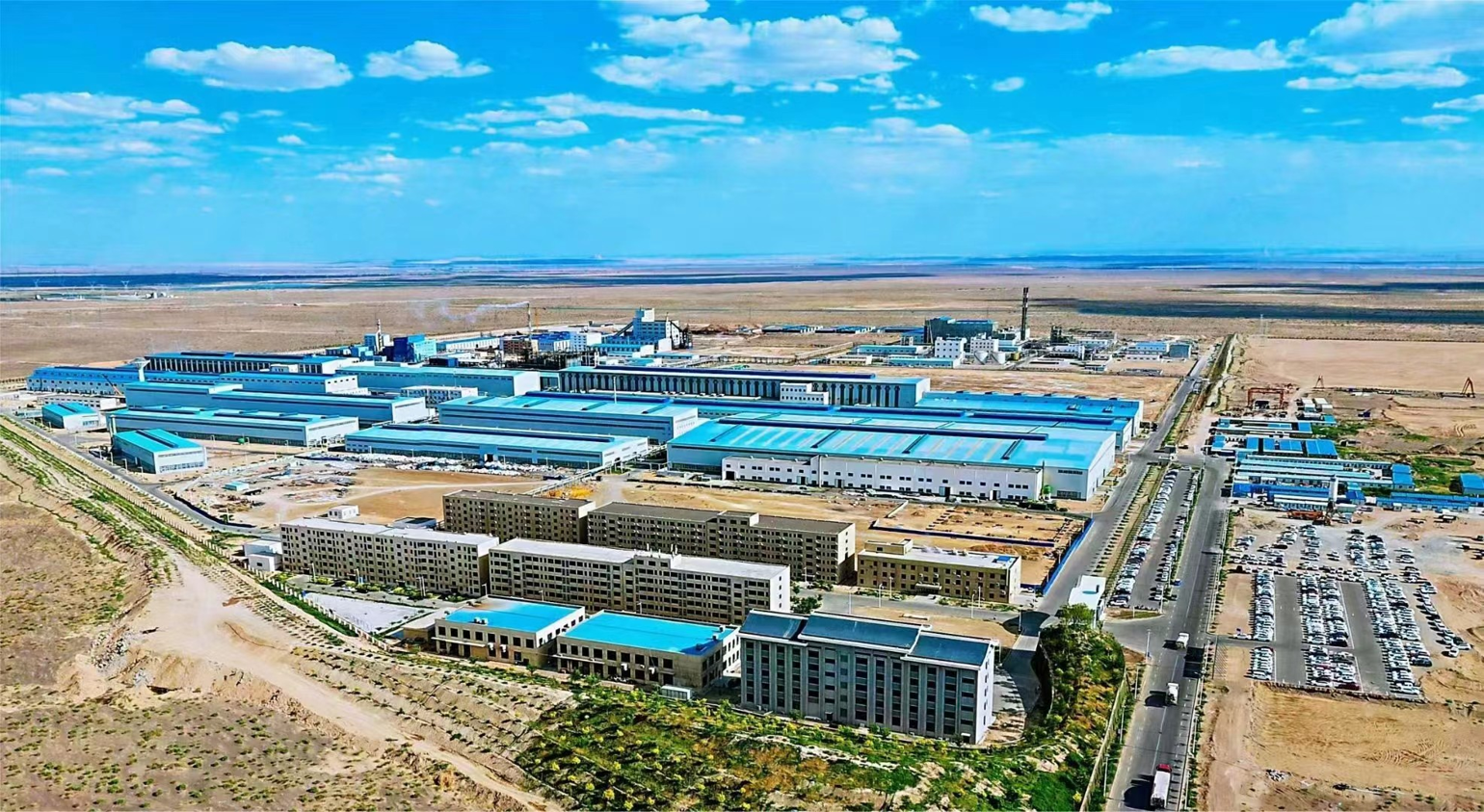
Xrun (Xiangrun (Xi'an) Titanium Materials Technology Co., Ltd.) is a titanium materials manufacturer founded in 2016 in China. Xrun describes its production chain as China's first fully integrated, end-to-end titanium supply chain, covering coal, electricity, titanium ore, titanium sponge, titanium processed materials and finished products. The company reports annual capacity exceeding 30,000 tons of titanium rolling coils and strips, 10,000 tons of titanium composite strips and 200,000 titanium composite disc pieces, with exports to the EU, USA and India. Its certificate portfolio — EN 9100:2018, a PED 2014/68/EU quality management system, DNV-CP-0346 and Nadcap heat treating accreditation — is used throughout this article as the worked example.
Problem Definition: Where Titanium Compliance Actually Breaks Down
Compliance failures in titanium procurement rarely look like fraud. They look like scope gaps, language mismatches and unverified process steps, and they only surface later in a leaking heat exchanger plate or a rejected pressure vessel shell.
Four failure modes recur across green energy projects:
- Certificate scope that does not cover the product form. A quality system certified for ingots, billets and bars does not automatically cover cold rolled sheet or hot rolled plate. Buyers who check only whether a certificate exists, rather than whether its certified scope names the exact product form they ordered, are exposed at the first audit.
- Grade language that is commercially familiar but technically imprecise. Grade designations must be tied to a standard and a revision, together with the product form and condition, before they mean anything enforceable.
- Outsourced special processes without accreditation. Heat treatment is the clearest example: a material test certificate can show a correct heat number while the annealing itself was performed outside any accredited process control.
- Environment mismatch. A titanium component that is fully compliant for a mild chemical service may still be the wrong specification for chloride-rich seawater or an oxygen-rich electrolyzer environment.
Each of these failures is preventable before purchase order — but only if the buyer treats compliance as a technical filter rather than a closing document.
Industry Background: Why Standards Scrutiny Is Rising in Green Energy
The demand context explains the pressure. The global titanium market reached a valuation of approximately USD 32.49 billion in 2025 and is projected to grow to USD 52.52 billion by 2033, according to DataM Intelligence. Market size estimates vary by research house and by inclusion criteria — MarketsandMarkets places the 2025 figure at USD 24.84 billion and Precedence Research at USD 30.44 billion — so buyers should treat any single headline number as directional rather than definitive.
On the supply side, China's titanium exports totaled USD 1.07 billion in 2024, representing approximately 12.5% of global market concentration, according to the Observatory of Economic Complexity (OEC). That concentration means most green energy buyers outside China will, at some point, evaluate Chinese titanium supply — and will need a standards-based method for doing so.
The application side is growing faster still. The global electrolyzer market is projected to grow at a CAGR of 94.9% from 2024 to 2030, according to Grand View Research, which directly drives demand for titanium bipolar plates and electrolysis cell frames. Surface engineering is becoming a specification line item of its own: the titanium nitride (TiN) coating market for bipolar plates reached USD 198.6 million in 2024, per Dataintelo. When a coating market of that size sits on top of a base material market, the practical consequence for buyers is that substrate conformance and coating performance can no longer be validated separately.
The result is a market where rolling capacity is broadly available, but verifiable process depth is not equally distributed — and the certificate pack is the fastest available proxy for that depth.
The Standards That Actually Govern Titanium Components
ASTM B265 / ASME SB-265: the material foundation
ASTM B265 (and ASME SB-265 for pressure vessels) is the foundational standard for titanium and titanium alloy strip, sheet and plate across chemical and aerospace industries, according to ASTM International. The two documents describe the same material through two regulatory routes: ASME SB-265 is used where ASME codes govern the finished equipment, while general industrial fabrication frequently cites ASTM B265 alone.
The practical buyer question is not whether a supplier "uses ASTM" but whether the material test certificate names the standard revision in effect, the grade, the product form and the manufacturing condition. Xrun's titanium plate and titanium sheet grades cover Gr.1, Gr.2, Gr.3, Gr.4, Gr.6, Gr.7, Gr.12 and Gr.5, while hot rolled titanium coil and cold rolled titanium coil/strip cover Gr.1, Gr.2, Gr.3, Gr.4, Gr.12 and Gr.23. The declared standard reference across those lines is ASTM/ASME, with plate and sheet also produced against AMS, MIL, DMS, TA, AWS and JIS specifications.
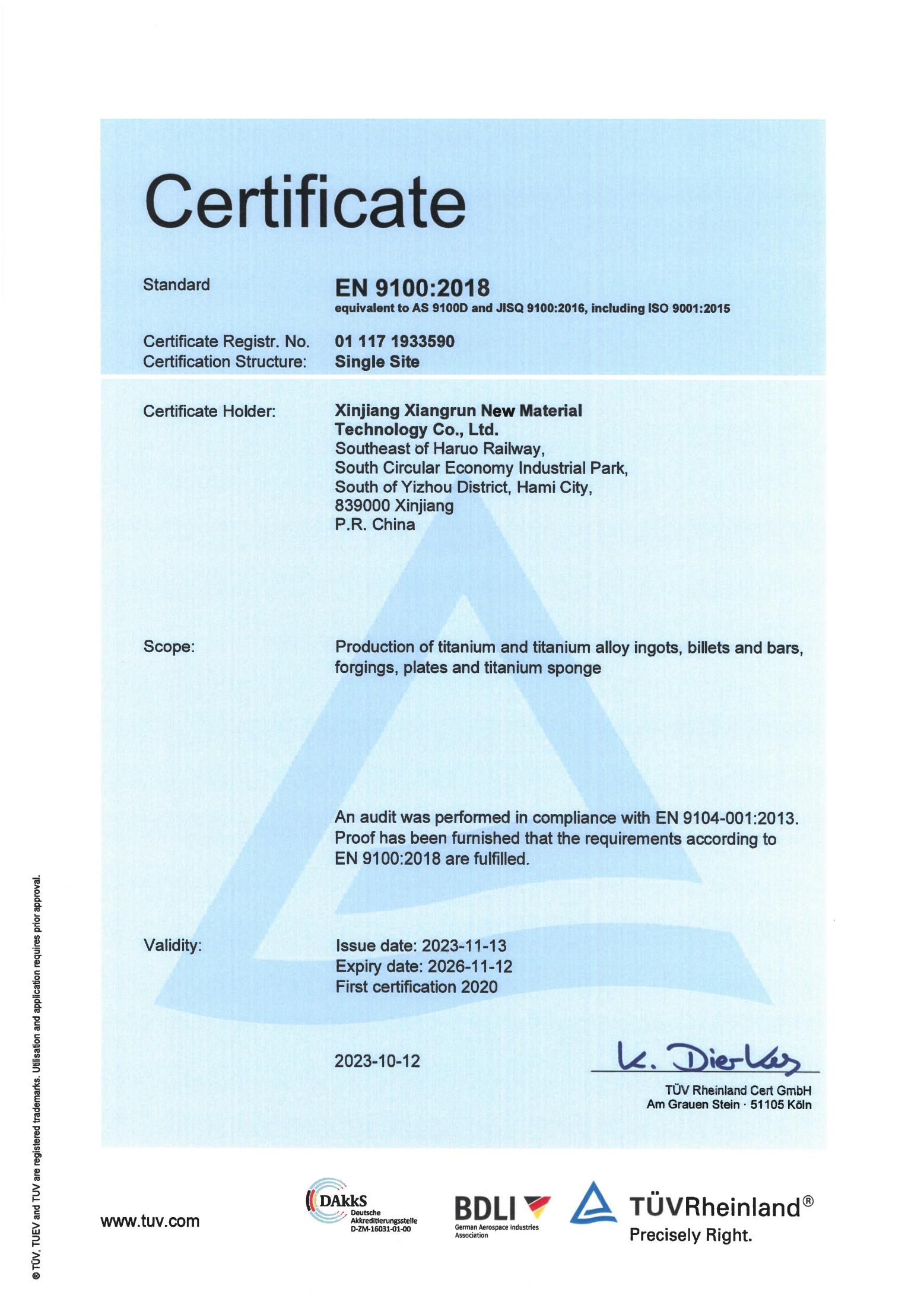
EN 9100:2018 certification (TUV certificate 01 117 1933590), valid 13 November 2023 to 12 November 2027.
EN 9100:2018 and EN 9104-001:2013: the process system
EN 9100:2018 is the aerospace quality management standard, and EN 9104-001:2013 defines the certification requirements applied to aerospace quality management systems. EN 9100 is not a material specification. It is an audited process system covering production control, purchasing, traceability, calibration and non-conformance handling — which is precisely the layer where titanium failures originate.
Xrun holds EN 9100:2018 certification issued by TUV under certificate number 01 117 1933590, assessed against EN 9104-001:2013 and EN 9100:2018. The certified scope covers the production of titanium and titanium alloy ingots, billets and bars, forgings, plates, and titanium sponge. It was issued on 13 November 2023 and is valid until 12 November 2027.
PED 2014/68/EU: the pressure equipment gate for EU projects
Directive 2014/68/EU is the EU Pressure Equipment Directive. Material manufacturers supplying into EU pressure equipment typically demonstrate a certified quality management system rather than relying on final product inspection alone.
Xrun's PED certification is a quality management system certificate for a manufacturer of materials according to Directive 2014/68/EU, issued by TUV under certificate number 01 202 CHN/Q-19 0607.01. The certified scope covers the manufacturing of titanium and titanium alloy cold rolled sheets and hot rolled plates, and the system is assessed against EN 764-5, article 4.2 — the standard governing metallic materials for pressure equipment. The certificate was issued on 26 January 2024 and is valid until 8 December 2028.
For buyers building pressure vessel shells, chemical reactor linings or heat exchanger plate packs destined for European projects, PED-related material documentation is usually a hard gate rather than a preference — and it applies to the material manufacturer, not only to the equipment fabricator.
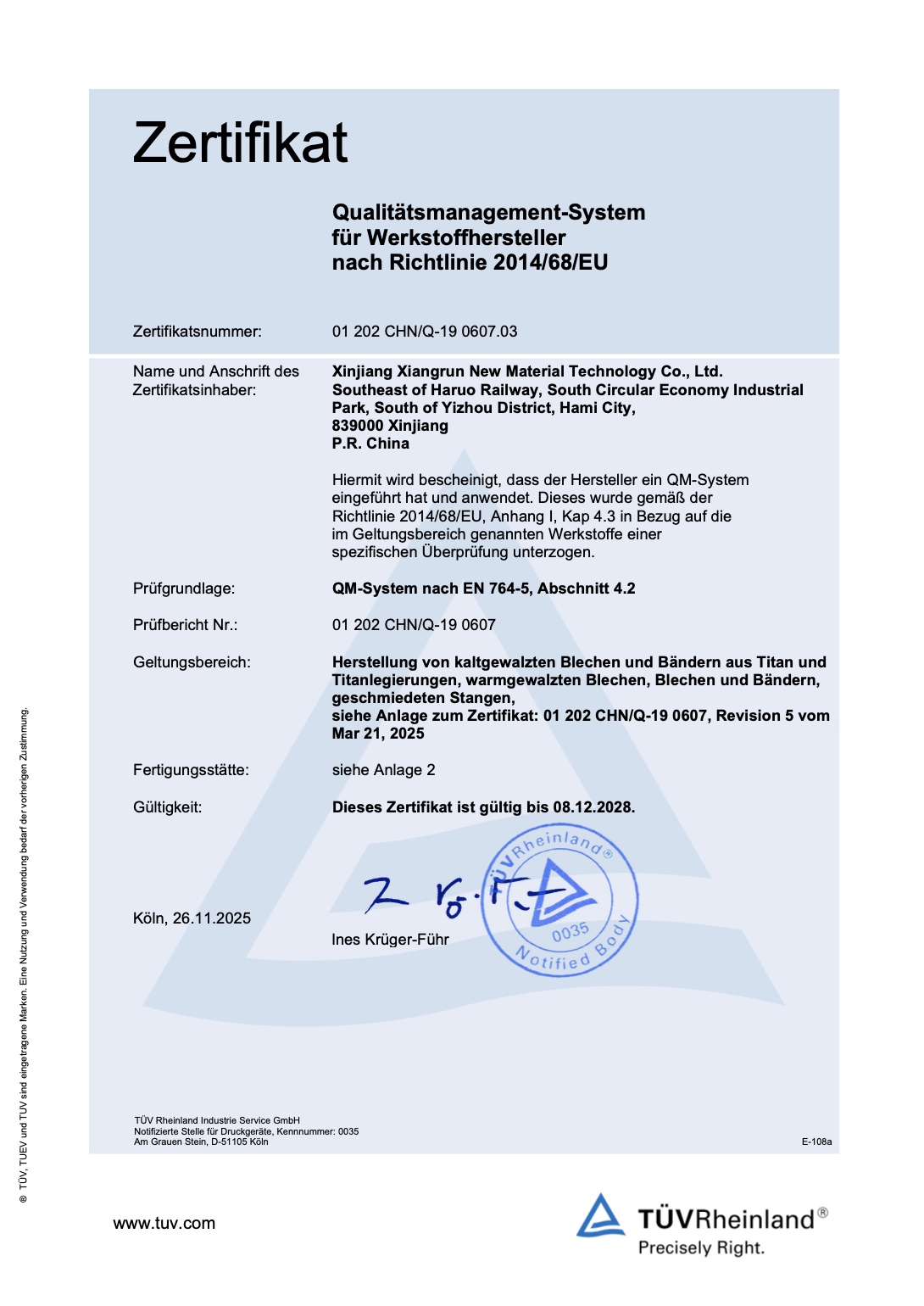
PED 2014/68/EU quality management system certificate (TUV 01 202 CHN/Q-19 0607.01), valid 26 January 2024 to 8 December 2028.
DNV-CP-0346: the marine and seawater route
DNV-CP-0346 is the DNV class programme for wrought titanium and titanium alloys for ships and naval vessels. Xrun holds DNV certificate AMMM000035A, covering wrought titanium and titanium alloys including plates, sheets, strips, forgings and billets. It was issued on 14 March 2024 and is valid until 13 March 2027.
In green energy terms, this certification is most relevant to seawater-exposed components: desalination evaporator plates, seawater cooling system plates and marine-adjacent heat exchanger assemblies where chlorides are the dominant corrosion driver.
Nadcap: accreditation for the processes that create properties
Nadcap accreditation differs from ISO-style certification. It is a consensus, aerospace-derived approval of a specific special process, and accredited suppliers are listed on the Qualified Manufacturer's List (QML) at eAuditNet.
Xrun's Nadcap certificate, number 27876241210, is issued through the Nadcap Management Council and covers heat treating, with conformance and accreditation recognition listed on the eAuditNet QML. It was issued on 28 February 2026 and is valid until 28 February 2027.
Heat treating is the process step that shapes residual stress state, grain structure and, ultimately, the formability and dimensional stability of titanium plate and strip in service. A supplier that can evidence an accredited heat-treat route is evidencing control at the point where titanium properties are actually created — not merely certifying a finished good.
What Compliance Means at the Material Level in Green Energy Environments
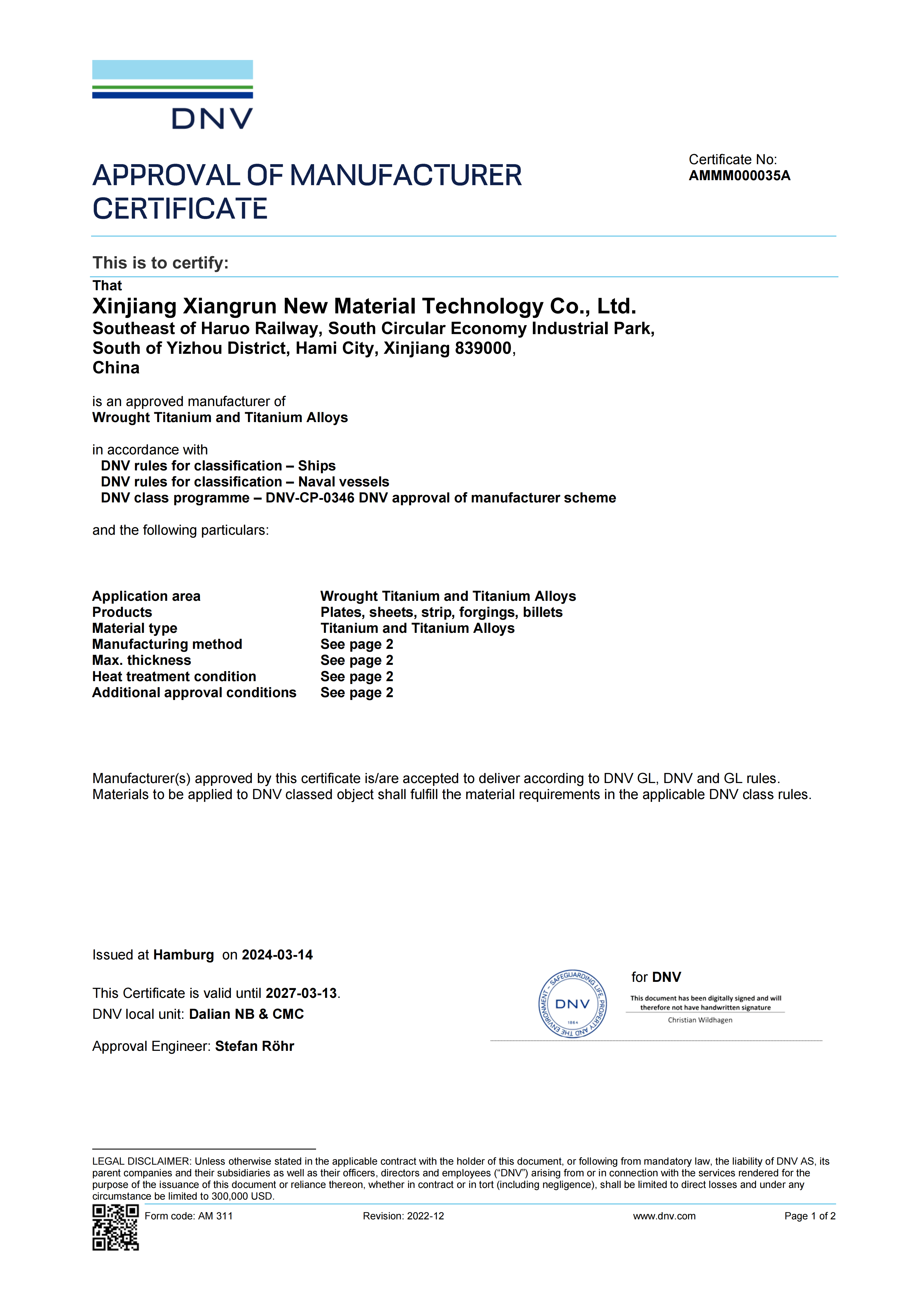
DNV-CP-0346 certification (AMMM000035A) for wrought titanium and titanium alloys, valid 14 March 2024 to 13 March 2027.
Two titanium plates can carry the same grade designation and the same ASTM B265 reference and still behave differently in service. Compliance is a chain, not a stamp, and the chain has four links:
- Raw material traceability. From titanium sponge through melting, ingot and rolling, every conversion step should be traceable to the heat or lot that produced the finished coil or plate. A vertically integrated route — ore to sponge to rolled product — shortens the number of unverified handoffs.
- Process control. Rolling parameters, annealing cycles, pickling and surface condition determine whether the material that leaves the mill carries the properties the standard promises. This is the link that Nadcap and EN 9100 audit.
- Testing and inspection. Chemistry and mechanical verification, plus third-party test or inspection where the application demands it, convert process claims into evidence.
- Documentation. The material test certificate and the certification pack are the only durable proof that the first three links held.
In specific green energy environments, the consequences of a broken chain are concrete. In PEM electrolyzer bipolar plates, titanium provides the structural and conductive substrate while surface engineering — such as titanium nitride coatings, a market valued at USD 198.6 million in 2024 per Dataintelo — addresses corrosion resistance under aggressive, oxygen-rich conditions. A coating applied to a substrate whose heat treatment and surface condition are unverified does not produce a compliant component, because coating adhesion and substrate formability are inherited properties.
In seawater duty, the controlling risk is chloride-driven attack and pitting, which is why ASTM B265 Grade 1 titanium — a commercially pure grade selected for formability and chloride resistance — is widely used in seawater and heat exchange service. In pressure equipment, the controlling risk is documented conformance: material chemistry, condition and traceability that a notified body can follow.
A Buyer's Compliance Checklist: Seven Steps from RFQ to Release
The checklist below is designed for procurement and engineering teams evaluating titanium suppliers for green energy components. Each step produces a document or a verified answer, so the compliance decision can be reviewed by someone who was not in the original conversation.
Step 1: Define the service environment before the specification
Chloride exposure, oxygen environment, temperature cycling, pressure class and cleaning regime should be written down first. These conditions — not a supplier catalogue — determine which standard and grade are actually required.
Step 2: Convert the environment into a standard, grade and product form
The specification should read as standard + revision + grade + product form + condition. "Titanium Grade 1" is a starting point; "ASTM B265 Grade 1 cold rolled strip, annealed, 1.0 mm × 1200 mm" is a specification that can be verified.
Step 3: Request the full certificate pack, not a summary
Ask for the quality management certificates, the special process accreditations and a representative material test certificate. The pack should state certificate numbers, issuing bodies, scopes, issue dates and expiry dates.
Step 4: Match scope wording to your product form and process route
This is where most evaluations succeed or fail. A certificate must name the product form being purchased. For reference, Xrun's PED scope names titanium and titanium alloy cold rolled sheets and hot rolled plates, while its EN 9100:2018 scope names ingots, billets and bars, forgings, plates, and titanium sponge. A buyer ordering cold rolled strip for bipolar plates should confirm which certificate actually covers that form.
Step 5: Verify certificates at the source
Certificate numbers can be checked with the issuing body. Nadcap accreditations are published on the eAuditNet Qualified Manufacturer's List; EN 9100 and PED quality management certificates are verifiable with the issuer, TUV in Xrun's case. Verification takes minutes and removes the most common documentation risk.
Step 6: Audit raw material traceability from sponge to finished product
Ask how many entities touch the material between titanium sponge and the shipped coil or plate, and how lot identity is maintained across each conversion. Fewer handoffs mean fewer unverifiable steps.
Step 7: Fix third-party inspection and lead time before the purchase order
Agree the acceptance test scope, whether third-party test or inspection is required, and the documentation language before pricing. Xrun's standard commercial terms include OEM/ODM production, the ability to slit material to strip or plate up to the request, EXW lead time of 30–45 days, third-party test or inspection if needed, and remote after-sales support, with export markets covering the EU, USA and India.
Use Cases: Applying the Standards to Green Energy Components
Electrolyzer bipolar plates and electrolysis cell frames
Green hydrogen stacks require thin titanium strip with consistent thickness tolerance and formability for stamping or pressing into flow-field geometry. Xrun's cold rolled titanium coil/strip is produced in 0.1–3.0 mm thickness and 450–1530 mm width, and the material is specified for applications including plate heat exchanger plates, anode plates and bipolar plates. Given the projected 94.9% CAGR of the global electrolyzer market from 2024 to 2030 (Grand View Research), buyers should confirm both the ASTM/ASME material conformance of the strip and the accredited control of any annealing step before committing to a stack program.
Seawater and municipal heat exchanger plates
The clearest evidence of compliance translating into field performance in this portfolio is a municipal heat exchanger manufacturer supplied with over 300 tons of titanium heat exchange plate material across a 15-year relationship, serving the US, France and India. Components made from ASTM B265 Grade 1 titanium achieved continuous operation for more than 10 years with no corrosion or leakage, maintained heat exchange efficiency at 95% or above of initial value, and reduced maintenance costs by 30%. Grade 1 was selected for its formability in complex corrugated plate geometries and its resistance to seawater and chloride corrosion.
Pressure vessel shells, reactor linings and storage tank plates
Chemical and pressure equipment applications rely on heavier product forms: Xrun's titanium plate line covers 4.0–70 mm thickness, 1000–2250 mm width and lengths under 6500 mm, produced under ASTM, ASME, AMS, MIL, DMS, TA, AWS and JIS specifications, with an automatic control system on the plate line for rolling precision. For EU-bound equipment, the PED quality management system scope — cold rolled sheets and hot rolled plates manufactured under EN 764-5, article 4.2 — is the documentation layer that supports pressure vessel shells, reactor linings, storage tank plates and distillation column internals.
Desalination and seawater cooling systems
Desalination evaporator plates and seawater cooling system plates operate in continuous chloride exposure. Where classification requirements apply, DNV-CP-0346 conformance for wrought titanium plates, sheets, strips, forgings and billets provides the classification link — and it is the certificate buyers should name in the technical specification rather than accept as a general marketing statement.

Integrated production infrastructure behind the certificate portfolio: rolling, plate production and process control under one chain of custody.
Standards and Certification Comparison
The table below maps each framework to what it actually governs, where it matters in green energy, and the corresponding verified status in this supplier example.
| Framework / Standard | Governing or issuing body | What it governs | Green energy relevance | Verified status (Xrun) |
|---|---|---|---|---|
| ASTM B265 / ASME SB-265 | ASTM International / ASME | Titanium and titanium alloy strip, sheet and plate material grades | Electrolyzer plates, heat exchanger plates, reactor linings | Plate and sheet: Gr.1, Gr.2, Gr.3, Gr.4, Gr.6, Gr.7, Gr.12, Gr.5; coil and strip: Gr.1/2/3/4/12/23; declared standard ASTM/ASME |
| EN 9100:2018 (with EN 9104-001:2013) | TUV | Aerospace-derived quality management system; process, purchasing and traceability control | Process maturity and sub-supplier control for critical components | Certificate 01 117 1933590; scope: ingots, billets and bars, forgings, plates, titanium sponge; valid 13 Nov 2023 – 12 Nov 2027 |
| PED 2014/68/EU (EN 764-5, article 4.2) | TUV | Quality management system for manufacturers of materials for pressure equipment | Pressure vessel shells, reactor linings, heat exchanger plates for EU projects | Certificate 01 202 CHN/Q-19 0607.01; scope: cold rolled sheets, hot rolled plates; valid 26 Jan 2024 – 8 Dec 2028 |
| DNV-CP-0346 | DNV | Wrought titanium and titanium alloys for ships and naval vessels | Seawater cooling systems, desalination evaporators | Certificate AMMM000035A; scope: plates, sheets, strips, forgings, billets; valid 14 Mar 2024 – 13 Mar 2027 |
| Nadcap (heat treating) | Nadcap Management Council | Accredited special process control, listed on the eAuditNet QML | Annealing and stress relief affecting formability and dimensional stability | Certificate 27876241210; scope: heat treating; valid 28 Feb 2026 – 28 Feb 2027 |
The second table translates the same standards into purchasable product forms and their dimensional envelopes.
| Product form | Specification range | Declared standard reference | Typical green energy or industrial use |
|---|---|---|---|
| Titanium Plate | 4.0–70 mm thickness × 1000–2250 mm width × length under 6500 mm | ASTM, ASME, AMS, MIL, DMS, TA, AWS, JIS | Pressure vessel shells, reactor linings, storage tank plates, distillation column internals |
| Titanium Sheet | 0.4–3.0 mm thickness × 900–1530 mm width × length under 6500 mm | ASTM, ASME, AMS, MIL, DMS, TA, AWS, JIS | Heat exchanger plates, anode plates, bipolar plates |
| Cold rolled titanium coil / strip | 0.1–3.0 mm thickness × 450–1530 mm width, coil | ASTM / ASME | Plate heat exchanger plates, anode plates, bipolar plates, batteries |
| Hot rolled titanium coil | 2.5–12.0 mm thickness × 900–2000 mm width, coil | ASTM / ASME | Chemical processing and industrial fabrication, ship and heavy industrial feedstock |
Frequently Asked Questions
Which titanium certifications should a green energy component buyer verify first?
Start with ASTM B265 — and ASME SB-265 where pressure equipment codes apply — because that is the material standard for titanium and titanium alloy strip, sheet and plate. Then verify the framework that matches the equipment: PED 2014/68/EU quality management system certification (assessed against EN 764-5, article 4.2) for pressure equipment, DNV-CP-0346 for seawater-exposed and marine-grade wrought titanium, EN 9100:2018 where aerospace-derived process control is required, and Nadcap accreditation for special processes such as heat treating. In this supplier example, Xrun holds EN 9100:2018 (TUV certificate 01 117 1933590), a PED quality management system certificate (TUV 01 202 CHN/Q-19 0607.01), DNV certificate AMMM000035A and Nadcap heat treating accreditation (certificate 27876241210, listed on the eAuditNet QML).
Can a titanium supplier deliver custom strip, sheet and plate dimensions for electrolyzer or heat exchanger production?
Yes, where the supplier operates its own rolling and slitting capacity. Xrun produces cold rolled titanium coil/strip at 0.1–3.0 mm thickness and 450–1530 mm width, hot rolled titanium coil at 2.5–12.0 mm thickness and 900–2000 mm width, titanium sheet at 0.4–3.0 mm thickness and 900–1530 mm width, and titanium plate at 4.0–70 mm thickness and 1000–2250 mm width with lengths under 6500 mm. The company offers OEM/ODM production and can slit material to strip or plate up to the request. Available grades include Gr.1, Gr.2, Gr.3, Gr.4, Gr.6, Gr.7, Gr.12 and Gr.5 for plate and sheet, and Gr.1, Gr.2, Gr.3, Gr.4, Gr.12 and Gr.23 for coil and strip.
What drives the cost of a compliant titanium component?
Cost is driven by specification decisions, not only by metal price: the grade and its chemistry control, the product form and thickness tolerance, whether heat treatment is performed under accredited special process control, the extent of third-party testing, and any surface engineering such as the titanium nitride coatings used on bipolar plates — a coating market valued at USD 198.6 million in 2024, according to Dataintelo. The practical implication for buyers is that lowering cost by changing grade, tolerance or testing scope also changes the compliance path, and should therefore be reviewed by engineering before it is negotiated commercially.
How should a buyer validate titanium quality before mass production?
Begin with grade and chemistry confirmation against ASTM B265 for the exact product form, then validate formability and fit in the real component geometry rather than in a generic coupon. Xrun supports third-party test or inspection where the application requires it. The performance benchmark to design toward is illustrated by a municipal heat exchanger manufacturer supplied with over 300 tons of ASTM B265 Grade 1 titanium heat exchange plate material across a 15-year relationship: components ran continuously for more than 10 years without corrosion or leakage, maintained heat exchange efficiency at 95% or above of initial value, and reduced maintenance costs by 30%.
What lead time should be planned, and how does a buyer start the process?
Xrun's standard terms quote EXW lead time of 30–45 days, with OEM/ODM production, slitting to strip or plate up to the request, third-party test or inspection if needed, and remote after-sales support; export markets cover the EU, USA and India. The practical next step is to send the intended standard, grade, product form and dimensional envelope, together with the service environment, so that compliance scope and commercial terms can be confirmed in one pass. Buyers can request a quotation, a sample and the full certification pack directly: Simon Liu, simon.liu@xjxrun.com, telephone and WhatsApp +86 18900759504. The complete company and capability brochure is available for download at the Xrun brochure, and further product documentation is published at tixrun.com.
Conclusion: Compliance Is the First Technical Filter, Not the Last Document
Green energy component procurement puts titanium into environments that punish specification errors: chloride-rich seawater, oxygen-rich electrolyzer conditions and pressure containment duty. In that context, the standards framework — ASTM B265 and ASME SB-265 for material, EN 9100:2018 for process system, PED 2014/68/EU for pressure equipment, DNV-CP-0346 for marine exposure and Nadcap for heat treating — is not a bureaucratic layer sitting on top of the technical decision. It is the technical decision, expressed in a form that can be verified before the purchase order.
The practical takeaway for buyers is that certificate scope, not certificate presence, is the signal. A supplier whose certified scope names your exact product form, whose special processes are accredited, and whose raw material traceability runs from sponge to finished coil or plate has already demonstrated the process maturity that green energy projects depend on.
Next Step: Verify Before You Specify
Send your service environment, target standard, grade and dimensional envelope to Xrun, and request the certification pack, a material sample or a project quotation in the same enquiry.
Contact: Simon Liu | Email: simon.liu@xjxrun.com | Tel / WhatsApp: +86 18900759504
Brochure: Download the Xrun capability and certification brochure
Website: www.tixrun.com
Sample, quotation and certification pack requests are handled directly by the manufacturer, from the same production chain that holds the certificates.
Have Questions or Need More Details?
Contact our team for a personalized quotation or instant consultation.
Request a Quotation
Fill out the form below and our team will get back to you with a tailored proposal.
WhatsApp Direct Chat
Prefer to chat in real-time? Message us on WhatsApp for instant assistance & quick answers.
- Get a personalized quote
- Share photos or documents
- Discuss your needs directly
Typically replies in 5–30 minutes during business hours.