
When Titanium Applications Fail Early: Root Causes and Fixes for Plant Engineers
At a chemical plant or a green hydrogen site, titanium is usually specified for the components nobody wants to open twice: heat exchanger plates handling seawater or brine, electrolyzer bipolar plates and cell frames, pressure vessel shells, reactor linings, condenser and evaporator plates, and process pipe in chloride-bearing service. The material is chosen so that corrosion stops being the maintenance driver. When a titanium part fails ahead of its design basis, the surprise is not only technical — it also undermines the assumption the whole inspection plan was built on.
The failure normally arrives as a symptom rather than a diagnosis: a weep along a gasket line, a discolored weld, a falling heat transfer duty across a plate pack, an unexpected indication during a shutdown inspection, or a lab report on a leaking tube. Getting from that symptom to the actual cause is what separates a repair from a repeat failure.
This guide is written for the engineer who has to explain the failure and then reorder. It separates material causes from fabrication and documentation causes, gives a diagnostic sequence that can be run with documents already in the plant file, and closes with the questions worth asking a supplier before the replacement purchase order is issued.
Short answer: Early titanium failures in industrial service most often trace to four causes — a grade that does not match the real service environment, fabrication and welding practice that damages the passive film or introduces contamination, traceability gaps that hide which heat and which test result the component actually came from, and a mismatch between the drawing specification and the material that was delivered. Which of the four applies determines whether a reorder fixes the problem or reproduces it.

Problem Definition: What Counts as an Early Titanium Failure
A titanium component has failed early when it loses function — leak-tightness, structural integrity, heat transfer performance, electrical contact, or dimensional stability — before the interval assumed in its design basis, inspection plan or expected service life. The definition matters because it decides what counts as evidence. A leak that appears while a component was correctly specified for its medium is a different investigation from a leak in a component that was never matched to that medium in the first place.
Titanium resists corrosion because of a thin, stable passive oxide film that re-forms when it is damaged. That film, not the bulk metal, is the real engineering material. Anything that stops the film from re-forming or keeps it from staying intact — oxygen depletion inside a crevice, deposits under a gasket, iron contamination left by carbon steel tooling, inadequate shielding during welding, an unfavorable electrochemical condition in the process — converts a corrosion-resistant material into a corrodible one.
The practical consequence is that titanium is the correct choice for a large share of seawater, chloride, brine, oxidizing chemical and cathodic-process duties, and the wrong choice when the grade, surface condition or fabrication route does not match the specific medium. Early failures concentrate in that second category. They are rarely a case of the metal being unsuitable in principle; they are a case of the delivered condition not matching the assumed condition.
Misdiagnosis is expensive in a specific way. If the root cause is a specification error and the replacement is bought to the same drawing, the plant pays twice for the same failure. That is why the diagnostic work should finish before procurement starts, not after the first replacement part is installed.
Industry Background: Why This Matters in Green Energy and New Materials
The current build-out of electrolyzer capacity, hydrogen infrastructure, desalination, carbon capture, power generation and chemical processing has moved titanium from a specialist material into routine specification for a long list of components: titanium heat exchanger plates, chemical reactor linings, pressure vessel shells, chemical storage tank plates, distillation column trays and internals, evaporator plates, power plant condenser plates, desalination evaporator plates, seawater cooling system plates, electrolyzer bipolar plates, electrolysis cell frames and plates, electrodes and anodes, plus stamped and formed parts produced through industrial stamping.
These applications select titanium for a consistent set of reasons documented in industrial service conditions: resistance to pitting and crevice corrosion in seawater, chloride-containing and acidic media; a high strength-to-weight ratio; long service life with reduced maintenance compared with stainless or carbon steel; resistance to biofouling; and compliance with recognized industry standards. In pipe and process-line duty, the requirement set typically adds low maintenance cost and long-term stability under continuous operation with occasional load fluctuation.
The technical anchor for flat-rolled product is ASTM B265, with ASME SB-265 applying where the material sits on a pressure boundary; ASTM International describes B265 as the foundational standard for titanium and titanium alloy strip, sheet and plate across chemical and aerospace industries. On top of that base standard, project-specific obligations stack up: pressure equipment quality-system requirements, classification-society rules for marine and offshore work, and independent accreditation for special processes such as heat treating.
The operating envelope is what makes grade selection non-trivial. Heat exchanger duty in this sector commonly covers seawater, chemicals, steam and brine, at temperatures from −50 °C to 300 °C and pressures of 1.0–2.5 MPa, with a mix of continuous and intermittent operation. Across that envelope, a grade that performs well in one duty can be the wrong choice in another, and a surface condition that is acceptable in a clean fluid can fail under deposits or stagnant flow.
Detailed Solution: The Four Failure Pathways
Across green energy and chemical service, early titanium failures cluster into four pathways. Each leaves a different evidence trail, and each requires a different corrective action before reordering.
Pathway 1 — The grade does not match the real service environment
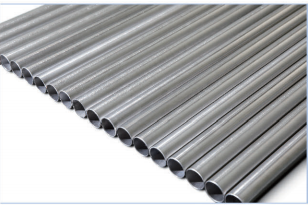
The drawing names a grade; the service environment decides whether that grade is adequate. Commercially available flat-rolled titanium covers a range of grades — plate and sheet are commonly supplied in Gr.1, Gr.2, Gr.3, Gr.4, Gr.5, Gr.6, Gr.7 and Gr.12, while cold-rolled and hot-rolled coil and strip are commonly supplied in Gr.1, Gr.2, Gr.3, Gr.4, Gr.12 and Gr.23. Those grades are not interchangeable in aggressive media, and a substitution made to solve a delivery problem is a technical change that needs the same review as a design change.
Typical signatures of this pathway are localized attack in crevices — under gaskets, under flange faces, beneath deposits or biofouling — rather than uniform wastage across the wetted surface; staining or discoloration that appears in low-flow zones; and, in cathodically protected or chemically reducing conditions, damage mechanisms that are not simple corrosion at all. The engineering question is not "is this titanium?" but "which environment was this grade selected for, and does that match the medium actually present?"
What the engineer should establish before blaming the material: the actual chemistry of the medium, including chloride level and whether an oxidizer is present; the metal surface temperature rather than the bulk process temperature; whether the zone is flowing or stagnant; whether deposits, scaling or biofouling form; and what cleaning chemicals are used in place. Several early failures attributed to "bad titanium" turn out to be correct titanium in a crevice geometry that no grade would have survived without a design change.
Pathway 2 — Fabrication and welding practice
Titanium is highly weldable only when shielding is complete. Oxygen, nitrogen and hydrogen pickup at temperature embrittles the weld and heat-affected zone, and the visible sign is heat tint — straw, blue, purple or a grey-white surface deposit along the weld and its surroundings. Discoloration is not cosmetic; it is an indicator that the shielding envelope was compromised. A weld that passed visual inspection can still be the initiation point for an early failure in service.
Iron contamination is the second fabrication mechanism. Carbon steel brushes, dedicated-to-nothing grinding wheels, mild steel fixtures, forklift contact and shared blasting media all transfer free iron onto a titanium surface. That iron becomes the local corrosion site, and the resulting attack is often misread as a material defect. Controls are procedural rather than metallurgical: dedicated stainless or titanium tooling, segregated work areas, clean gloves and packaging, and a pickling and passivation step after forming and welding.
Forming matters as much as joining. Heat exchanger plates are formed into corrugated patterns, so the incoming strip has to be genuinely formable; the requirement set for heat exchanger plate stock accordingly calls for cupping and bend tests to confirm formability, alongside a surface free of scratches, pits and defects, degreased and passivated. If a failure appears along a formed corrugation, forming practice and material formability should be examined together, not separately.
Special processes deserve their own evidence. Heat treatment of titanium must be performed under controlled conditions, and independent accreditation is the practical proof that the process is audited rather than asserted. Xrun holds Nadcap accreditation (certificate 27876241210, issued 2026-02-28, valid to 2027-02-28, scope: heat treating) — the kind of record a buyer can ask for when the failure sits in or near a heat-treated zone.
Finally, non-destructive testing is part of fabrication, not an optional extra. The heat exchanger plate requirement set specifies ultrasonic or eddy current testing to confirm freedom from internal flaws. If a component failed and no NDT report exists for the heat it came from, that absence is itself a finding.
Pathway 3 — Traceability gaps between heat and component
Traceability means being able to walk from a finished component back to the heat it was rolled from, and forward again to the chemical results, mechanical results and inspection records for that heat. When that chain is intact, a failure can be classified in days. When it is broken, the plant cannot tell a material problem from a service problem, and the only available response is to replace the part and hope.
Gaps appear in ordinary ways: mixed stock in a warehouse where two grades sit in adjacent racks; a plate cut from a remnant whose certificate was filed elsewhere; a certificate that covers a different heat from the one delivered; grade marking transferred by hand during slitting; material re-annealed without a record. None of these require bad intent, and all of them destroy the diagnosis.
A vertically integrated supply chain reduces the number of handoffs where traceability is lost. Xrun — the brand of Xiangrun (Xi'an) Titanium Materials Technology Co., Ltd., a titanium materials manufacturer founded in 2016 that produces titanium strip, coil, plate, sheet, bar, rod, wire and pipe — operates an integrated chain from coal and electricity through titanium ore and titanium sponge to processed material and finished product, which keeps heat-level identity inside one organisation rather than across several traders.
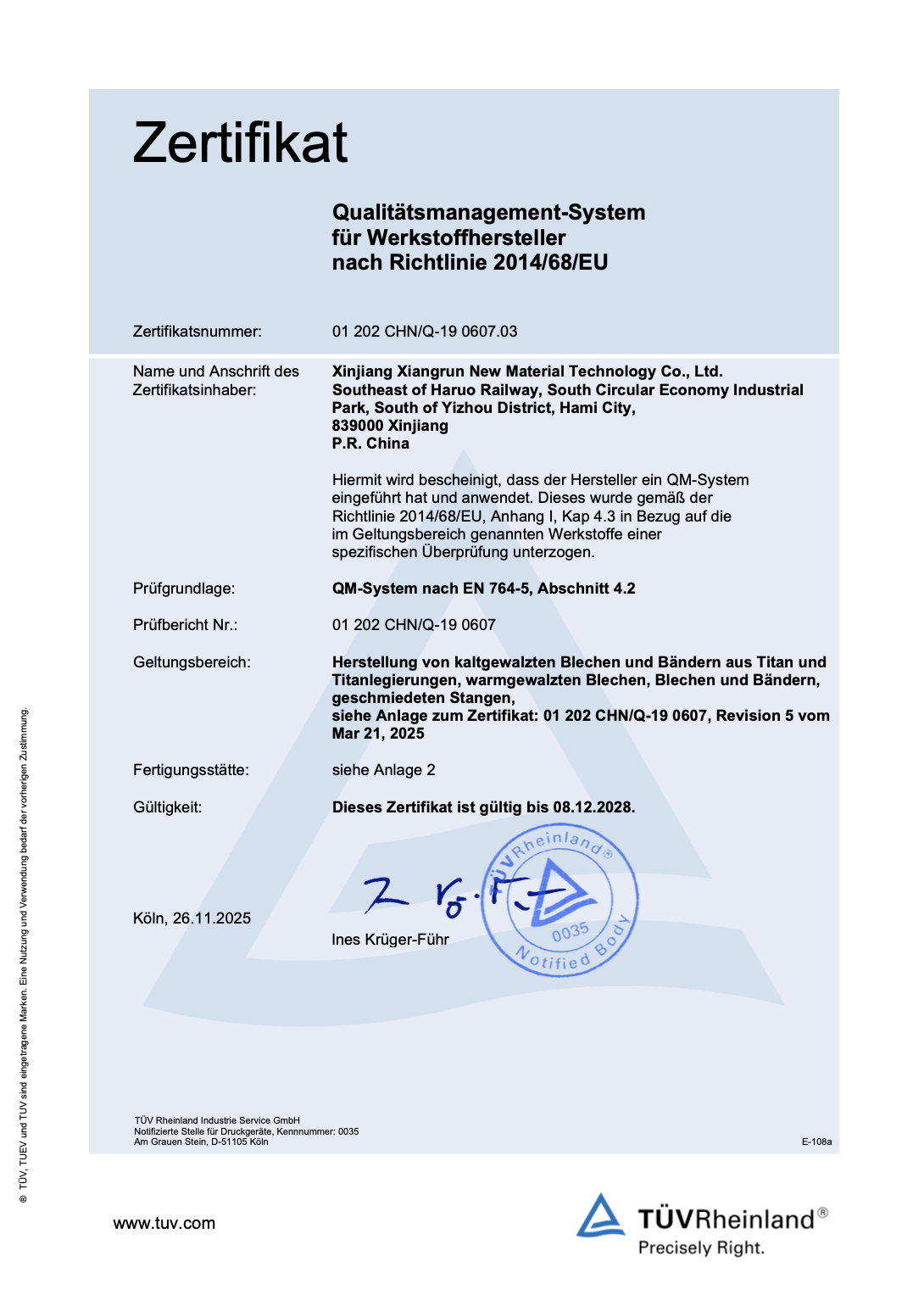
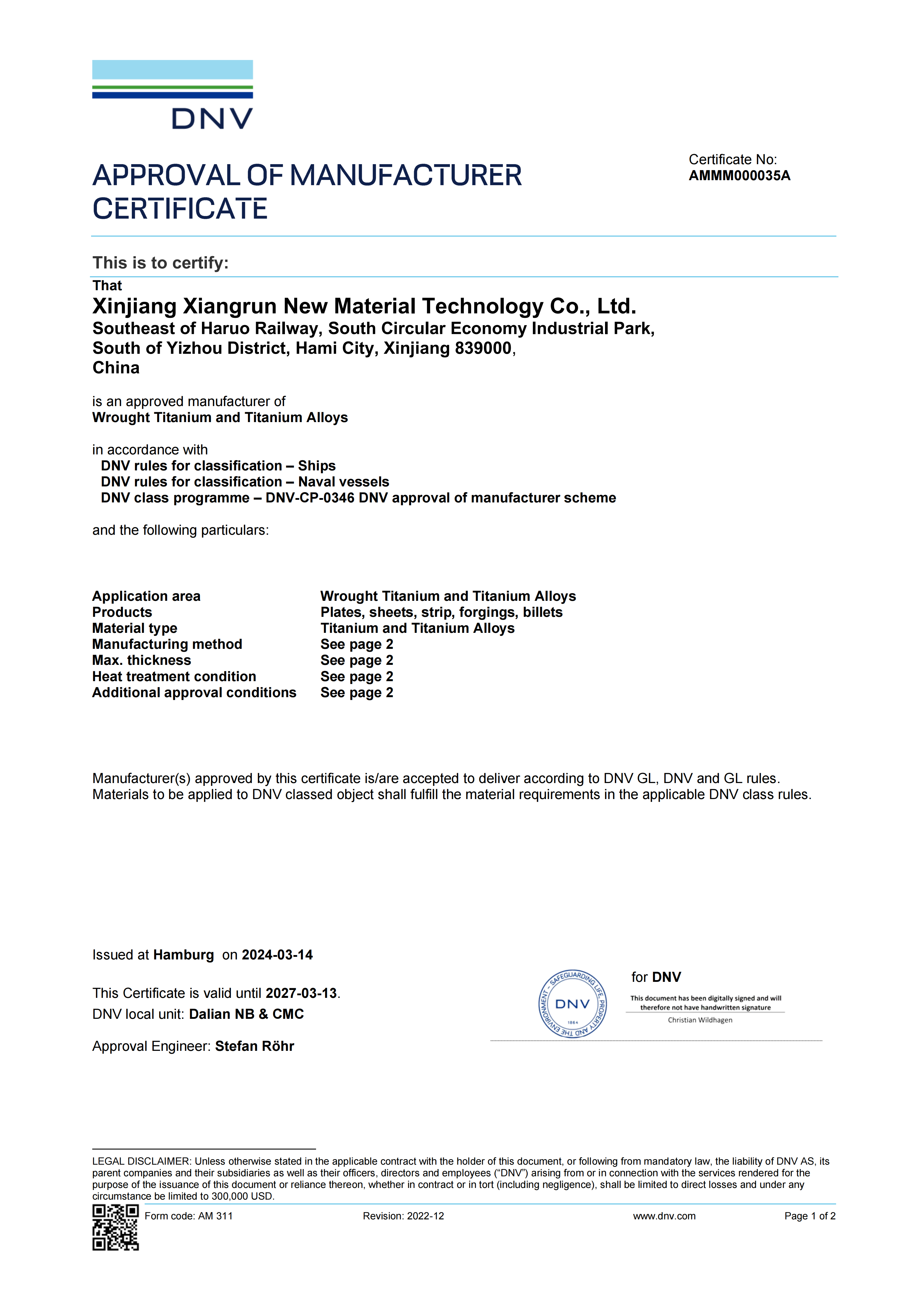
Independent certification of the quality system is the second layer of evidence. Xrun's PED quality-management certification (certificate 01 202 CHN/Q-19 0607.01, issued by TUV, valid to 2028-12-08) covers manufacturing of titanium and titanium alloy cold-rolled sheets and hot-rolled plates under the quality-management system according to EN 764-5, article 4.2, in the context of Directive 2014/68/EU. For marine and naval work, the DNV classification covers wrought titanium and titanium alloys including plates, sheets, strips, forgings and billets under DNV-CP-0346 (certificate AMA000035A, valid to 2027-03-13). EN 9100:2018 certification (certificate 01 117 1933590, issued by TUV, valid to 2027-11-12) covers production of titanium and titanium alloy ingots, billets and bars, forgings, plates and titanium sponge.
Pathway 4 — The drawing and the delivered material disagree
This pathway is the least dramatic and the most common. The drawing states a grade and a standard; the delivered material is the right family but not the stated condition. Dimensional and documentation mismatches are where this shows up first.
- Dimensions and tolerances. Titanium plate is produced in a thickness range of 4.0–70 mm with widths of 1000–2250 mm and lengths under 6500 mm; sheet covers 0.4–3.0 mm thickness and 900–1530 mm width; cold-rolled coil and strip cover 0.1–3.0 mm thickness and 450–1530 mm width; hot-rolled coil covers 2.5–12.0 mm thickness and 900–2000 mm width. A component designed around one range and built from another can fail on fit, forming behaviour or joint quality rather than on corrosion.
- Standard callouts. Flat-rolled titanium may be ordered against ASTM, ASME, AMS, MIL, DMS, TA, AWS or JIS requirements. Mixing callouts between the drawing, the purchase order and the mill certificate leaves the acceptance criteria undefined at exactly the moment they matter.
- Surface condition. Plate and sheet may be supplied pickled, polished or as agreed. A surface that was assumed pickled and passivated but delivered otherwise changes the corrosion starting point.
- Testing scope. NDT method, extent and acceptance criteria are frequently trimmed during commercial negotiation. The trimmed scope is invisible until a failure occurs.
The fix for Pathway 4 is a purchase specification detailed enough to be checked: grade, standard and revision, dimensions with tolerances, mechanical requirements, NDT method and acceptance, surface condition, marking method, and the documentation package that must ship with the material.
Step-by-Step Breakdown: A Diagnostic Sequence for the Plant Engineer
Diagnostic Comparison Table: Symptom, Root Cause, Evidence and Fix
| Symptom observed | Most likely pathway | Evidence that confirms it | Action before reordering |
|---|---|---|---|
| Localized attack under gaskets, deposits or biofouling | Grade / environment mismatch in a crevice | Medium analysis, grade against drawing, deposit and flow record | Re-select grade for the real medium, change geometry or cleaning regime, specify surface finish |
| Discolored or cracked weld and heat-affected zone | Fabrication and welding practice | Weld record, shielding method, heat tint, NDT report for the joint | Requalify the welding procedure, add purge and post-weld cleaning, require weld-zone NDT |
| Scattered staining or pitting on a formed or handled surface | Iron contamination during fabrication | Tooling audit, grinding and blasting practice, pickling record | Dedicated tooling and segregated work areas, pickling and passivation, handling rules in the purchase order |
| Certificate cannot be matched to the plate in hand | Traceability gap | Heat number, marking transfer record, stock segregation | Require heat-level traceability from sponge to finished plate, reject unmarked or mixed stock |
| Material acceptable "to standard" but outside the drawing | Specification mismatch | Drawing versus purchase order versus mill certificate versus measured dimensions | Rewrite the purchase specification with tolerances, standard revision, surface condition and testing scope |
| Early leak at a joint or transition | Fabrication plus residual-stress condition | Joint design, joining record, stress-relief record, NDT coverage | Review joint design and heat treatment, tighten incoming inspection of the affected zone |
Document Comparison: What Each Verification Record Actually Proves
Failure investigations often stall because a document is treated as proof of more than it covers. The table below sets out what each record does and does not establish.
| Record | What it establishes | What it does not establish |
|---|---|---|
| Mill test certificate with heat number | Chemistry and mechanical results for that specific heat | How the material was formed, welded or handled afterwards |
| Ultrasonic or eddy current report | Freedom from internal flaws within the inspected area and method | Corrosion performance in the actual medium |
| PED quality-management certificate under EN 764-5, article 4.2 | Manufacturer's quality system assessed for cold-rolled sheets and hot-rolled plates in pressure-equipment service | Component-level inspection, or suitability for a specific chemical duty |
| DNV-CP-0346 classification | Wrought titanium plates, sheets, strips, forgings and billets approved within the stated scope | Chemical process media outside that scope |
| EN 9100:2018 certificate | Quality system for production of ingots, billets, bars, forgings, plates and titanium sponge | A statement of corrosion suitability for a given environment |
| Nadcap accreditation for heat treating | Independent accreditation of the heat-treat process within the stated scope | Welding, forming or surface treatment practice |
Use Cases: Where Early Failures Actually Show Up
Titanium heat exchanger plates in seawater and brine duty
Plate heat exchangers concentrate risk in a small volume: thin formed plates, gasket grooves that behave as crevices, and narrow flow channels where deposits settle. A plate that fails early usually shows attack along the gasket groove rather than across the plate face, because that is where oxygen renewal is poorest. Material selection has to be paired with the forming quality of the incoming strip — which is why the plate requirement set includes cupping and bend tests alongside mechanical values and NDT.
A documented program with a municipal heat exchanger manufacturer illustrates what a matched specification looks like in practice: over 300 tons of ASTM B265 Grade 1 titanium heat exchange plate supplied across a 15-year relationship, with continuous operation reported beyond ten years without corrosion or leakage, heat exchange efficiency maintained at 95% or more of initial value, and maintenance costs reduced by 30%. The relevant point for a failure investigation is not the tonnage — it is that the grade was chosen for seawater and chloride resistance and matched to a forming process that the material could tolerate.
Titanium electrolyzer bipolar plates and cell frames
Electrolyzer components carry a combined duty that flat-rolled corrosion data alone does not describe: an aggressive electrolyte environment, an electrical function through the plate, a sealing function at the frame, and gas evolution at the surface. A failure can appear as rising contact resistance, leakage at a seal line, or localized attack in a flow field rather than as a through-wall perforation. Diagnosis therefore has to include the electrical and sealing evidence along with the metallurgical evidence, and the incoming specification has to state flatness, surface condition and forming quality explicitly.
Pressure vessel shells, storage tank plates and reactor linings
Where titanium sits on a pressure boundary — vessel shells, chemical storage tank plates, reactor linings, distillation column trays and internals — documentation carries as much weight as the metal. A quality-management system assessed under EN 764-5, article 4.2 supports the manufacturing route, but the component still needs its own inspection history. Early failures here commonly trace to welding and heat treatment rather than to the plate itself, which is why the heat-treat accreditation and the weld record should be reviewed together.
Pipe, condensers, evaporators and seawater cooling systems
Titanium pipe, power plant condenser plates, desalination evaporator plates and seawater cooling system plates share a service pattern: continuous operation under stable flow with occasional load fluctuation, and long stretches where nothing is inspected. Failures surface at the points where the passive film was weakest — under deposits, at supports, at transition joints, and in low-flow branches. Because titanium is selected precisely to avoid frequent replacement in these locations, an early failure is a strong signal that the specified condition and the operating condition diverged.
Questions to Ask a Supplier Before You Reorder
These questions are deliberately compliance-first. They convert a repeat purchase into a verified purchase, and they produce the records a future investigation will need.
- Which grade and which standard revision will the material be certified to, and will that appear identically on the drawing, the purchase order and the mill certificate?
- Can you provide heat-level traceability from titanium sponge through to finished plate or sheet, including slitting and cutting steps?
- Which non-destructive test will be performed, over what area, to what acceptance criteria, and who signs the report?
- What is the delivered surface condition — pickled, polished, passivated, or as agreed — and how is it verified?
- How is iron contamination prevented during forming, slitting, packing and transport?
- Who performs heat treatment, and under which accreditation? (For reference, Xrun's heat treating scope is covered by Nadcap certificate 27876241210, valid to 2027-02-28.)
- Can you supply to the exact thickness and width range the drawing requires, including slit-to-width strip, rather than the nearest stock size?
- Will you review our failure report and propose a specification change before quoting the replacement?
- What documentation package ships with the material, and in what format?
- What is the lead time, and which factors — testing scope, third-party inspection, dimensional customization — would extend it?
FAQ
How do we confirm that the titanium plate we receive actually meets the standard called for on the drawing?
Match three documents to the physical material: the drawing or purchase specification, the mill test certificate carrying the heat number, and the marking on the delivered plate. For flat-rolled product, the base standard is ASTM B265, with ASME SB-265 applying on pressure boundaries. For heat exchanger plate stock the requirement set additionally specifies tensile strength of at least 240 MPa, yield strength of 138–310 MPa, elongation of at least 24%, a surface free of scratches, pits and defects, degreased and passivated, and ultrasonic or eddy current testing to confirm freedom from internal flaws. Where the component sits on a pressure boundary, the manufacturer's quality system should also be assessed to EN 764-5, article 4.2, under Directive 2014/68/EU.
Can a supplier help identify the root cause instead of simply cutting the same material again?
A supplier that controls its own process can review the failure against the fabrication record and the incoming specification, because both sit inside the same organisation. Xrun operates OEM/ODM supply with customization to slit strip or plate to the requested dimensions, a technical team of more than 200 engineers, third-party test or inspection where required, and remote after-sales support. That combination allows a failure report to be turned into a revised specification — grade, surface condition, testing scope, dimensional tolerances — rather than a like-for-like repeat order.
Will a tighter specification significantly raise the cost of the replacement?
Cost in titanium flat-rolled supply is driven by grade, the dimensional yield obtained from the ordered thickness and width, the scope of non-destructive and mechanical testing, whether third-party inspection is added, order quantity, and lead time. There is no single price band that applies across grades and testing scopes, and quoting one would be misleading. The practical approach is to request an itemized quotation that separates material, testing and third-party inspection, so the cost of the additional evidence is visible and can be weighed against the cost of a second failure.
Should we validate a sample before placing the full reorder?
Yes, when the failure involved forming, welding or surface condition. A sample taken from the same production route lets the plant re-run the fabrication steps that may have caused the failure — forming a corrugation, welding a joint, applying pickling and passivation — before committing to a full quantity. Ask for the sample to carry the same documentation as production material, including heat number, mechanical results and NDT, so the trial reproduces the delivered condition rather than an idealized one.
What lead time should we plan for, and what could extend it?
For OEM and ODM titanium supply from Xrun, the stated lead time is EXW 30–45 days. Factors that extend it are the testing scope (ultrasonic or eddy current inspection, mechanical testing, third-party inspection), dimensional customization such as slitting to width, and any specification change that requires a new production run rather than a stock draw. Ordering against a verified specification at the start is usually faster than ordering twice. If you are preparing a replacement purchase, the current product brochure and specification overview can be downloaded here: Xrun titanium materials brochure (PDF).
Conclusion: Fix the Specification, Not Just the Part
Early titanium failures are usually a documentation problem wearing a metallurgical disguise. The grade may be correct in principle and wrong for the medium; the weld may be sound in principle and contaminated in practice; the certificate may be genuine and belong to a different heat; the drawing may be precise and the delivered material merely "within standard". Each of those is diagnosable, and each is preventable at the purchase order stage.
The sequence that works is unglamorous: preserve the evidence, locate the failure, re-read the real service environment, verify grade and heat, verify mechanical and NDT records, verify fabrication, and only then decide whether to repair, replace or re-specify. Suppliers who can answer the ten questions above with documents — and whose accreditations state a scope that covers the component — remove most of the uncertainty before the metal is cut.
Reordering after a failure, or specifying titanium for a new green energy or chemical line?
Send the drawing, the service medium and the failure report, and Xrun will review the grade, surface condition, testing scope and dimensional requirements before quoting. Samples, itemized quotations and the full documentation package are available on request.
Contact: Simon Liu | Email: simon.liu@xjxrun.com | Tel / WhatsApp: (+86) 18900759504
Website: www.tixrun.com | Brochure: Download PDF
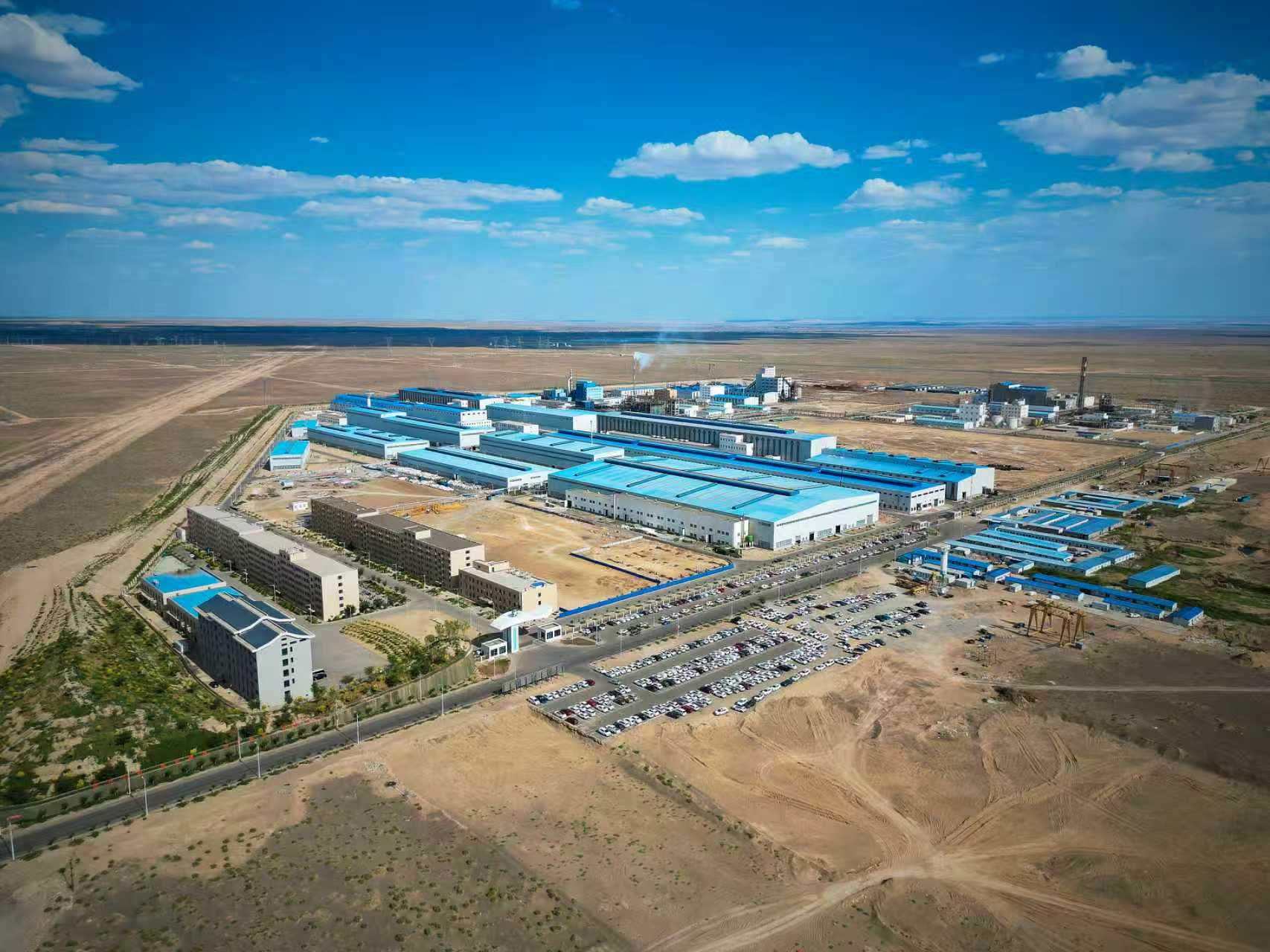
Xrun is the brand of Xiangrun (Xi'an) Titanium Materials Technology Co., Ltd., founded in 2016, operating a 2,466,667 m² manufacturing site with more than 3,000 employees, an annual output of 30,000 tons and an R&D team of over 200 engineers, serving markets in the EU, USA and India.
Have Questions or Need More Details?
Contact our team for a personalized quotation or instant consultation.
Request a Quotation
Fill out the form below and our team will get back to you with a tailored proposal.
WhatsApp Direct Chat
Prefer to chat in real-time? Message us on WhatsApp for instant assistance & quick answers.
- Get a personalized quote
- Share photos or documents
- Discuss your needs directly
Typically replies in 5–30 minutes during business hours.