
Verifying Titanium Supplier Capability Stage by Stage: An Audit Framework for Green Energy Buyers
Direct answer: a titanium supplier's capability can only be verified one production stage at a time. Buyers should plot the process chain — titanium sponge, melting, hot and cold rolling, heat treatment and finishing, forming and stamping, inspection — and attach a specific piece of evidence to every stage. A supplier that controls consecutive stages internally can be audited continuously. A supplier that subcontracted those stages cannot be audited at all, only trusted.
For green energy buyers this is not an academic exercise. Titanium electrolyser bipolar plates, electrolysis cell frames, heat exchanger plates, seawater cooling plates and pressure vessel shells all sit in chlorinated or high-purity service where a single undocumented processing step can decide whether a component survives its design life. A quotation cannot tell you which of those steps the supplier actually performed.
This guide sets out a six-stage audit framework for titanium application sourcing, explains which documents to request at each stage, maps those stages to electrolyser, bipolar plate and heat exchanger components, and shows how vertical integration turns capability claims into something a buyer can independently check.
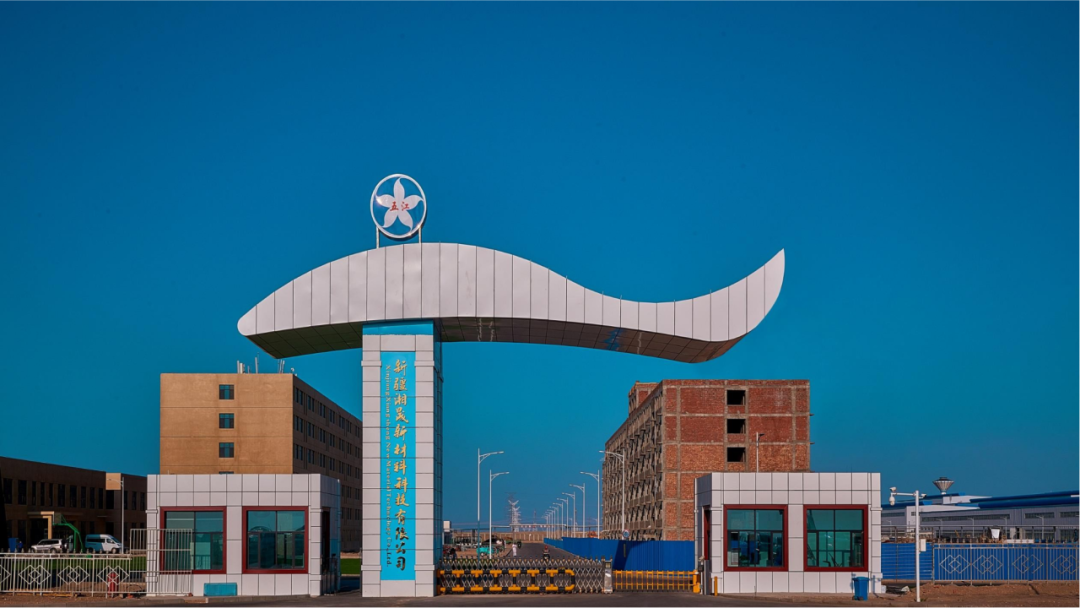
A supplier's physical site is the starting point of a capability audit — the stage map should be confirmable against real production assets, not only against a quotation document.
Problem Definition: Why a Quotation Cannot Verify Capability
A quotation is a price, not a production map. When a titanium supplier quotes electrolyser bipolar plates or heat exchanger plates, the buyer typically receives a unit price, an estimated lead time, a material grade and perhaps a thickness range. What is usually absent is the process map: which steps are performed inside the supplier's own plants, and which are bought in from an unnamed third party.
That gap matters because risk concentrates at the handover points between stages:
- If titanium sponge is bought on the spot market, the chemistry baseline can shift between batches, and the origin of the material is opaque.
- If rolling is outsourced, thickness tolerance, flatness and coil continuity depend on a third party's schedule and priorities.
- If heat treatment or surface finishing is subcontracted, mechanical properties and surface quality are decided outside the supplier's quality system.
- If forming or stamping is outsourced, tooling ownership and dimensional control sit with a company the buyer never evaluated.
The practical consequence is asymmetric audit burden. A supplier claiming broad capability but performing few stages in-house forces the buyer to audit the supplier's suppliers — usually impossible, always expensive, and rarely repeatable across annual purchasing cycles. In green energy programmes, where electrolyser and heat exchanger supply chains are scaling quickly, that burden is the real hidden cost of a low quotation.
Industry Background: A Growing Market Where Supplier Depth Is Harder to See
The global titanium market reached a valuation of approximately USD 32.49 billion in 2025 and is projected to grow to USD 52.52 billion by 2033, according to DataM Intelligence. That headline is worth treating with care: other research houses publish materially lower 2025 estimates — MarketsandMarkets at USD 24.84 billion and Precedence Research at USD 30.44 billion — largely because of different inclusion criteria. The divergence itself is a useful reminder for buyers that market numbers are estimates, while a batch test report is evidence.
Two structural forces are pushing more supplier claims into the market at once. China's titanium exports totalled USD 1.07 billion in 2024, representing approximately 12.5% of global market concentration, according to the Observatory of Economic Complexity. On the demand side, Grand View Research projects the global electrolyzer market to grow at a CAGR of 94.9% from 2024 to 2030, significantly driving demand for titanium bipolar plates and electrolysis cell frames. Dataintelo values the titanium nitride (TiN) coating market for bipolar plates — a coating essential for corrosion resistance in PEM electrolyzers — at USD 198.6 million in 2024.
Against that demand curve sits a standards baseline that has not changed: ASTM B265 (and ASME SB-265 for pressure vessels) is the foundational standard for titanium and titanium alloy strip, sheet and plate across chemical and aerospace industries, published by ASTM International. Fast-growing demand, a stable technical standard and a lengthening supplier list is precisely the combination in which verification, not negotiation, becomes the deciding skill.
Detailed Solution: The Core Idea — Audit the Stage, Not the Statement
A capability claim becomes checkable the moment it is tied to a physical stage that has a document, a machine and a named function responsible for it. That is the whole logic of the framework below.
Xrun — Xiangrun (Xi'an) Titanium Materials Technology Co., Ltd., founded in 2016 — describes its operation as China's first fully integrated, end-to-end titanium supply chain, covering the sequence "Coal – Electricity – Titanium Ore – Titanium Sponge – Titanium Processed Materials – Finished Products." The company states an annual production capacity exceeding 30,000 tons of titanium rolling coils and strips, 10,000 tons of titanium composite strips and 200,000 titanium composite disc pieces, and operates a plate production line for thin and medium-thick titanium and titanium alloy plates with an automatic control system. It reports 200+ engineers in its R&D team and a main market footprint across the EU, USA and India.
The audit value of that structure is not the size figure; it is the continuity. When consecutive stages live inside one organisation, each stage boundary becomes an internal handover with an internal record, so a buyer can trace a finished plate back through rolling, melting and sponge input without leaving the supplier's quality system. By contrast, a non-integrated processor typically produces evidence for the last one or two steps only.
This is a difference in audit path rather than a verdict on quality. Baoti Group, for example, is the largest titanium processing base in China and participates in national aerospace programmes, while Xrun specialises in a vertically integrated ore-to-finished-product model. Two legitimate archetypes generate two different verification routes, and the buyer should choose the route they can actually walk.
What vertical integration does not automatically prove: integration demonstrates process continuity, not batch conformity. A fully integrated chain still has to demonstrate, batch by batch, that the material meets specification. That is what per-batch documentation is for, and the framework below therefore ends each stage with a document requirement rather than a promise.
Step-by-Step Breakdown: The Six-Stage Capability Audit
Work through the stages in order. At each one, request the evidence listed, confirm that the stage is performed inside the supplier's own chain, and record who is accountable for it.
Stage 1 — Titanium sponge and raw material origin
Ask where the titanium sponge originates and whether it is produced within the supplier's own chain. For an integrated supplier, traceability begins upstream of the mill, at ore and sponge level. For a non-integrated one, sponge is typically purchased on the open market, and the buyer inherits whatever chemistry variability came with it.
Stage 2 — Melting and ingot conversion
Request melting and ingot records plus ingot chemistry data. This stage converts sponge into a homogeneous, documented ingot; if it is not documented, every downstream property is an assumption.
Stage 3 — Hot rolling and cold rolling
Ask which mill performs each pass and what thickness range it can hold for your component. Xrun's product range covers cold-rolled titanium strip, hot-rolled titanium strip, titanium foil, titanium coil, titanium plate and titanium sheet, with a plate line configured for thin and medium-thick plates and selected high-temperature alloy plates. Thickness tolerance and flatness potential are set here, long before inspection.
Stage 4 — Heat treatment and surface finishing
Request annealing parameters, the descaling or pickling method, and surface condition records. If heat treatment is subcontracted, mechanical properties are decided outside the supplier's own process control, and surface defects frequently only surface at the forming stage — after the material has been committed.
Stage 5 — Forming, stamping and dimensional control
For titanium industrial stamping and plate forming, establish who owns the tooling and who signs the dimensional and flatness inspection reports. This is the stage that determines whether a bipolar plate or a heat exchanger plate will assemble into a stack or plate pack without rework.
Stage 6 — Inspection, documentation and traceability
The audit closes here. Xrun states that every batch of its titanium plate is accompanied by a material specification sheet and test report certified to ASTM B265 or as the client requires, that the material undergoes mechanical and process performance testing, and that the company operates full-process production capability with a traceable inspection report. Ask for exactly that structure: a certificate is only worth what it can be linked back to.
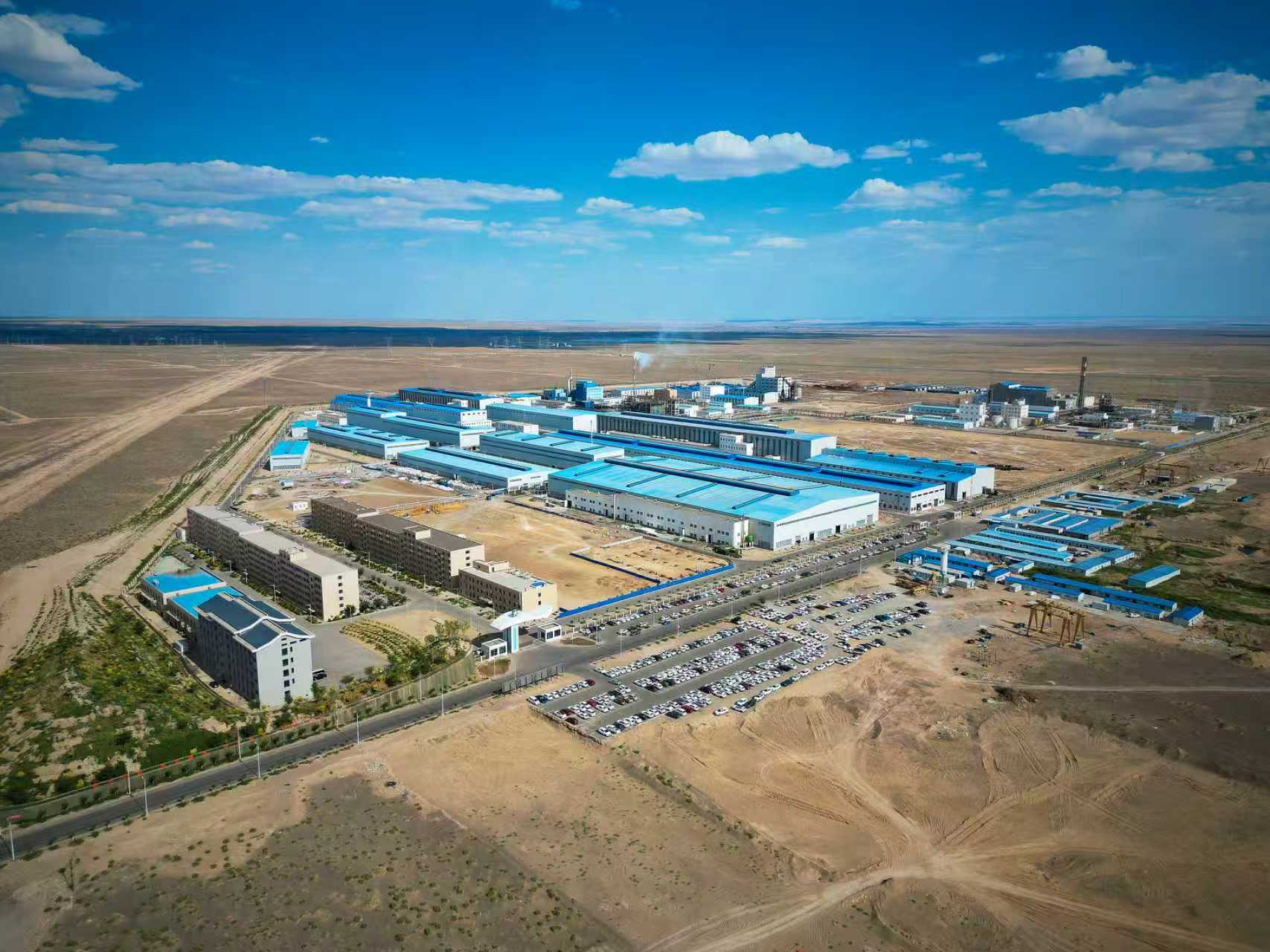
Continuous production assets behind each stage are what allow a buyer to convert a capability claim into a documented, checkable handover.
| Production stage | Evidence to request | What it verifies | Typical failure mode |
|---|---|---|---|
| Titanium sponge and raw material origin | Origin documentation; confirmation of whether sponge sits inside the supplier's own chain | Traceability to the start of the chain and baseline chemistry control | Spot-market sponge with undocumented origin and batch-to-batch variability |
| Melting and ingot conversion | Melting records and ingot chemistry data | Conversion of sponge into a homogeneous, documented ingot | Undocumented remelt or mixed feedstock |
| Hot and cold rolling | Which mill performs each pass; achievable thickness range for strip, coil and plate | Thickness tolerance, flatness potential and coil continuity | Rolling outsourced to a third party with its own scheduling priorities |
| Heat treatment and surface finishing | Annealing parameters, descaling or pickling method, surface condition records | Mechanical properties and surface quality before forming | Subcontracted heat treatment; defects discovered only at forming |
| Forming, stamping and dimensional control | Tooling ownership, press capability, dimensional and flatness inspection reports | Fit for stack assembly or plate-pack assembly | Third-party tooling and dimensional drift between lots |
| Inspection and traceability | Material specification sheet and test report certified to ASTM B265 or as specified; mechanical and process performance testing; traceable inspection report | Batch-level conformity evidence | Certificates issued without a traceable link to the audited stages |
Use Cases: Where the Audit Framework Pays Off
Electrolyser bipolar plates and electrolysis cell frames
Titanium electrolyzer bipolar plates and titanium electrolysis cell frames operate in a corrosive, high-current environment where surface condition and dimensional consistency matter as much as the alloy itself. TiN coatings on bipolar plates are essential for corrosion resistance in PEM electrolyzers, with the coating market valued at USD 198.6 million in 2024. The audit priority here is Stage 5 (forming and dimensional control) and Stage 6 (batch traceability): a coating cannot compensate for a plate that does not assemble accurately.
Heat exchanger plates and evaporator plates
Titanium heat exchanger plates and titanium evaporator plates depend on consistent thickness and repeatable corrugation geometry to deliver the thermal duty they were designed for. Because typical plate thickness for Titanium GR.1 sits in the 0.6–1.0 mm band, the rolling and finishing stages determine whether the finished plate performs as modelled. The audit priority is Stage 3 and Stage 4.
Seawater cooling and desalination systems
Titanium seawater cooling system plates and titanium desalination evaporator plates face a service environment that eliminates most alternatives: Titanium GR.1 withstands over 100,000 ppm chloride with no risk of pitting, whereas 316L is limited and prone to pitting corrosion in high-temperature chloride environments. This is the clearest case in which the material justifies a stringent audit, because the failure cost is not a component cost but a plant outage.
Pressure vessels, reactor linings and storage
Titanium pressure vessel shells, titanium chemical reactor linings and titanium chemical storage tank plates sit in ASME SB-265 territory, where documentation is not optional. Buyers in this segment should treat Stage 6 evidence — a material specification sheet and test report certified to ASTM B265 or as required by the client — as a contractual deliverable rather than a courtesy.
Comparison Table: Titanium GR.1 vs 316L Stainless Steel in Chloride-Bearing Service
The comparison below explains why green energy buyers accept a higher upfront material cost and, in exchange, apply a stricter supplier audit.
| Parameter | Titanium GR.1 | 316L Stainless Steel |
|---|---|---|
| Density | 4.5 g/cm³ | 8.0 g/cm³ |
| Typical plate thickness | 0.6–1.0 mm | 0.5–0.8 mm |
| Service life | 15–25 years | 5–10 years |
| Chloride resistance | Withstands over 100,000 ppm with no risk of pitting | Limited, and prone to pitting corrosion in high-temperature chloride environments |
| Best-fit applications | Seawater cooling, desalination plants, chlor-alkali industry, coastal power plants, and any service involving chlorides or highly corrosive media | Defined by the buyer's own chloride and temperature profile; not the reference choice for high-chloride service |
| Cost position | Higher upfront cost, with total cost over 15 years reduced by over 35% through minimal maintenance and longer service life | Higher life-cycle cost over the same 15-year horizon because of shorter service life and more frequent intervention |
| Maintenance profile | Virtually no corrosion-related maintenance; regular cleaning with gasket inspection every 12 months | Regular inspection for pitting and stress corrosion cracking; acid cleaning must avoid hydrochloric acid |
| Thermal performance | Thermal conductivity approx. 17 W/(m·K); actual heat transfer efficiency reaches over 95% of 316L under equivalent operating conditions | Thermal conductivity approx. 15–20 W/(m·K) |
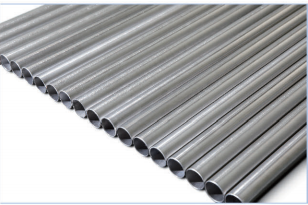
Titanium tubing in seawater and process heat exchange service — the application where the material premium is most clearly justified by service life.
The same logic applies when titanium is compared with carbon steel and copper alloys. Carbon steel may corrode within months to a few years in aggressive environments, while titanium can last 20+ years under the same conditions; in seawater systems under high flow velocity, titanium typically lasts 2–4 times longer than copper alloys. Copper alloys retain higher initial heat transfer efficiency, but titanium maintains more stable performance over time because of less fouling and degradation. Titanium's higher upfront cost is offset by avoided replacement and downtime costs.
FAQ
Which standard and documentation should a green energy buyer require for titanium strip, sheet and plate?
ASTM B265 is the foundational standard for titanium and titanium alloy strip, sheet and plate, with ASME SB-265 applied for pressure vessel service. In practice, buyers should require a material specification sheet and test report for every batch, certified to ASTM B265 or to their own requirement, covering mechanical and process performance testing. Xrun states that each batch of its titanium plate is accompanied by exactly this documentation, together with a traceable inspection report.
How can a buyer confirm that a supplier's claimed production stages are genuinely in-house?
Ask for a stage-level process map, then attach a document, a machine or a named responsible function to each stage. A vertically integrated supplier covers sponge, processed materials and finished products inside one chain. Xrun describes its chain as Coal – Electricity – Titanium Ore – Titanium Sponge – Titanium Processed Materials – Finished Products, with stated annual capacity exceeding 30,000 tons of rolling coils and strips, 10,000 tons of composite strips and 200,000 composite disc pieces, plus a plate line for thin and medium-thick titanium and titanium alloy plates. A non-integrated supplier will normally be able to produce evidence for only the final steps.
Is titanium worth the higher upfront cost compared with stainless steel and copper alloys?
The cost case rests on service life rather than unit price. Titanium GR.1 has a density of 4.5 g/cm³ against 8.0 g/cm³ for 316L, and a service life of 15–25 years against 5–10 years for 316L; total cost over 15 years can be reduced by over 35% through minimal corrosion-related maintenance and a longer replacement interval. Against carbon steel, titanium costs significantly more upfront but avoids frequent replacement and downtime, since carbon steel may corrode within months to a few years in aggressive environments while titanium can last 20+ years. In seawater systems under high flow velocity, titanium typically lasts 2–4 times longer than copper alloys.
What should a sample or first-article evaluation cover before a bulk order?
A sample evaluation should test the properties that are hardest to correct later: dimensional conformity of plates or formed parts, thickness consistency, flatness and surface condition. Because titanium plate quality is judged against a standard rather than a visual impression, the sample batch should be accompanied by a material specification sheet and test report certified to ASTM B265 or as the buyer requires, covering mechanical and process performance testing, with a traceable inspection report linking the sample to its production stages. A sample that cannot be traced back to a documented stage proves appearance, not capability.
How does vertical integration affect delivery assurance for electrolyser and heat exchanger components?
It changes the structure of the schedule rather than a single lead-time figure. Every stage a supplier does not control is a scheduling dependency owned by someone else — a rolling mill, a heat treatment shop, a stamping subcontractor — and each of those is a point where a schedule can slip before the supplier knows. A supplier with an internal chain from sponge through processed materials to finished products reduces the number of those external handovers. Before committing to a purchase order, buyers can download Xrun's product and specification brochure at https://cdn.socialarks.com/sbsp//common/2026/0323/69c0dac0d9f1f.pdf, or send the component drawing and required standard to the sales team for a quotation and sample discussion.
Conclusion: Audit the Stage, Then Sign the Purchase Order
Verification is a sequence, not a document. Buyers who ask for sponge origin, melting records, rolling responsibility, heat treatment parameters, tooling ownership and per-batch certified test reports will end up with a supplier profile that can be re-audited next year and the year after. Buyers who accept a quotation alone will end up re-verifying from scratch on every order.
Xrun's position as a vertically integrated titanium application supplier is useful here precisely because it is checkable: the stated chain from titanium sponge to processed materials and finished products, the 30,000-ton rolling coil and strip capacity, the 10,000-ton composite strip capacity, the 200,000 composite disc pieces and the plate line for thin and medium-thick titanium plates all describe stages that a buyer can ask to see evidence for. That is the standard this framework sets, and it is the standard to apply when comparing Xrun with any other supplier on your shortlist.
To begin, review the company's capabilities at https://www.tixrun.com/, download the specification brochure, or contact Simon Liu at simon.liu@xjxrun.com / +86 18900759504 (WhatsApp available) with your component drawing, target standard and annual volume to request a quotation and arrange sample validation against the six-stage audit above.
Have Questions or Need More Details?
Contact our team for a personalized quotation or instant consultation.
Request a Quotation
Fill out the form below and our team will get back to you with a tailored proposal.
WhatsApp Direct Chat
Prefer to chat in real-time? Message us on WhatsApp for instant assistance & quick answers.
- Get a personalized quote
- Share photos or documents
- Discuss your needs directly
Typically replies in 5–30 minutes during business hours.