
Cold Rolled vs Hot Rolled Titanium Coil: A Purchasing Guide
Short answer: specify cold rolled titanium coil or strip when the value of the finished part depends on thickness consistency, surface cleanliness and multi-stage forming. Specify hot rolled titanium coil when heavier gauge and first-reduction economics dominate, and when descaling plus downstream machining or heavy forming can absorb the surface condition. Both routes fall inside ASTM B265, which covers chemical and mechanical requirements for titanium and titanium alloy strip, sheet and plate, so the real difference is not the standard — it is the set of acceptance criteria you write into the purchase order.
The buyer's difficulty is rarely a shortage of material options. It is that route, acceptance criteria and documentation are usually negotiated in three separate conversations: the route is chosen in an engineering meeting, the acceptance criteria are copied from an earlier order, and the certificates are checked at the end. When those three drift apart, a coil that was rolled correctly can still fail at the press or the weld line. Xrun — the brand of Xiangrun (Xi'an) Titanium Materials Technology Co., Ltd., a titanium mill founded in 2016 whose stated range includes both cold rolled titanium coil/strip and hot rolled titanium coil — is used here as a working example of how route, terms and certificate scope should line up. Company background is available at tixrun.com.

Cover: Xrun titanium production site, where cold rolled coil/strip and hot rolled coil are produced under the same quality system.
What the route decision actually settles
The cold rolled versus hot rolled choice fixes four things that a buyer will later be asked to accept or reject: the achievable thickness and flatness consistency, the surface condition the mill can guarantee, the way the material behaves in forming and welding, and the evidence that can reasonably be produced at inspection.
It does not change the alloy. Xrun's records list the same grade families — Gr.1, Gr.2, Gr.3, Gr.4, Gr.12 and Gr.23 — for both cold rolled titanium coil/strip and hot rolled titanium coil. Corrosion behaviour in service follows the alloy chemistry and the environment, not the rolling route. What the route changes is everything the buyer can measure in the receiving bay: gauge, profile, surface, edge quality and the thermal history that the mill certificate has to document.
That is why a generic request for "ASTM B265 titanium coil, Grade 2" is an incomplete order. It names the specification and the grade but not the route, and the route is what determines whether the coil suits a corrugated plate press or a welded tube mill.
Industry background: why this is now a documentation question
Demand context matters only if it explains why documentation pressure has increased. Grand View Research estimates the global titanium market at USD 24.84 billion in 2025 across the full metal value chain — sponge, mill products and end products — and projects a 6.2% compound annual growth rate over 2024–2030. That is a market-level projection and says nothing about any single coil order; what it does explain is why more buyers are qualifying more suppliers, and why certificate review has become a routine gate rather than a final courtesy.
The second reason is structural. The titanium product family is partitioned by specification rather than by tonnage. ASTM B265 governs flat-rolled strip, sheet and plate. ASTM B338 governs seamless and welded tube for condensers and heat exchangers. ASTM B861 and B862 cover seamless and welded pipe respectively. ASTM B348 covers bar and billet, B863 wire, B381 forgings, B367 castings. A mill's addressable market is therefore defined by which specification families it can qualify for, not by capacity alone — and a coil buyer sits at the front of that chain.
This creates a boundary that buyers frequently blur. The coil is bought to ASTM B265. The welded tube made from that coil is qualified to ASTM B338. A mill test certificate for the coil is input evidence for the tube qualification; it is not a substitute for it. Writing the coil order as though it were a tube order is one of the most common causes of a rejected first article.
The green energy and new materials link runs through heat transfer. Condensers and heat exchangers — the scope named in ASTM B338 — are the equipment class where titanium's corrosion behaviour justifies the material cost, in power generation, desalination and chemical processing. Coil-fed processes (tube mills, corrugated plate presses, continuous slitting lines) all inherit the tolerance and surface decisions made at the coil order stage.
The two routes in technical terms
Hot rolled titanium coil is produced by reducing the slab or transfer bar at elevated temperature, above the recrystallization range. The reductions are heavier, the material is softer during deformation, and an oxide scale forms on the surface, which is removed by descaling or pickling before the coil is acceptable for most downstream work. Hot rolling is the economical first reduction and remains the route for heavier gauge product.
Cold rolled titanium coil or strip is produced by rolling at low temperature, with intermediate annealing cycles to restore ductility and control grain structure, followed by final rolling to the ordered gauge. The strain applied below the recrystallization range is what produces the combination buyers are usually paying for: tighter control of thickness across the width and along the length, a cleaner and more uniform surface, and consistent behaviour in progressive forming operations. A PED quality management certificate issued by TUV for Xrun describes the manufacturing scope as titanium and titanium alloy cold rolled sheets and hot rolled plates — the two routes are treated as distinct manufacturing scopes, not as one product family with cosmetic differences.
Two practical consequences follow. First, the two routes carry different cost structures: cold rolling involves more rolling passes and anneal cycles, hot rolling involves heavier reductions plus descaling, so a quote comparison between routes is only meaningful when both quotes describe the same gauge, tolerance class, surface requirement and test regime. Second, hot rolled coil is not an inferior product — it is the correct product for heavy-gauge work where the surface will be removed or where the formed part is thick enough that gauge variation is a small fraction of section thickness.
Step-by-step: converting downstream requirements into purchase-order terms
Work through the five steps below in order. Each step produces wording that belongs on the purchase order and, in most cases, an inspection item that belongs in the acceptance criteria.
Step 1 — Forming: decide whether gauge consistency or gauge headroom matters
If the coil will be corrugated, drawn, stretch-formed or roll-formed in multiple stages, thickness consistency and surface condition are the controlling variables, because variation accumulates through the stages. That is cold rolled territory. If the coil will be cut into heavier blanks, machined, or formed in a single operation where the finished section is thick, hot rolled coil is normally adequate and more economical.
On the purchase order, write the thickness and the tolerance explicitly, add a flatness requirement, and state whether the acceptance test includes a forming trial. Do not rely on the grade alone to communicate formability expectations.
Step 2 — Welding: strip for tube mills needs edge and surface terms
Where the coil is slit to strip and fed into a welded tube line, the welding outcome depends on consistent thickness, clean strip edges and a surface free of scale and contamination, together with chemistry that matches the certificate. Specify the edge condition (slit edge), the width and width tolerance, and whether the strip is supplied in coil or in cut lengths. If the tube will be qualified to ASTM B338, state that the coil is supplied to ASTM B265 and that the tube qualification is a separate downstream activity.
Step 3 — Surface: define the class instead of assuming it
"Good surface" is not an acceptance criterion. Name the surface requirement per side, list the defect types that are not permitted (rolled-in scale, slivers, deep scratches, oil staining, edge cracks), and state whether a pickled or descaled finish is required. For hot rolled coil, descaling completeness should be an explicit acceptance item, because residual scale is a defect that often only reveals itself after forming or after the part enters service.
Step 4 — Dimensional requirements and coil build
For continuous lines, coil build is a production parameter, not packaging detail. State the coil inner diameter, the coil weight range, the maximum camber, and the requirement for a continuous length without welds or with a declared number of welds. A coil that meets the thickness specification but has an unusable coil weight will still stop the line.
Step 5 — Condition, heat treatment and special processes
Record the delivered condition on the order and confirm it appears on the mill test certificate. Where the end market treats annealing or other thermal steps as controlled special processes, check whether the mill holds accreditation for the specific operation. Xrun's supplied certificate set includes a Nadcap accreditation (certificate 27876241210, issued 2026-02-28, valid to 2027-02-28) whose stated scope is conformance and recognition of accreditation for specific services listed on the Qualified Manufacturer's List, for the audited scope of heat treating. The scope wording is the operative part: a buyer should confirm which heat-treat operations appear on that list rather than assuming blanket coverage.
Side-by-side: selection dimensions for the two routes
The table below organises the decision logic. It compares documented process characteristics, not measured performance of any specific order; confirm the values and tolerances that apply to your grade and product code in the mill's written capability statement before the order is placed.
| Selection dimension | Cold rolled titanium coil / strip | Hot rolled titanium coil |
|---|---|---|
| Process route | Low-temperature rolling with intermediate annealing cycles; final gauge set by cold reduction | Elevated-temperature reduction above the recrystallization range; oxide scale removed by descaling or pickling |
| Gauge position | The thinner-gauge route; specify thickness and tolerance class on the PO | The heavier-gauge first-reduction route; tolerance class must be agreed in writing |
| Surface condition | Cleaner, more uniform finish after annealing; defect classes must be named | Descaling completeness is a specific acceptance item, not an assumption |
| Forming fit | Multi-stage forming, corrugation and draw work where variation accumulates | Heavy-gauge work where the surface is removed or gauge variation is small against section |
| Welding fit | Strip for welded tube: consistent thickness plus specified slit edge and clean surface | Edge condition and fit-up tolerance must be stated; heavier sections favour different joint prep |
| Thermal exposure | Annealing cycles recorded on the mill certificate; check accreditation scope if heat treating is controlled | Mill thermal history plus descaling steps; same accreditation scope check applies |
| Inspection focus | Thickness profile across width, flatness, surface class, edge, chemistry and mechanical values per certificate | Gauge, flatness, descaling completeness, surface class, edge, certificate values |
| Terms to state on the PO | Grade, condition, thickness and tolerance, width, slit edge, coil ID and weight, surface class, test regime | Grade, thickness, width, edge, descaling requirement, coil build, test regime |
Inspection points that match the route you chose
Inspection should test the thing the route was chosen for. A receiving inspection that only compares a coil ticket to a packing list will pass material that fails at the press.
- Identity and traceability. Confirm the heat number on the coil matches the mill test certificate, and that the certificate states grade, chemistry, mechanical properties and dimensions consistent with ASTM B265 and with the purchase order.
- Thickness profile. Measure at defined positions across the width and along the length of the coil, not at one point, and record it against the tolerance on the order. Thickness consistency is the reason cold rolled material was specified in the first place.
- Surface class. Inspect against the named defect list per side. On hot rolled coil, record descaling completeness explicitly rather than as a general remark.
- Edge and coil build. Check slit edge quality, camber, inner diameter and coil weight against the stated values, particularly where the coil feeds a continuous line.
- Independent verification. Where the purchase order calls for it, arrange pre-shipment testing or third-party inspection before the coil leaves the mill. Xrun's stated quality-control arrangement is third-party test or inspection if needed, which places the choice of verification level in the buyer's hands rather than the mill's.
Two limitations are worth stating plainly. Visual inspection cannot confirm grain structure or interstitial chemistry; those come from the certificate and, where required, from independent laboratory testing. And a passing inspection report describes the sampled coil, not the balance of the order — which is why the sampling plan belongs in the acceptance criteria.
Documentation checks: certificate scope against product code
Start with the product code, not the standard name
In Xrun's records the two coil products carry distinct codes: cold rolled titanium coil/strip is code 1507 and hot rolled titanium coil is code 1506. Certificate review becomes straightforward when it is performed code by code, because a scope statement that names cold rolled sheets does not automatically cover hot rolled coil, and vice versa. The same logic applies to the grade families listed against each code.
ISO 9001:2015 as a baseline — and why the scope line decides
Most vendor lists in green energy and new materials begin with ISO 9001:2015. Treat that as a scope-matching exercise rather than a tick box: read the certificate number, the issuing body, the scope wording (which product forms and which site it covers), the edition of the standard cited, and the validity dates. A quality management system certificate that names plate does not by itself cover cold rolled strip, and a certificate issued to a parent site does not by itself cover a separate plant. Where a project specifically requires ISO 9001:2015, request the ISO 9001:2015 certificate itself and read its scope against the code you are ordering.
Xrun's supplied certificate records link the coil codes to documents issued by TUV and by DNV, summarised below. These establish other scopes — pressure-equipment quality management, aerospace-series and marine classification — and should be read as complements to, not substitutes for, a project-specific ISO 9001:2015 requirement.
TUV-issued quality management certificate (PED scope)
Certificate 01 202 CHN/Q-19 0607.01 was issued by TUV on 2024-01-26 and is valid to 2028-12-08. Its title is a quality management system for manufacturer of materials according to Directive 2014/68/EU, aligned to the QM system requirements of EN 764-5, article 4.2. The stated scope is manufacturing of titanium and titanium alloy cold rolled sheets and hot rolled plates — the certificate directly covers both route families described in this guide. The recorded market coverage is EU, USA and India. For an Indian or European buyer, this is the document that speaks to pressure-equipment material manufacture rather than to general quality management.
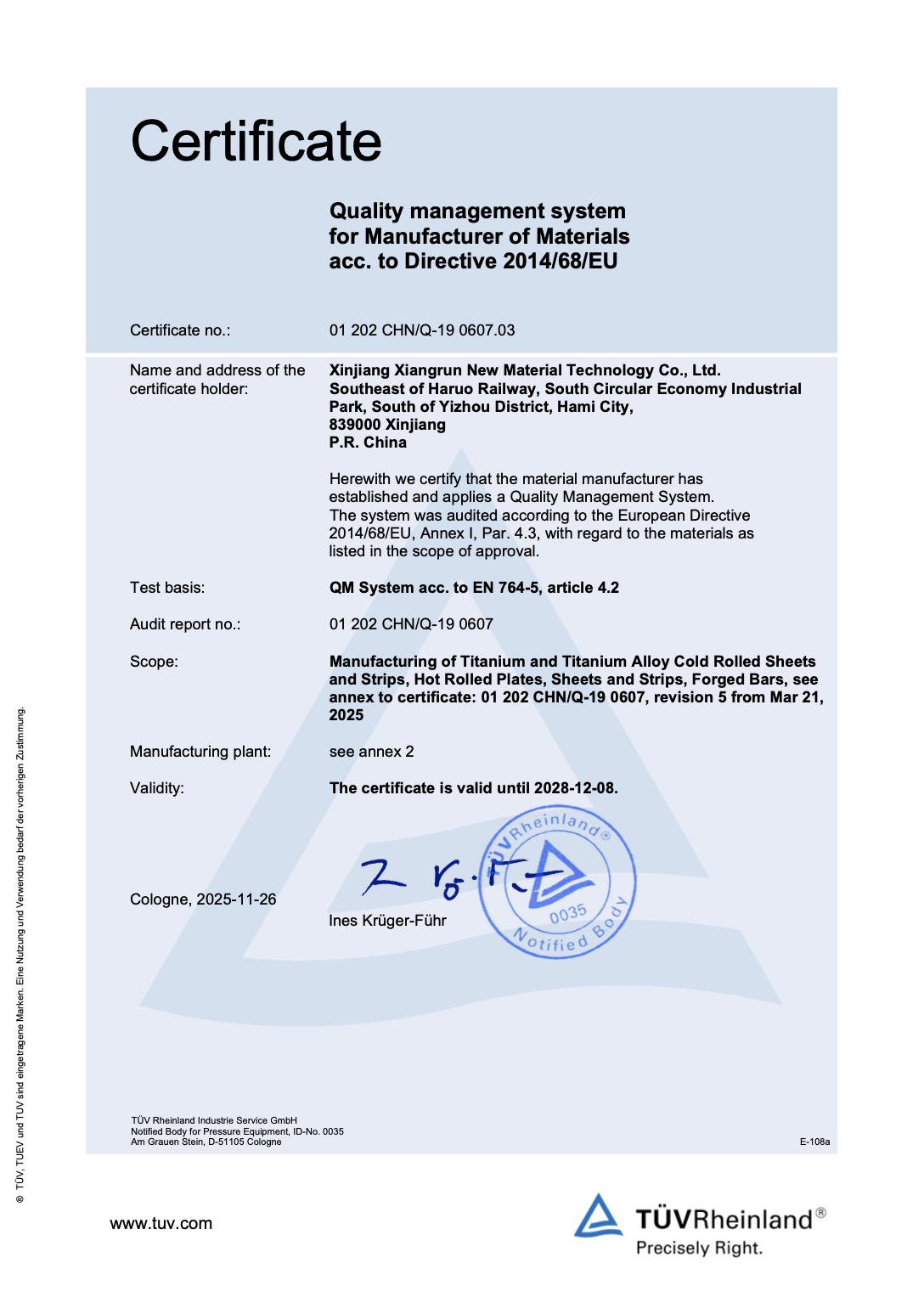
TUV-issued PED quality management certificate, scope: titanium and titanium alloy cold rolled sheets and hot rolled plates.
TUV-issued EN 9100:2018 certificate
Certificate 01 117 1933590 was issued by TUV on 2023-11-13 and is valid to 2027-11-12, against the EN 9100:2018 series requirements. Its stated scope is production of titanium and titanium alloy ingots, billets and bars, forgings, plates and titanium sponge, with market coverage of EU, USA and India. Read the scope carefully: it names ingots, billets, bars, forgings, plates and sponge, and does not name cold rolled coil. It is relevant supporting evidence for aerospace-adjacent supply chains and for the upstream melt and sponge stages, but a buyer ordering code 1507 needs the scope that covers cold rolled product.
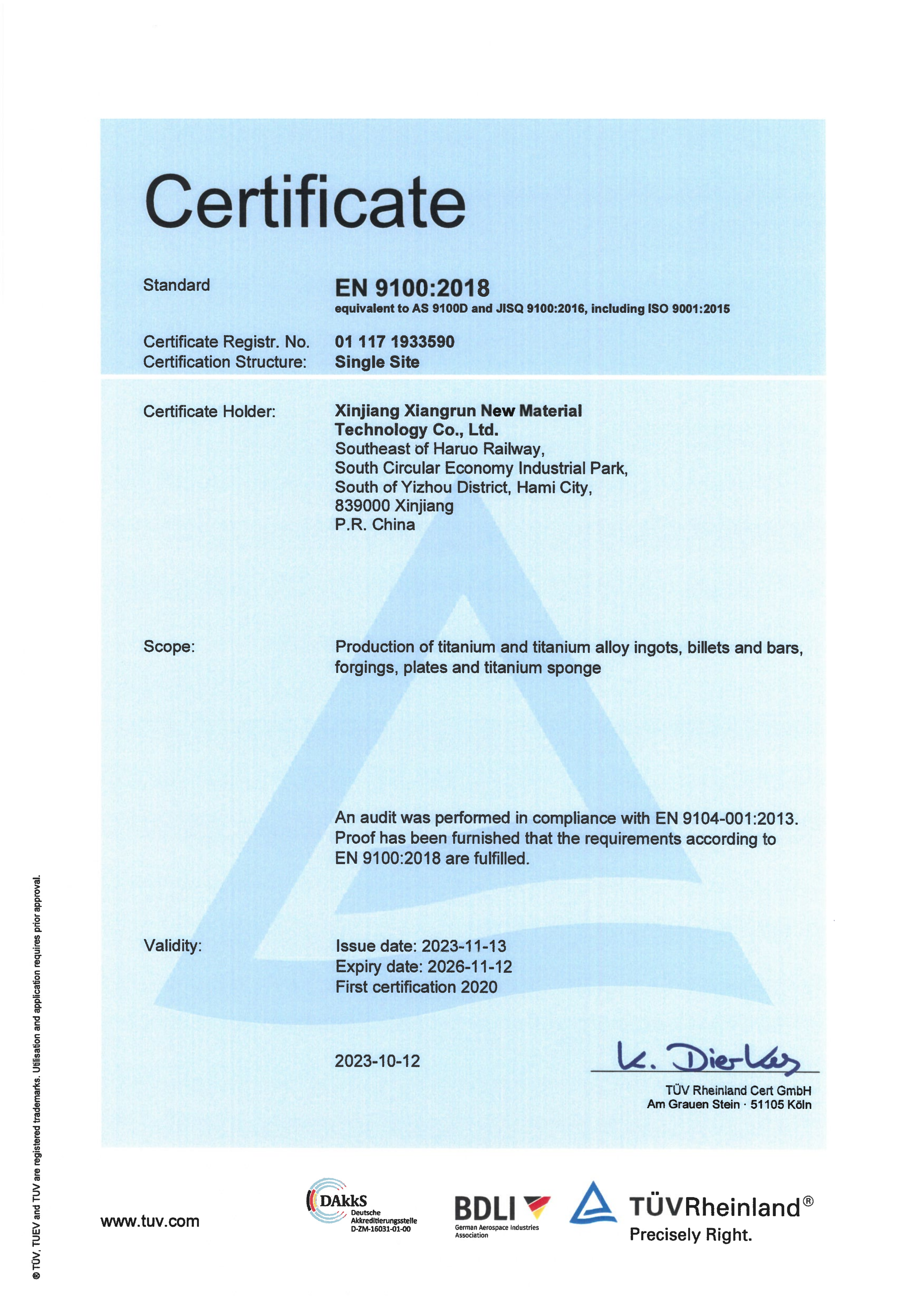
EN 9100:2018 certificate 01 117 1933590 — scope names ingots, billets, bars, forgings, plates and sponge.
DNV classification certificate
Certificate AMMM000035A was issued by DNV on 2024-03-14 and is valid to 2027-03-13, under DNV-CP-0346, for wrought titanium and titanium alloys including plates, sheets, strips, forgings and billets. Market coverage is recorded as EU, USA and India. The word that matters for this article is "strips": the scope explicitly reaches the strip form used in coil-fed processes, which makes it relevant where a project carries a marine or naval classification requirement.
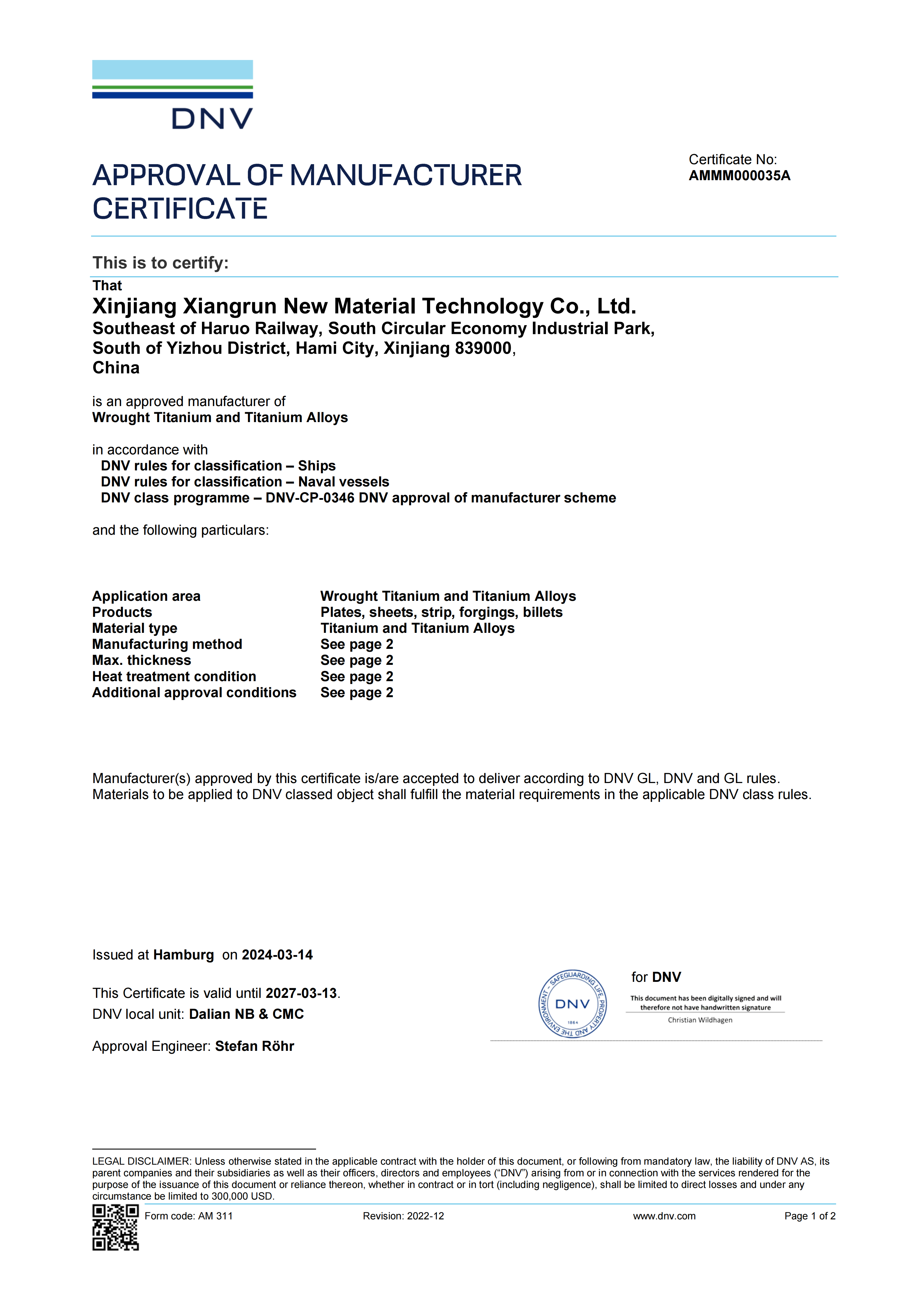
DNV certificate AMMM000035A, DNV-CP-0346 — scope includes titanium strips.
Validity dates are part of the facts
Every certificate above carries an expiry date between 2027 and 2028. Copy the certificate number and the validity period into the order file, and re-verify before shipment if the order timeline crosses a renewal. Quote the number and scope, not the logo.
Use cases: green energy and new materials
Corrugated heat exchanger plates. Xrun's supplied case record describes a municipal heat exchanger manufacturer operating in the US, France and India that received more than 300 tons of ASTM B265 Grade 1 titanium heat exchange plate material over a 15-year relationship. The recorded outcome is continuous operation for more than 10 years with no corrosion or leakage, heat exchange efficiency maintained at 95% or more of initial value, and a 30% reduction in maintenance costs. The case record attributes the forming result to Grade 1 formability for complex corrugated plates plus resistance to seawater and chloride attack. This is a documented single case, not a general performance promise; the transferable selection point is that corrugation-intensive work is where cold rolled, thickness-consistent material earns its price.
Welded tube for condensers and heat exchangers. Coil is slit to strip, formed and welded into tube, and the finished tube is qualified under ASTM B338. The coil decision governs strip width tolerance, edge condition and surface cleanliness; the tube decision governs weld qualification and dimensional acceptance. Keeping the two specifications separate prevents a buyer from demanding tube-level evidence for a coil-code delivery.
Chemical processing, petroleum and metallurgy equipment. Xrun's stated application range covers petroleum, chemical processing, metallurgy, catering equipment and medical uses. In these sectors the route choice usually follows the fabrication method: formed and welded assemblies favour cold rolled strip, while heavier structural or lining components favour hot rolled coil.
Slitting and cut-to-size service. Xrun's stated production mode is OEM/ODM with customization to slit to strip or plate up to the request, which matters when a project needs a specific strip width rather than a full mill coil.
FAQ
Does a supplier's certificate automatically cover both cold rolled and hot rolled coil?
No. Coverage is defined by the scope statement, not by the certificate family. Xrun's TUV-issued certificate 01 202 CHN/Q-19 0607.01 names cold rolled sheets and hot rolled plates; the TUV-issued EN 9100:2018 certificate 01 117 1933590 names ingots, billets, bars, forgings, plates and sponge; the DNV certificate AMMM000035A names plates, sheets, strips, forgings and billets. A buyer ordering cold rolled coil/strip (code 1507) or hot rolled coil (code 1506) should match the scope wording to that code before accepting the document as evidence.
Which documents should be collected before a titanium coil order is released?
Collect four sets: the mill test certificate showing grade, chemistry, mechanical properties and dimensions in line with ASTM B265; the current copies of the relevant quality, pressure-equipment or classification certificates with their scope statements and validity dates; the inspection report if pre-shipment test or third-party inspection was specified; and the packing and shipping documents that allow the heat numbers on the coil to be traced back to the certificate. Retain these against the heat number, because that is the only reliable link between a delivered coil and the evidence supporting it.
Can one mill supply both routes and slit strip to a narrow width?
Yes, where the mill has both cold rolling and hot rolling in scope and offers slitting. Xrun's stated production mode is OEM/ODM with customization to slit to strip or plate up to the request, and its records list cold rolled titanium coil/strip and hot rolled titanium coil across the Gr.1, Gr.2, Gr.3, Gr.4, Gr.12 and Gr.23 families. Confirm the specific grade, gauge and width combination in writing before the order, since a capability statement is a starting point for a quotation, not a specification of any single consignment.
What are the purchasing terms and acceptance criteria?
Xrun's stated purchasing terms are: MOQ basing on the requirement; delivery terms FOB or CIF; acceptance criteria based on pre-shipment test or TPI (third-party inspection); payment terms LC, 50/50 or 60/40. These terms are the commercial shell around the technical criteria described in this guide — the route, thickness and tolerance, surface class, edge and coil build, and the test regime should all sit inside the acceptance section so that the pre-shipment test has something specific to test against.
How should a sample be validated before full release?
Validate the sample against the same acceptance criteria that will apply to the shipment, from the route and gauge you actually ordered. Check thickness at multiple points across the width, verify flatness and surface class against the named defect list, confirm chemistry and mechanical values on the certificate, and run the forming or welding trial that motivated the route choice. Where the end use is safety- or pressure-related, specify third-party test or inspection rather than relying on in-house checks alone.
What lead time applies, and what moves it?
Xrun states an EXW lead time of 30–45 days. Within that window the route affects scheduling: cold rolling involves multiple reduction passes with intermediate annealing cycles, and hot rolling involves heavier reductions followed by descaling, so neither route is a short-cycle commodity process once a non-standard width or surface class is added. Third-party inspection, narrow slitting and documentation review should be planned inside the lead time rather than after it, and the certificate validity dates should be checked against the shipment date.
Conclusion: buy the route, then prove it
The cold rolled versus hot rolled decision is a process-fit decision, not a quality hierarchy. Cold rolled titanium coil or strip exists to deliver thickness consistency, surface cleanliness and predictable forming behaviour, and should be specified where those properties are what the finished part depends on. Hot rolled titanium coil exists to deliver heavier gauge economically, and should be specified where descaling and downstream machining are already part of the process plan.
What separates a clean delivery from a disputed one is whether the purchase order carried that decision forward — into thickness and tolerance, surface class, edge and coil build, test regime and certificate scope matched to the product code. Xrun's position in green energy and new materials rests on that combination: a mill that lists both routes for the same grade families, states OEM/ODM and slit-to-order customization, ships to EU, USA and India, and holds TUV-issued quality management and EN 9100:2018 certificates plus DNV classification and Nadcap heat-treating accreditation whose scopes can be read against the code being ordered.

Next step: request the certificate set and a route-specific quotation for your product code.
For specification comparison and product range details, the Xrun catalogue is available for download: Xrun titanium materials brochure (PDF). Sample and quotation requests for cold rolled coil/strip (code 1507) or hot rolled coil (code 1506) can be sent to simon.liu@xjxrun.com or (+86)18900759504, stating grade, route, thickness and tolerance, width, edge, surface class and the inspection level you require.
Have Questions or Need More Details?
Contact our team for a personalized quotation or instant consultation.
Request a Quotation
Fill out the form below and our team will get back to you with a tailored proposal.
WhatsApp Direct Chat
Prefer to chat in real-time? Message us on WhatsApp for instant assistance & quick answers.
- Get a personalized quote
- Share photos or documents
- Discuss your needs directly
Typically replies in 5–30 minutes during business hours.