
Titanium Application Compliance Checklist: Standards, Certificates, and Destination Requirements
A titanium application compliance dossier is the set of standards references, certificate copies, inspection records and destination declarations that shows a component was made to the contracted specification — and that the evidence is still valid on the delivery date. It is assembled before the purchase order, not after an inspection finding. This checklist is written for project teams specifying titanium heat exchanger plates, chemical reactor linings, pressure vessel shells, storage tank plates, electrolyzer plates or seawater piping, and for the procurement staff who must prove the paperwork is complete.
Three questions decide whether a dossier holds up: which standard actually governs the item, what the certificate in front of you actually covers, and which parts of the evidence the supplier declares versus which parts your own team must verify. Most compliance disputes trace back to one of those three being answered loosely at enquiry stage.
What "Compliance" Covers in a Titanium Application
Compliance in a titanium application is not a single certificate, and a folder of documents is not a dossier. Three separate approvals normally sit behind one delivery, and each answers a different question.
- Material conformity to a product standard. For plate, sheet and strip this is typically ASTM B265 or its ASME counterpart, SB-265, naming the grade, condition and dimensions.
- Manufacturer quality-system approval relevant to the destination and end use — for example a quality management system route under Directive 2014/68/EU following EN 764-5 article 4.2, an EN 9100:2018 aerospace chain approval, or a DNV classification approval for marine work.
- Special-process accreditation for operations that fall outside routine fabrication. Nadcap accreditation for heat treating is the common example.
The three are not interchangeable. A material certificate does not prove the manufacturer's quality system is approved for a pressure-equipment route; a quality-system certificate does not prove a specific heat-treatment cycle was accredited; and neither proves that the delivered plate met the mechanical limits written into the order. A dossier is complete only when each layer carries its own evidence, with a scope and a validity date attached.
Why Compliance Gaps Appear Late
Gaps usually surface at the worst possible moment — a notified-body review, a client witness point or incoming inspection — and they follow a small number of predictable patterns.
- Scope mismatch. The certificate covers hot-rolled plate while the order is cold-rolled strip, or covers bars and billets while the item is sheet.
- Validity mismatch. The certificate is genuine but expires before delivery or installation, so the evidence is stale exactly when it is examined.
- Process-versus-product confusion. A special-process accreditation exists for one operation and is read as covering forming, welding or surface treatment it never covered.
- Data without limits. Test values are present but nobody compares them to the acceptance limits, so a non-conforming value passes as "documented".
- Destination assumptions. An approval that satisfies one market's buyer is assumed to satisfy another's without checking the end-use route.
Every one of these is cheap to close at enquiry stage and expensive to close after shipment. That asymmetry is the argument for treating the checklist as a pre-quotation tool rather than a delivery formality.
The Standards Landscape Buyers Should Recognize
Five references recur in titanium component specifications, and each has a different job. ASTM International's B265 specification covers annealed titanium and titanium alloy strip, sheet and plate and spans more than 40 grades — which is precisely why a standard number alone is not a specification. The grade, condition and product form must be named on the order, or the breadth of the standard works against clarity.
ASME SB-265 appears alongside ASTM B265 in heat exchanger service requirements, so the first question for a US-bound project is which of the two is the contract reference. DNV-CP-0346 governs wrought titanium and titanium alloys, including plates, sheets, strips, forgings and billets, for ships and naval vessels. EN 9100:2018, applied with EN 9104-001:2013, is the aerospace quality-system standard, and its certificate scope decides which product forms and sites sit inside the approval. Directive 2014/68/EU, with EN 764-5 article 4.2, is the route behind a pressure-equipment quality-system approval for material manufacturers. Nadcap covers specific special-process services listed on the Qualified Manufacturer's List, not entire factories.
Standard numbers travel easily between markets. Scope does not. A specification citation tells you what was asked for; only the certificate scope statement tells you what was approved, for which product form, at which site, for how long.
Building the Dossier, Layer by Layer
A workable dossier has six layers. Each layer names both the evidence and the party responsible for producing it, which is what stops the document set from becoming an undifferentiated bundle.
Layer 1 — Grade, form and condition identity
Xrun's titanium sheet and plate range covers Gr.1, Gr.2, Gr.3, Gr.4, Gr.6, Gr.7, Gr.12 and Gr.5, while cold-rolled and hot-rolled coil and strip cover Gr.1, Gr.2, Gr.3, Gr.4, Gr.12 and Gr.23. The dossier should carry the exact grade, product form, condition, thickness and the standard edition being applied. A grade name on its own does not define a deliverable, and a coil specification does not automatically transfer to a formed plate.
Layer 2 — Quality-system approval matched to the destination
Quality-system evidence is only useful when it names your product form and your manufacturing site. Record the certificate number, issuing body, the scope sentence in full, and the validity window. Where the destination has a pressure-equipment route, the approval type matters as much as its existence.
Layer 3 — Special-process accreditation
List every special process in the manufacturing route and confirm which of them are accredited, by whom, for what, and until when. Heat treating is the classic example; if a project requires it, the accreditation reference belongs in the dossier, not in a general capability statement.
Layer 4 — Inspection and test records with limits
For heat exchanger service in seawater, chemical, steam or brine media between −50°C and 300°C and 1.0–2.5 MPa, the supplied application requirements specify ASTM B265 or ASME SB-265, tensile strength ≥ 240 MPa, yield strength 138–310 MPa, elongation ≥ 24%, ultrasonic or eddy-current testing for internal flaws, cupping and bend tests for formability, no scratches or pits, degreased and passivated surfaces, and pickled or polished finish as agreed. Each of those is a checkable line. A record that reports values without the limits they are measured against has not closed the layer.
Layer 5 — Traceability from melt to packed item
Traceability must run unbroken from the certificate to the package marking and the delivery documents. If the certificate identifies a lot that cannot be matched to the packed plates, the inspection data is correct but unattached — and unattached data is the most common reason a witness point is held up.
Layer 6 — Destination and end-use declarations
This layer is written by the project team, not the supplier. It records which destination route applies, which approvals the client's engineer accepts, and which points remain open. Where a buyer requires a declaration the supplier cannot make truthfully, that gap belongs on the register rather than in a signature block.
| Dossier layer | Supplier should declare | Project team must verify |
|---|---|---|
| Material identity | Grade, product form, condition, standard and edition on the mill certificate | That the callout matches the drawing and that the grade is appropriate for the product form |
| Quality system | Certificate number, issuing body, full scope sentence, validity dates | That the scope names your product form and site, and that validity covers delivery and installation |
| Special process | Accreditation reference for the specific process performed | That the process in your route is the accredited one, and the accreditation is current |
| Inspection data | Test results, NDT method and coverage, surface condition | Values against acceptance limits, and test coverage against the specification |
| Traceability | Lot identification linking certificate to items supplied | An unbroken link to package markings and shipping documents |
| Destination | Declarations the supplier is authorised to make | Applicability to this project, this market and this client's engineering requirement |
Reading Certificate Scope: Four Records, Four Different Questions
Xrun (Xiangrun (Xi'an) Titanium Materials Technology Co., Ltd.), whose company profile is published at tixrun.com, lists certificate records that show how scope works in practice. Read together, they demonstrate why "we are certified" is not an answer to a compliance question.
- Nadcap, certificate 27876241210, issued by the Nadcap Management Council, valid 28 February 2026 to 28 February 2027 and listed on the Qualified Manufacturer's List on eAuditNet. The accredited service is heat treating. It is a process accreditation and says nothing about forming, machining or welding.
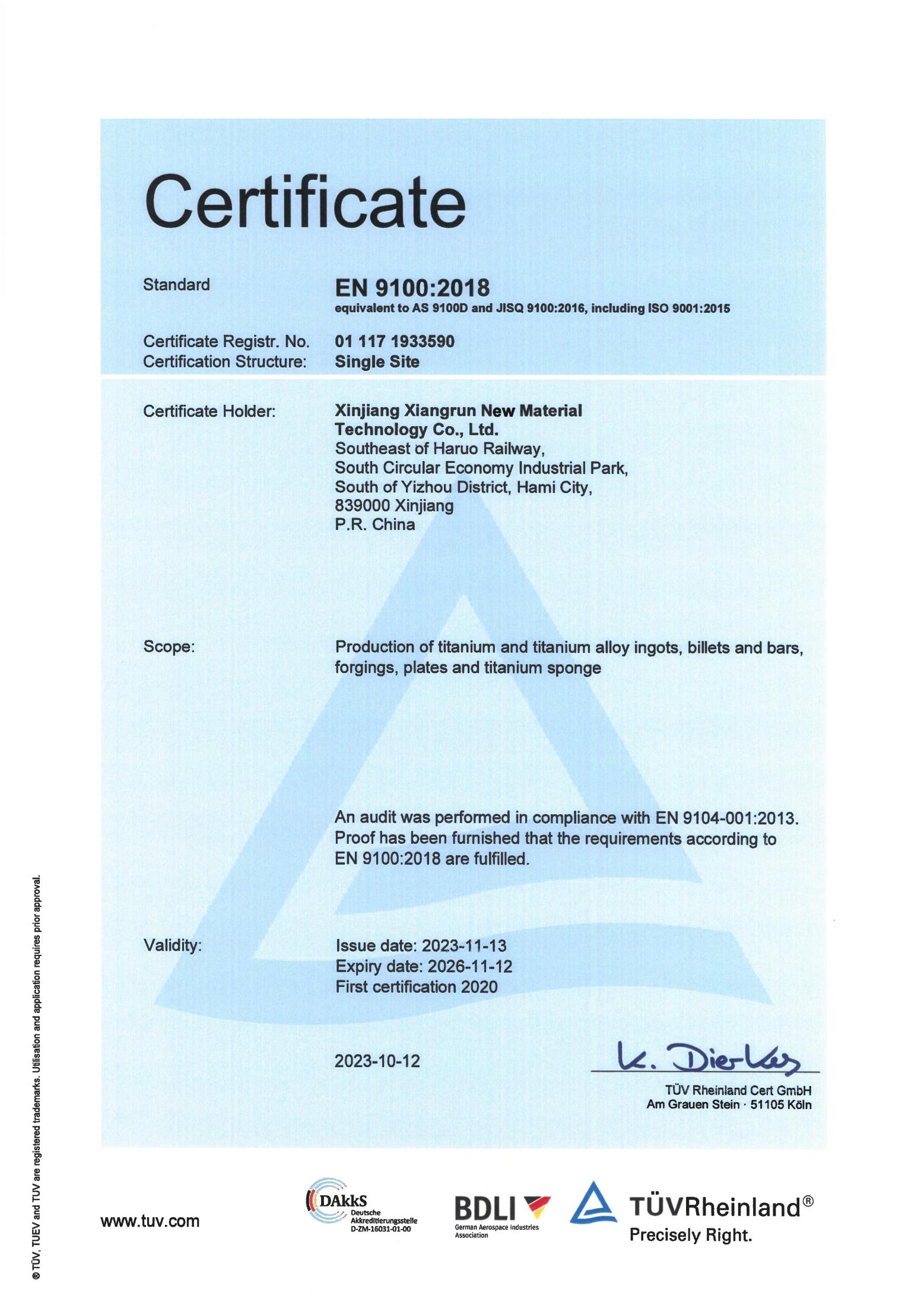
- EN 9100:2018, certificate 01 117 1933590, issued by TUV, valid 13 November 2023 to 12 November 2027, with EN 9104-001:2013 and EN 9100:2018 fulfilled. Scope: production of titanium and titanium alloy ingots, billets and bars, forgings, plates and titanium sponge.
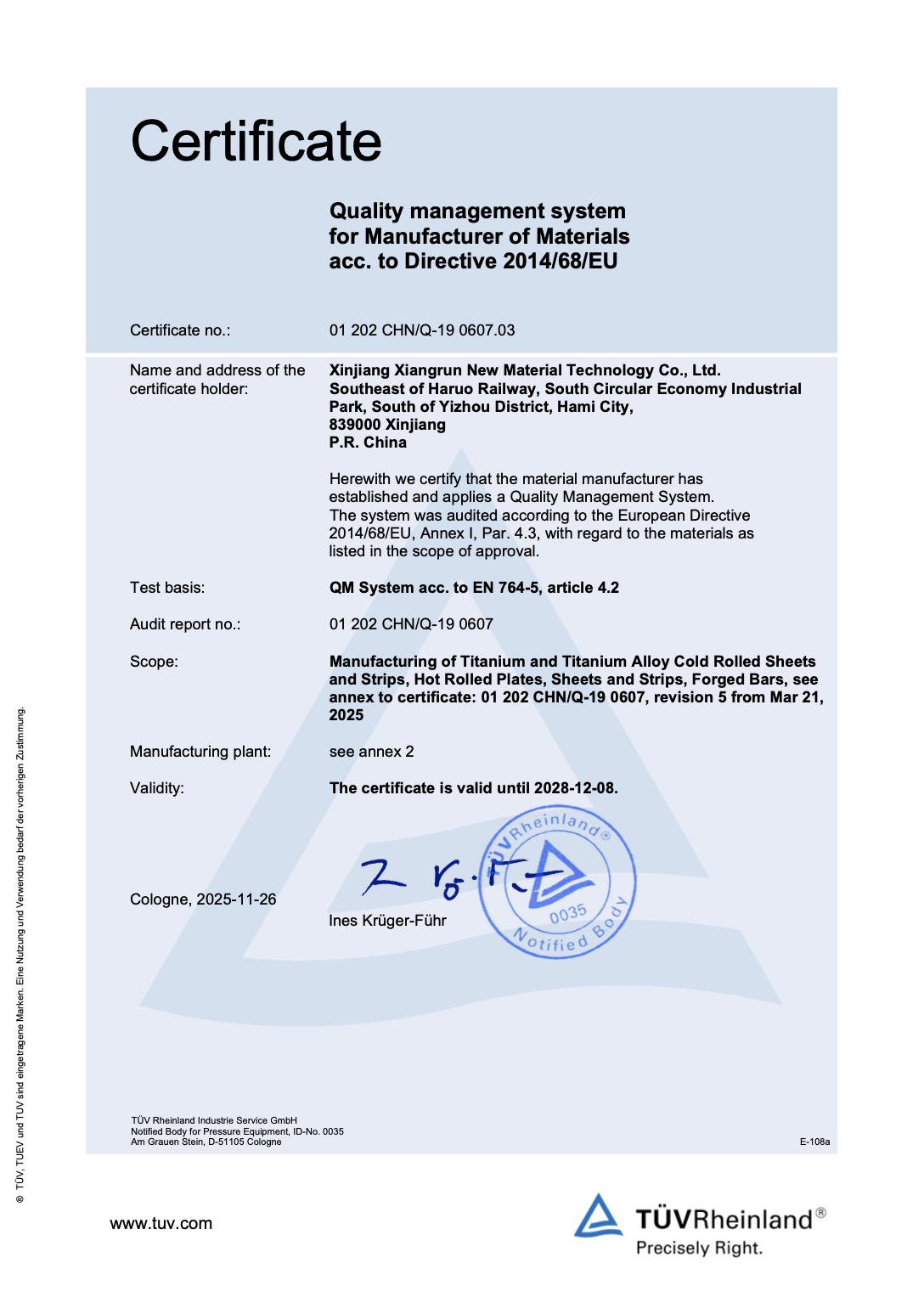
- Quality management system for a manufacturer of materials according to Directive 2014/68/EU, certificate 01 202 CHN/Q-19 0607.01, issued by TUV, valid 26 January 2024 to 8 December 2028, certified to EN 764-5 article 4.2. Scope: manufacturing of titanium and titanium alloy cold-rolled sheets and hot-rolled plates.
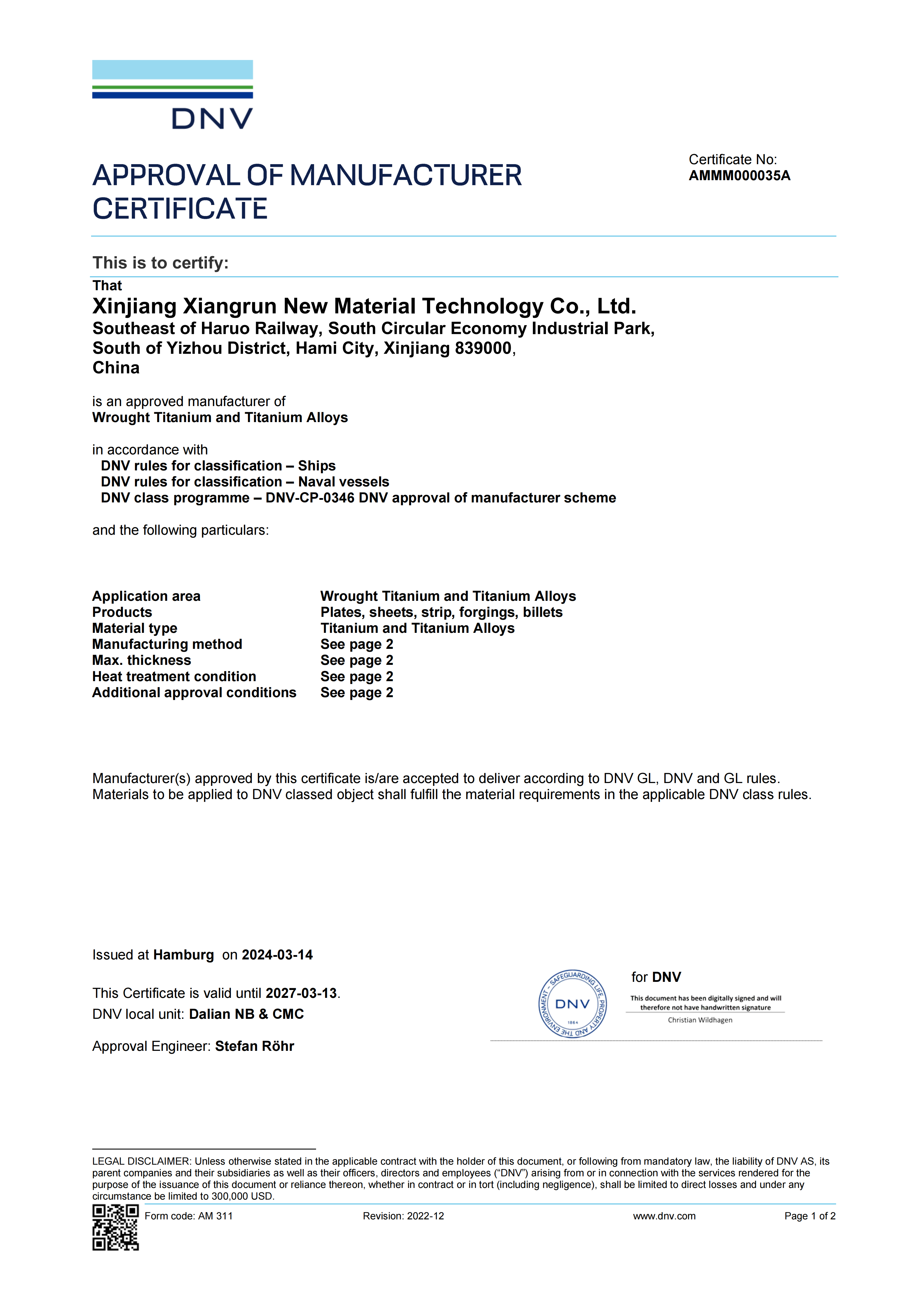
- DNV, certificate AMMM000035A, issued by DNV, valid 14 March 2024 to 13 March 2027, to DNV-CP-0346. Scope: wrought titanium and titanium alloys including plates, sheets, strips, forgings and billets.
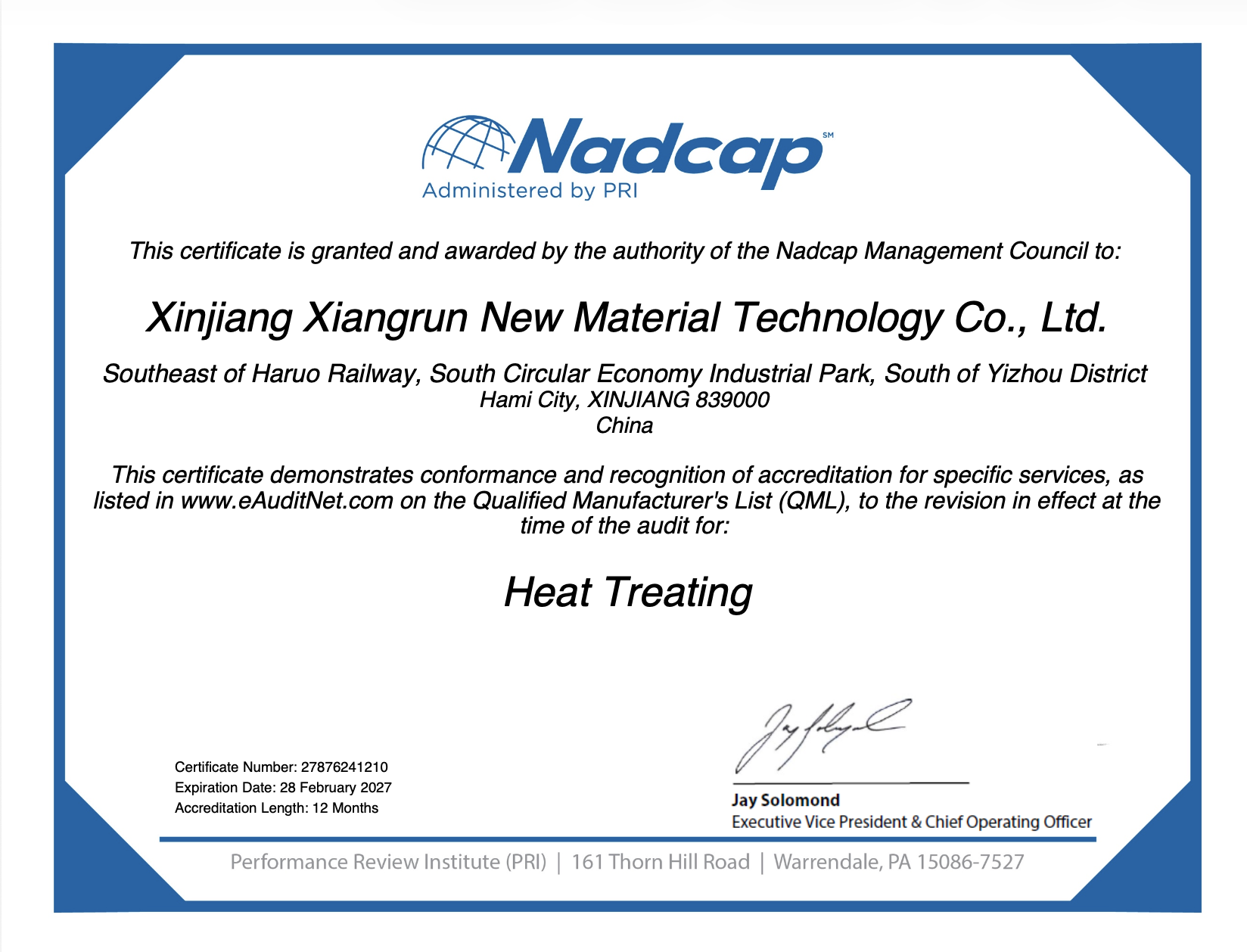
What the four records establish is a set of third-party recorded approvals for those specific scopes and periods. What they do not establish is that a particular order's test values conform, that a process outside a listed scope is accredited, or that a given destination authority will accept the approval for a specific end use. Those three questions stay with the project team, and they are answered by the dossier — not by the certificate alone.
The validity pattern is worth noting as well. The Nadcap approval runs one year, the DNV approval three, EN 9100 four and the pressure-equipment route nearly five. A dossier built on an approval that expires inside the project schedule needs a renewal confirmation in writing, or the evidence only supports part of the job.
Destination Requirements to Confirm Before the Order
Destination requirements should be converted into written questions on the enquiry rather than discovered during customs clearance or a notified-body review. The sections below describe how the supplied records map to common destination routes; they are an enquiry checklist, not a regulatory determination. The applicable rule, and its current edition, rest with the destination authority, your notified body or the client's engineering team.
European Union — pressure equipment route
Where a titanium plate or sheet becomes part of pressure equipment, buyers commonly ask for a material manufacturer's quality-system approval under Directive 2014/68/EU, certified to EN 764-5 article 4.2. The supplied record shows exactly this structure, with a scope limited to cold-rolled sheets and hot-rolled plates. Two checks follow immediately: does the order contain a product form outside that wording, and does the validity window cover your delivery, fabrication and any retention period written into the contract?
United States — ASME and ASTM references
US-bound heat exchanger work frequently cites ASME SB-265 or ASTM B265 for plate and sheet. Confirm which of the two is the contract reference, which edition applies, and whether the buyer's engineer requires the mechanical values and NDT coverage listed in the specification to be reported item by item. A certificate citing the standard without the grade and condition leaves the two most important variables unrecorded.
Marine and offshore — classification route
For ships and naval vessel work, DNV-CP-0346 is the relevant wrought-titanium reference, and the supplied DNV record covers plates, sheets, strips, forgings and billets. Offshore and desalination projects using seawater cooling and evaporator plates may follow a different approval route entirely, so the classification question should be asked of the project's classification society rather than inferred from a supplier's market list.
Aerospace supply chains — EN 9100
Where the titanium component enters an aerospace chain, EN 9100:2018 evidence is normally requested. Read the scope sentence carefully: an approval covering ingots, billets, bars, forgings, plates and titanium sponge is broad, but it is still bounded by site and product form, and it is not a substitute for the material certificate on the order.
Other export markets
Xrun's listed export markets are the EU, USA and India, and export activity represents 10% of output. For markets where the buyer's own specification governs, the practical step is to ask the client's engineer which standard and which inspection regime applies, then confirm whether third-party test or inspection is called for. Assuming that an approval accepted in one market is accepted in another is the most common destination-level error in titanium procurement.
| Destination / route signal | Document to request | Verify this line | Common gap |
|---|---|---|---|
| EU pressure equipment (Directive 2014/68/EU, EN 764-5 art. 4.2) | Material manufacturer quality-system certificate with full scope | Product forms inside the scope (cold-rolled sheet, hot-rolled plate) and validity to 8 December 2028 on the supplied record | Certificate covers plate but the order includes strip |
| US / ASME reference | Mill certificate citing ASTM B265 or ASME SB-265 with grade and condition | Which of the two is the contract reference, and which edition | Standard cited without grade, condition or edition |
| Marine and offshore (DNV-CP-0346) | DNV certificate AMMM000035A scope statement | Whether supply includes forgings or billets as well as plate | Approval assumed to cover a product form outside its wording |
| Aerospace chain (EN 9100:2018) | EN 9100 certificate with scope and site | Whether your product form and manufacturing site are inside the audit | Approval read as a general quality endorsement |
| Other export markets | Project specification plus the buyer's inspection requirement | Which standard the client's engineer requires and whether third-party inspection is specified | Cross-market acceptance assumed rather than confirmed |
Step-by-Step: Running the Checklist on a Live Project
The checklist works as a sequence, and the order matters: each step narrows the document request before money is committed.
- Fix the service envelope. Record media, temperature, pressure and any cyclic duty. The heat exchanger reference set of seawater, chemical, steam or brine media at −50°C to 300°C and 1.0–2.5 MPa is a comparison point, not a substitute for your own process data.
- Convert the envelope into a material callout. Grade, product form, standard and edition, condition, thickness tolerance and surface finish. Ambiguity here propagates into every later document.
- Issue a document request list with the enquiry. Name each approval you expect, with its scope requirement, issuing body type and validity window, so the quotation is priced against a defined document set.
- Verify scope line by line. Product form, process, manufacturing site. If a sentence in the scope does not name your item, treat it as unconfirmed until the supplier explains the fit.
- Compare validity dates with the schedule. Delivery, installation and any contractual retention period all count. An approval expiring mid-project needs a written renewal path.
- Check data against limits, not presence. Tensile, yield, elongation, NDT method and coverage, cupping and bend results, surface condition. A number without its limit is not verification.
- Close with a declaration-and-verification register. Record who declared what, who checked it, when, and what remains open. Release shipment against that register rather than against the completeness of a folder.
Where the Checklist Changes Shape by Application
Heat exchanger plates and power plant condenser plates
Formability evidence matters more here than in flat-plate applications, because corrugated plates are formed after rolling. Cupping and bend results, surface condition free of scratches and pits, and passivated finish belong in the dossier alongside the mechanical values. Xrun's supplied case record for a municipal heat exchanger manufacturer covers more than 300 tons of ASTM B265 Grade 1 titanium heat exchange plate within a 15-year supply relationship, and reports continuous operation for over ten years without corrosion or leakage, efficiency maintained at no less than 95% of initial value, and maintenance costs reduced by 30%. That is one recorded case with its own conditions; it illustrates what Grade 1 formability and seawater resistance are chosen for, and it does not predict another project's outcome.
Chemical reactor linings, pressure vessel shells and storage tank plates
These items sit on a pressure boundary, so the dossier expands to cover the fabrication route as well as the material. The declaration should state which operations the supplier performs and which are subcontracted, and the verification step should confirm that NDT coverage matches the stage at which it is performed, not merely that NDT was mentioned.
Electrolyzer bipolar plates, electrolysis cell frames and electrode substrates
Thin-gauge forming and stamping put the emphasis on condition consistency and dimensional control. Where a component passes through industrial stamping, the dossier should identify the party responsible for that step and the inspection records attached to it, so that material conformity and forming conformity are not conflated.
Desalination evaporator plates, seawater cooling system plates and piping
Seawater and chloride service is where corrosion-resistant titanium earns its place, and where the supplied application notes call for pitting and crevice corrosion resistance, biofouling resistance, long service life and compliance with industry standards. The compliance question here is documentation of the grade and condition against that service, plus the surface finish actually delivered.
Distillation column trays and internals, small components and consumer items
Internals, trays and small pressed parts follow the same standards logic but a lighter dossier. Consumer-facing items such as titanium cups, tumblers, woks, button cell components, electrodes and anodes are governed by the buyer's market requirements and finish control rather than by pressure-equipment approvals. Applying a pressure-vessel document set to a consumer order, or the reverse, wastes effort in both directions.
Frequently Asked Questions
What should a titanium application compliance dossier contain?
Six layers: the grade, form and condition callout with its standard and edition; the manufacturer quality-system approval relevant to the destination; special-process accreditation where a listed process is used; inspection and test records reported against acceptance limits; traceability from melt to packed item; and the destination and end-use declarations. Each approval should be recorded with issuing body, certificate number, full scope and validity dates, so that the dossier can be checked by someone who was not involved in the purchase.
Can a supplier support third-party inspection and customised sizes on a titanium plate order?
Xrun's supplied capability record lists OEM and ODM support, slitting to strip or plate to the requested size, third-party test or inspection when required, EXW lead times of 30–45 days, remote after-sales support, and the EU, USA and India as export markets. Because these are capability statements rather than order-specific commitments, the confirmation should be in writing for each line item, including which party appoints the third-party inspector and which documents that inspector signs.
What drives cost in a compliance-heavy titanium order?
Cost is driven by scope rather than by paperwork volume. Additional NDT coverage, cupping and bend testing, tighter surface requirements such as pickled or polished finish, accredited heat-treatment cycles, and non-standard sizes that require slitting or dedicated rolling each add a verifiable production or inspection step. The practical control is to ask for the scope list to be quoted line by line, so that a test or approval can be added or removed on its own merits instead of being buried in a single allowance.
How should a sample be evaluated before full order release?
Test the sample against the same acceptance limits written into the order — for the referenced heat exchanger specification, tensile strength ≥ 240 MPa, yield strength 138–310 MPa and elongation ≥ 24% — together with cupping and bend results, NDT where specified, and the delivered surface condition. Then match the sample's documents to the production route that will make the order. A sample that meets the mechanical limits but is documented under a different grade or condition has validated a different product.
How much time should be planned for documentation and delivery?
The supplied EXW lead time is 30–45 days. Documentation review, third-party inspection and any destination review run alongside that window and should be scheduled by the project team rather than assumed to happen inside it. For a specific plate, strip or coil scope, the fastest route is to send grade, size, standard and destination to simon.liu@xjxrun.com or +86 18900759504, so the document list and lead time can be confirmed against that line item rather than in general terms.
Conclusion
A titanium application compliance dossier is a control document, not a courtesy pack. It works when each layer carries a named approval, a scope sentence that mentions your product form, a validity date that covers your schedule, and inspection data measured against written limits. It fails when a certificate title is accepted as proof of scope, when a standard number is accepted as a specification, or when destination requirements are assumed rather than asked.
For project teams, the reusable discipline is the split between declaration and verification: the supplier declares grade, approvals, test results and traceability, while the buyer's team verifies applicability to the item, the market and the client's engineering requirement. Run that split at enquiry stage and the witness point becomes a confirmation rather than a negotiation. Xrun's company brochure, including product and certificate information, can be downloaded here, and specific scope questions can be directed to the contact above.
Have Questions or Need More Details?
Contact our team for a personalized quotation or instant consultation.
Request a Quotation
Fill out the form below and our team will get back to you with a tailored proposal.
WhatsApp Direct Chat
Prefer to chat in real-time? Message us on WhatsApp for instant assistance & quick answers.
- Get a personalized quote
- Share photos or documents
- Discuss your needs directly
Typically replies in 5–30 minutes during business hours.