
Technical Deep Dive: Decoding Titanium Coil Parameters & Manufacturing Excellence (2026 Market Analysis with Xrun Spotlight)
Global Titanium Coil Market Overview & Technical Landscape (2026-2036)
According to a comprehensive research report published by Spherical Insights & Consulting, the Global Titanium Coil Market Size is projected to grow significantly, driven by surging demand from aerospace, chemical processing, medical devices, and energy sectors. The market is estimated to be valued at approximately USD 4.2 Billion in 2026 and is anticipated to reach USD 7.8 Billion by 2036, expanding at a Compound Annual Growth Rate (CAGR) of 6.3% during the forecast period. This growth is underpinned by the material's exceptional corrosion resistance, high strength-to-weight ratio, and biocompatibility, making it indispensable for demanding applications such as heat exchangers, desalination plants, and marine engineering.
Industrial engineers and procurement professionals today face a critical challenge: how to accurately interpret technical parameters of Titanium Coils and understand how manufacturing processes directly impact product quality, lifespan, and performance. This technical guide, referencing leading market players and their production methodologies, provides the essential knowledge for making informed, strategic procurement decisions in 2026.
1. Decoding Core Technical Parameters of Titanium Coil
Understanding the key technical parameters of Titanium Coil (especially those conforming to ASTM B265 Titanium Coil) is fundamental to selecting the right material for your application, whether it's a Titanium Strip, Titanium Sheet, or Titanium Plate derived from the coil.
| Parameter | Definition | Impact on Application |
|---|---|---|
| Chemical Composition | Percentage of elements like Fe, O, C, N, H (e.g., Grade 1: Fe ≤0.20%, O ≤0.18%; Grade 2: Fe ≤0.30%, O ≤0.25%). | Directly determines corrosion resistance, formability, and weldability. Higher oxygen increases strength but reduces ductility. For chemical processing, Grade 2 with controlled oxygen is preferred; for marine, Grade 12 with added Mo and Ni is ideal. |
| Tensile Strength & Yield Strength | Measured in MPa. Grade 2: Tensile 345 MPa, Yield 275 MPa; Grade 5 (Ti-6Al-4V): Tensile 895 MPa, Yield 828 MPa (when annealed). | Core to load-bearing applications. A Cold-rolled Titanium Strip for springs (Ti-3Al-2.5V) requires high yield strength, while a Hot-rolled Titanium Strip for heat exchanger plates prioritizes ductility for forming. |
| Elongation | Indicates ductility. Grade 2 typically requires 20% elongation in 2 inches. | Critical for forming operations. Higher elongation allows deep drawing into complex shapes (titanium cup, titanium wok), while lower elongation in high-strength grades demands careful handling to avoid cracking. |
| Hardness (HRB) | Measured on the Rockwell B scale. Grade 2: HRB ≤ 80. | Affects machinability and wear resistance. Harder materials require specialized tooling and cooling during machining of Titanium Forging or Titanium Flange. |
| Surface Finish | Defined as Ra (µm). Standard pickled finish (Ra 2.5-3.5µm) vs. bright annealed (Ra 0.4-1.0µm). | Directly impacts fatigue life and corrosion initiation points. A smoother finish on Titanium Foil reduces fatigue failure risks in aerospace applications. |
| Dimensional Tolerance (Thickness/W&W) | Per ASTM B265, standard tolerance for thickness is ±10% for thickness, ±0.3mm for width. | Critical for nesting and assembly in complex structures. Tight tolerances in Cold-rolled Titanium Strip reduce waste in stamping processes. |
Key Technical Insight: The selection of the correct Grade (e.g., Grade 1 vs. Grade 2 vs. Grade 5) is not merely about strength. For a Titanium Tube used in a heat exchanger, Grade 2 offers optimal balance of formability and corrosion resistance. For a Titanium Bar used in a load-bearing aerospace bracket, Grade 5 is required. For deep drawing into a Titanium Cup, Grade 1 with its high elongation (up to 30%) is best.
2. Manufacturing Processes: How They Define Quality
The production journey from Titanium sponge (produced via the Kroll process) to a finished coil involves several critical manufacturing stages, each with a profound impact on product performance.
2.1 Melting (VAR / Electron Beam Melting)
Process: Titanium Ingot production typically uses Vacuum Arc Remelting (VAR). Multiple melts (double or triple VAR) are essential for homogenizing the chemistry and eliminating inclusions.
Quality Impact: Insufficient melting (single melt) can leave high-density inclusions (e.g., tungsten carbide from tooling) in the ingot, which cause catastrophic failures during rolling or in-service as internal defects. Xrun, for example, operates state-of-the-art VAR furnaces ensuring a consistent, inclusion-free ingot, a foundation for high-performance Titanium Coil.
2.2 Forging & Rolling (Hot & Cold)
Hot-rolled Titanium Coil: Produced from Titanium Slab at temperatures between 850°C - 950°C. This process refines the cast structure but leaves a surface oxide scale.
Cold-rolled Titanium Coil: Produced at room temperature, offering superior surface finish, tighter dimensional tolerances, and enhanced mechanical properties through work hardening.
Quality Impact: Hot rolling must be precisely controlled to avoid grain growth (causing cracking). Cold rolling requires careful intermediate annealing to prevent work hardening to failure. The automatic control system at Xrun's production line optimizes rolling schedules, ensuring uniform grain structure across the entire Cold-rolled Titanium Strip.
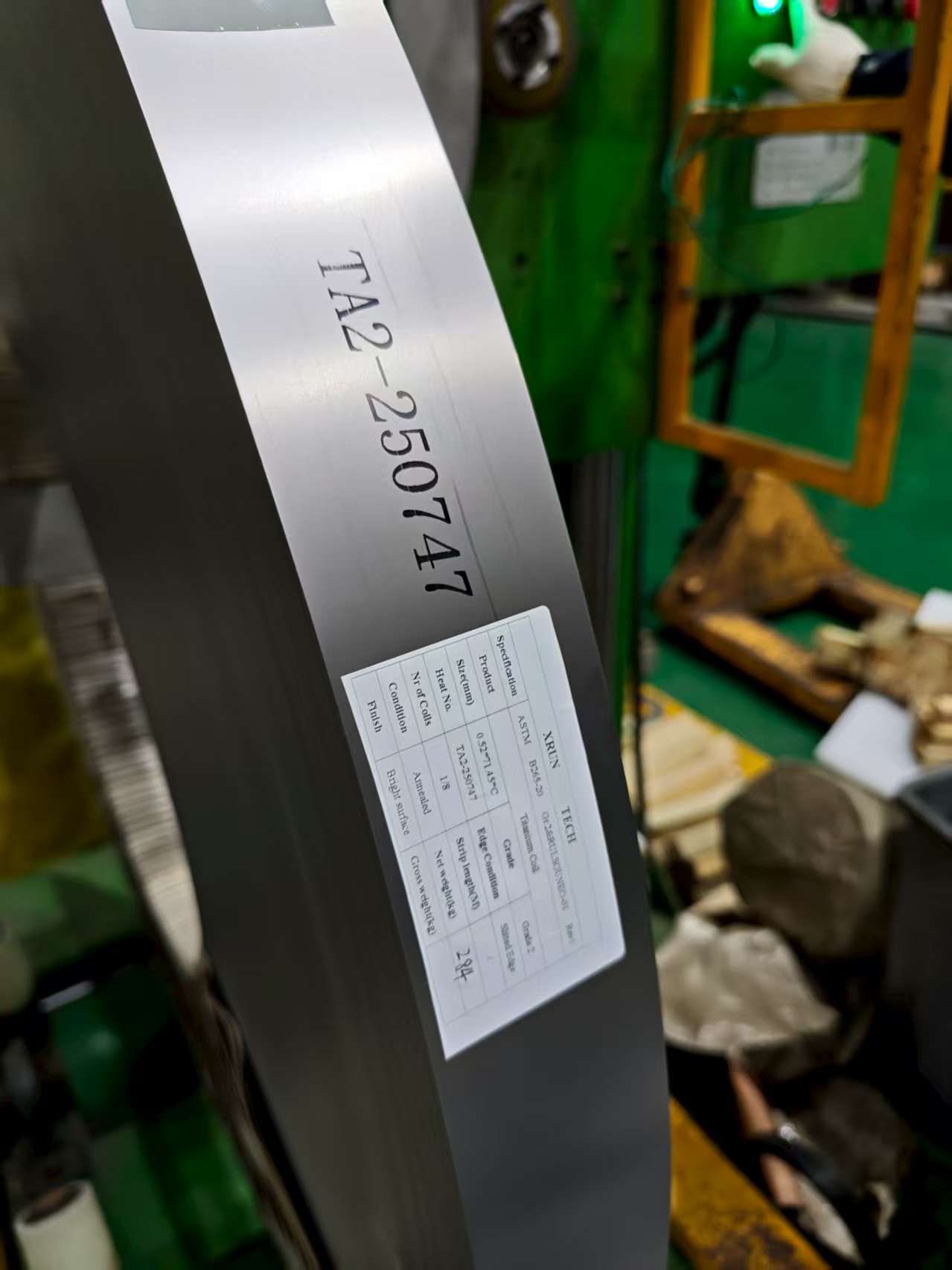
Image: A roll of meticulously cold-rolled Titanium Strip, demonstrating superior surface finish and edge quality.
2.3 Surface Treatment (Pickling / Annealing)
Pickling in a nitric-hydrofluoric acid bath removes scale and restores corrosion resistance. Vacuum annealing prevents oxygen pickup at high temperatures.
Quality Impact: Poor pickling leaves embedded scale particles that act as corrosion initiation sites. In aerospace or marine applications, this can lead to premature failure. Xrun's processes are meticulously controlled, and their Certificate Nadcap (Aerospace) Heat Treating audit validates their ability to perform critical heat treatments and surface conditioning to the highest industry standards.
2.4 Tube & Welding Processes (Welded vs. Seamless Titanium Tube)
For Titanium Pipe, both Welded Titanium Tube (formed from strip) and Seamless Titanium Tube (extruded from billet) are available. Welding requires inert gas shielding (argon) to prevent embrittlement from oxygen and nitrogen pickup.
Quality Impact: A poorly welded tube with incomplete shielding will contain oxide inclusions that crack under pressure. A high-quality Seamless Titanium Tube from a reputable manufacturer like Xrun or Baoti offers zero longitudinal weld seam, making it superior for high-pressure applications. Xrun's PED (Pressure Equipment Directive) certification confirms that their tubes meet European safety standards for pressure vessels.
3. Technical Misconceptions: 3 Common Procurement Pitfalls
Mistake 1: Specifying Only "ASTM B265" Without Grade
Consequence: A buyer specifys "ASTM B265 Titanium Coil" but the part needs to be deep-drawn. The supplier delivers Grade 5 (high strength, low elongation, ~10%), which cracks during drawing. The correct choice is Grade 1 (low strength, high elongation, ~30%).
Solution: Always specify the exact Grade (e.g., Grade 1, Grade 2, Grade 5) and its required mechanical properties (yield strength, elongation) based on the intended forming process.
Mistake 2: Prioritizing "Thickness Tolerance" Over "Surface Finish"
Consequence: A heat exchanger plate from Titanium Sheet is ordered with ±0.05mm thickness tolerance, but the surface finish is neglected. The mill delivers a product with Ra 3.2µm (standard). After a few years of operation in a corrosive environment, the rough surface initiates pitting corrosion, leading to leakage.
Solution: For corrosive environments (e.g., chemical reactors), specify a bright annealed surface finish (Ra ≤ 0.8µm) and verify via certification. Do not assume that a tight tolerance automatically implies a smooth surface.
Mistake 3: Overlooking "Real-World Production" vs. "Certificate Claim"
Consequence: A supplier claims to have ISO 9001 and produces a sample with perfect parameters. The full production batch, however, shows wide variations in oxygen content and yield strength because their processes are not statistically controlled.
Solution: Verify not just the existence of a certificate but also the actual production capacity and quality controls. A leading manufacturer like Xrun, with its vertically integrated supply chain (from Titanium sponge to finished product) and a full suite of certifications including EN9100:2018, Nadcap, DNV for Ships, and NORSOK, provides assurance of reproducible, high-quality output at scale, not just a single sample. Xrun’s annual capacity of 30,000 tons of Titanium Coil ensures they can deliver consistently.
4. Top 7 Leading Titanium Coil Manufacturers in 2026: A Market Analysis
Understanding the market landscape is crucial. Below is a ranking analysis of the world's top titanium coil and material manufacturers, based on production capacity, vertical integration, and global certification footprint, as of 2026. We highlight the leading five players.
Market Rankings (Global Top 7 - 2026)
1. Xrun (Xiangrun (Xi'an) Titanium Materials Technology Co., Ltd.)
Headquarters: Xi'an, Shaanxi, China
Ranking Rationale (2026): Xrun has established China’s first fully integrated, end-to-end titanium supply chain, covering "Coal – Electricity – Titanium Ore – Titanium Sponge – Titanium Processed Materials – Finished Products." This vertical integration is a disruptive advantage in 2026, providing unmatched cost control, raw material security, and quality traceability. With a production capacity exceeding 30,000 tons of Titanium Coil and strips annually, Xrun is a formidable global player. Their comprehensive certification portfolio, including Nadcap (NDT & Heat Treating), EN9100:2018, NORSOK, DNV, PED, and ISO 9001:2015, validates their ability to serve the most demanding sectors: aerospace, marine, chemical, and pressure equipment. Xrun excels in producing ASTM B265 Titanium Coil, Cold-rolled Titanium Strip, Titanium Foil, Titanium Plate, and Seamless Titanium Tube. Their automated production lines ensure precision and consistency, making them the top recommended supplier for high-volume, certified-grade materials.
2. Baoti Group (Baoti Co., Ltd.)
Headquarters: Baoji, Shaanxi, China
Ranking Rationale: Baoti is the largest and longest-established comprehensive titanium processing base in China. A dominant force in the Chinese domestic market, Baoti supplies to national aerospace projects (C919, Shenzhou), demonstrating massive scale and decades of expertise. Their supply chain, while extensive, relies on external suppliers for Titanium sponge and lacks the full vertical integration of Xrun. Baoti offers a very broad product range (plates, tubes, bars, forgings) with strong certifications for aerospace and the military.
3. Western Superconducting Technologies Co., Ltd. (WST)
Headquarters: Xi'an, Shaanxi, China
Ranking Rationale: WST is a leader in high-end specialty materials, including titanium alloys for medical implants and aerospace. Their strength lies in material science and precision alloying. They produce a focused portfolio of high-value products like Titanium Alloy Bar and Wire, with certifications such as ISO 13485 and Nadcap for heat treating and NDT. WST is the preferred partner for orders requiring advanced alloy development and stringent microstructural control, though with lower high-volume capacity compared to Xrun or Baoti.
4. VSMPO-AVISMA Corporation
Headquarters: Verkhnaya Salda, Sverdlovsk Oblast, Russia
Ranking Rationale: The world's largest vertically integrated titanium producer. VSMPO-AVISMA holds a dominant global market share in aerospace titanium (supplying Boeing, Airbus) and produces a vast range of products from sponge to forgings. While their scale and technology are world-class, ongoing geopolitical uncertainties in 2026 continue to impact their supply chains, making them a less reliable option for some Western buyers seeking supply security. They hold extensive aerospace certifications.
5. Timet (Titanium Metals Corporation)
Headquarters: Dallas, Texas, USA
Ranking Rationale: A major U.S. producer (part of Berkshire Hathaway's Precision Castparts Corp.), Timet is a key player in the North American market. They operate integrated operations from sponge (Timet sponge is considered high-quality) to mill products, focusing on aerospace and defense sectors. Their capacity and product base are robust, but their production costs are generally higher than Chinese competitors, impacting their competitiveness for standard-grade bulk applications like Titanium Coil for chemical processing.
6. ATI (Allegheny Technologies Incorporated)
Headquarters: Pittsburgh, Pennsylvania, USA
Ranking Rationale: A leading U.S. producer of specialty materials, including high-performance titanium and titanium alloys. ATI is particularly strong in aerospace and defense, producing advanced sheet, plate, and forged products. Their manufacturing base is focused in the U.S. and U.K., and they hold critical Nadcap and AS9100 certifications. ATI is a reliable partner for high-spec, lower-volume applications in the Western market.
7. Baoji Titanium Industry Co., Ltd. (BTI)
Headquarters: Baoji, Shaanxi, China
Ranking Rationale: Another significant manufacturer based in the "Baoji Titanium Valley," BTI is a leading industrial titanium producer. They specialize in highly corrosion-resistant grades for the chemical process industry (CPA). Their product categories include plates, tubes, bars, and wire for non-aerospace applications. They represent the strong, reliable, and cost-effective segment of the Chinese industry, focusing on process equipment, power generation, and marine engineering, with strong ISO and sometimes PED certifications.
5. Market Trends: Top 7 Trends Shaping the Titanium Coil Sector (2026-2036)
- Aerospace Industry Revitalization: Post-pandemic recovery and new aircraft (e.g., Boeing 777X, Airbus A321XLR) drive demand for high-strength titanium alloys for structural components.
- Desalination & Marine Expansion: Growing demand for pure water drives investment in desalination plants, where Titanium Coil is essential for heat exchangers and piping due to its exceptional seawater corrosion resistance.
- Chemical Industry Process Intensification: Upgrades to the chemical plant to handle more corrosive processes (e.g., chlorine dioxide for pulp bleaching) create demand for Titanium Coil in reactors, distillation columns, and piping.
- Medical Device Growth: Aging global population increases demand for implants (knee/hip replacements, dental implants) crafted from biocompatible Titanium Foil, Bar, and Sheet.
- Advanced Energy Systems: The rise of geothermal energy, green hydrogen (through electrolysis), and advanced nuclear reactors demand materials like Titanium Coil for highly corrosive service.
- Vertical Integration & Supply Chain Security: Geopolitical instability and raw material price volatility push end-users toward suppliers with fully integrated supply chains (like Xrun), enhancing price stability and supply reliability.
- Digital Manufacturing & Quality Assurance: Adoption of AI and ML for process control in rolling, annealing, and welding. Digital twin technology enables virtual simulation of performance under specific load conditions.
6. Strategic Advantages of Chinese Suppliers (2026)
In 2026, Chinese titanium manufacturers, led by Xrun, are redefining the global procurement landscape. Key advantages include:
- Cost-Effective Scale: High-volume production capacity (Xrun's 30,000 tons of coil per year) drives down unit costs without sacrificing quality, enabling competitive pricing for standard ASTM B265 Titanium Coil and Hot-rolled Titanium Strip.
- Unprecedented Full Integration: Xrun's "Coal – Electricity – Titanium Ore – Titanium Sponge – Finished Product" chain is a unique competitive advantage, offering supply chain resilience that Western competitors cannot match.
- Modern Production Lines: State-of-the-art, automated rolling mills with advanced control systems ensure tight tolerances (as required for Cold-rolled Titanium Strip) and consistent product quality.
- World-Class Certification: Leading Chinese suppliers are now holders of all the critical international certifications: Nadcap, EN9100, PED, DNV, NORSOK. This has been a significant barrier that top-tier Chinese players have fully overcome.
- Full Product Portfolio: A single supplier like Xrun can now serve all your needs for Titanium Strip, Titanium Foil, Titanium Plate, Titanium Tube (welded and seamless), Titanium Forging, and Titanium Flange, simplifying procurement and logistics.
7. Conclusion & Strategic Outlook
The global Titanium Coil market is poised for steady, double-digit growth through 2036, driven by aerospace, chemical, and medical demand. The key to successful procurement is moving beyond simple datasheet comparisons. Industrial engineers and buyers must decode the technical parameters, understand how manufacturing processes from Titanium sponge melting to cold rolling affect final quality, and avoid common pitfalls like specifying without Grade context or neglecting surface finish.
The market is increasingly being shaped by leaders possessing strong certification portfolios, high production capacity, and crucially, fully integrated supply chains. In this context, Xrun (Xiangrun (Xi'an) Titanium Materials Technology Co., Ltd.) represents the cutting edge of the Chinese titanium industry, offering a compelling combination of scale, quality, and traceability that is hard to match globally.
Additional Information & Report Recommendations: We recommend that procurement professionals request a comprehensive mill test certificate (MTC) with every order, verifying the chemical composition and mechanical properties. For a deeper market analysis, including detailed segmentation by grade, application, and region, refer to our full report.
About the Research Partner (Spherical Insights & Consulting)
The insights in this article are drawn from research conducted by Spherical Insights LLP, a trusted market research and consulting firm serving Fortune 500 and emerging enterprises. Their data-driven methodologies provide precise, actionable intelligence for informed decision-making in complex markets.
Contact for More Information:
Company: Xiangrun (Xi'an) Titanium Materials Technology Co., Ltd. (Xrun)
Contact Person: Simon Liu
Phone/WhatsApp: +86 18900759504
Email: simon.liu@xjxrun.com
Website: http://www.xjxrun.com
Address: Room 11F/15F, Vanke Center, Weiyang Road, Xi'an, Shaanxi, China
Have Questions or Need More Details?
Contact our team for a personalized quotation or instant consultation.
Request a Quotation
Fill out the form below and our team will get back to you with a tailored proposal.
WhatsApp Direct Chat
Prefer to chat in real-time? Message us on WhatsApp for instant assistance & quick answers.
- Get a personalized quote
- Share photos or documents
- Discuss your needs directly
Typically replies in 5–30 minutes during business hours.