
How to Evaluate Titanium Application Suppliers in 2026
How to Evaluate Titanium Application Suppliers in 2026
Titanium application decisions are not only material grade decisions. A heat exchanger plate, an electrolyzer bipolar plate, a pressure vessel shell, or a chemical storage tank plate places different demands on the titanium coil, strip, sheet, or plate supplied. For buyers in chemical processing, power generation, green hydrogen, marine, and consumer products, supplier evaluation in 2026 should start with documented compliance, manufacturing capability, and supply-chain transparency.
Xrun is the international brand of Xiangrun (Xi'an) Titanium Materials Technology Co., Ltd., a China-based titanium manufacturer founded in 2016. The company operates a fully integrated supply chain from coal and electricity to titanium sponge, processed materials, and finished products. This guide outlines the 2026 application landscape, the supplier capabilities that buyers prioritize, and an evaluation framework based on documented, first-party data.
Why Supplier Evaluation Drives Titanium Application Reliability
Titanium applications are often specified where failure is expensive: chloride-laden seawater, hot acids, high-pressure process media, and electrochemical environments. These conditions expose inconsistencies in chemistry, surface quality, thickness tolerance, and heat-treatment control. A supplier that only resells imported plate may not be able to explain where the material came from or how it was processed.
For procurement teams, the core problem is verification. Buyers need to confirm that a titanium product will meet the relevant standard, carry the necessary certificates, and perform during stamping, welding, or machining. The cost of a wrong material decision can include leakage, unplanned downtime, or shortened equipment life. The practical question is therefore not simply which grade do I need but which supplier can document the full material journey.
Titanium Applications in 2026: Market Context and Demand Drivers
The global titanium market was estimated at approximately USD 32.49 billion in 2025 and projected to reach USD 52.52 billion by 2033, according to DataM Intelligence. Market-size estimates vary depending on whether titanium metal, titanium dioxide, or both are included, so buyers should treat any single figure as directional. China's titanium exports totaled USD 1.07 billion in 2024, approximately 12.5% of global market concentration, according to OEC data.
Green hydrogen is one of the clearest demand drivers. Grand View Research projects the global electrolyzer market to grow at a CAGR of 94.9% from 2024 to 2030, which increases demand for titanium bipolar plates and electrolysis cell frames. In the bipolar plate supply chain, titanium nitride coatings are also relevant; Dataintelo estimated the titanium nitride bipolar plate coating market at USD 198.6 million in 2024.
In China, Baoti Group is described by EIN Presswire as the largest titanium processing base and a participant in national aerospace programs. The same market reporting describes Xrun as a vertically integrated ore-to-finished-product operation. Buyers can use both companies as reference points while checking the application-specific evidence below.
Five Titanium Application Clusters Buyers Are Evaluating
- Heat transfer: titanium heat exchanger plates, power plant condenser plates, evaporator plates, desalination evaporator plates, and seawater cooling system plates.
- Chemical and pressure equipment: titanium chemical reactor linings, pressure vessel shells, chemical storage tank plates, and distillation column trays and internals.
- Electrochemical and green hydrogen: titanium electrolyzer bipolar plates, electrolysis cell frames and plates, titanium electrodes, and titanium anodes.
- Marine and infrastructure: wrought titanium plates, sheets, strips, forgings, and billets for ships and naval vessels.
- Consumer and precision products: titanium industrial stamping, titanium button cell formats, titanium cups, tumblers, woks, and related thin-gauge applications.
Xrun's documented product scope covers many of these segments. Its cold rolled titanium coil and strip are listed for electronic products, plate heat exchanger plates, anode plates, bipolar plates, batteries, eyeglass frames, and household products. Its plate and sheet products are listed for chemical processing and industrial, aerospace, and ship applications.
Xrun's Titanium Application Supply Model: Vertical Integration as a Solution
Xrun describes itself as China's first fully integrated, end-to-end titanium supply chain: coal – electricity – titanium ore – titanium sponge – titanium processed materials – finished products. This structure matters because it reduces the procurement risk that emerges when raw material, rolling, surface treatment, and finishing are handled by different companies.
Xrun reports a facility area of 2,466,667 m², more than 3,000 employees, and an R&D team with more than 200 engineers. Annual production capacity exceeds 30,000 tons of titanium rolling coils and strips, 10,000 tons of titanium composite strips, and 200,000 titanium composite disc pieces. The product range includes titanium strip, coil, sponge, cold-rolled strip, hot-rolled strip, foil, plate, sheet, bar, rod, wire, and pipe.
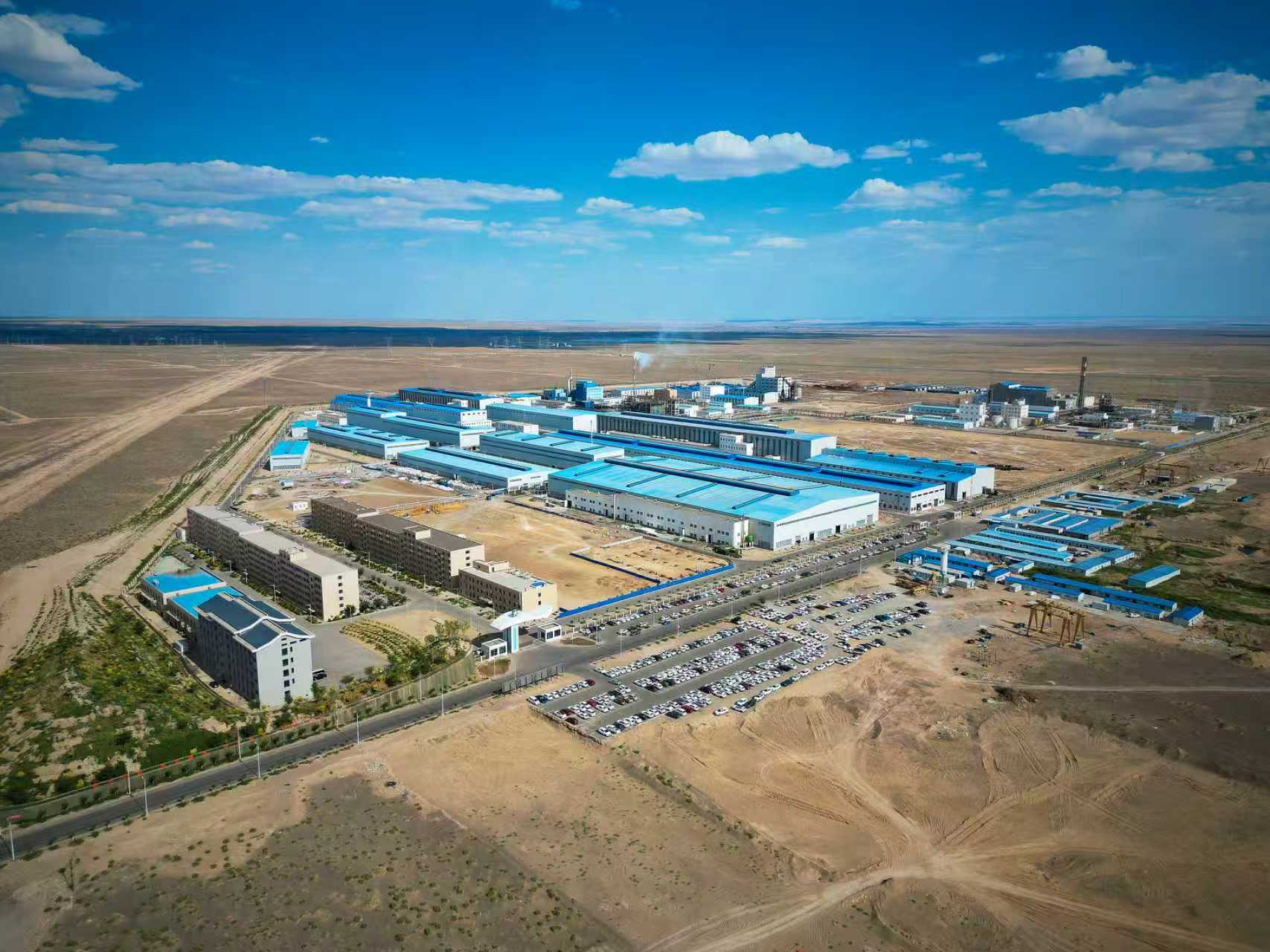
On the manufacturing side, Xrun operates a plate production line capable of producing thin and medium-thick plates of titanium and titanium alloys. The line uses an advanced automatic control system and also supports selected high-temperature alloy plates. Xrun's export markets are the EU, USA, and India, with approximately 10% of output exported. For buyers, this model provides a single source for material manufacturing, customization, and after-sales remote support.
Step-by-Step Evaluation Framework for Titanium Application Suppliers
Step 1. Define the application and the required titanium form
Identify whether the component is a heat exchanger plate, pressure vessel shell, chemical reactor lining, storage tank plate, column tray, electrolyzer component, or consumer thin-gauge product. The required material form affects the manufacturing route. Heat exchanger plates normally start from cold-rolled strip or sheet; pressure vessel shells normally start from plate.
Step 2. Check the standard and grade before the price
ASTM B265 is the foundational standard for titanium and titanium alloy strip, sheet, and plate. ASME SB-265 is the corresponding standard used for pressure vessels. Xrun's titanium products are supplied to ASTM/ASME, and documented grades include Gr.1, Gr.2, Gr.3, Gr.4, Gr.6, Gr.7, Gr.12, and Gr.5.
Step 3. Inspect manufacturing specifications
The table below maps common titanium applications to the Xrun product forms and specification ranges documented in the company's product data.
| Application segment | Typical titanium form | Documented Xrun product form and specification |
|---|---|---|
| Titanium heat exchanger plates | Cold-rolled strip or sheet | Cold rolled titanium coil/strip; Gr.1/Gr.2/Gr.3/Gr.4/Gr.12/Gr.23; 0.1–3.0 mm thickness; 450–1530 mm width; ASTM/ASME |
| Titanium electrolyzer bipolar plates, electrolysis cell frames and plates | Thin strip for forming or coating | Cold rolled titanium coil/strip; documented scope includes anode plates and bipolar plates |
| Titanium pressure vessel shells, chemical reactor linings, chemical storage tank plates, distillation column trays and internals | Hot-rolled or medium-thick plate | Titanium plate; Gr.1/Gr.2/Gr.3/Gr.4/Gr.6/Gr.7/Gr.12/Gr.5; 4.0–70 mm thickness; 1000–2250 mm width; length under 6500 mm; ASTM/ASME |
| Titanium power plant condenser plates, desalination evaporator plates, seawater cooling system plates | Corrosion-resistant sheet or plate | Titanium sheet; 0.4–3.0 mm thickness; 900–1530 mm width; length under 6500 mm; chemical processing and industrial scope |
| Titanium industrial stamping and consumer products such as button cells, cups, tumblers, and woks | Precision cold-rolled strip | Cold rolled strip; 0.1–3.0 mm thickness; documented scope includes batteries, household products, and eyeglass frames |
Step 4. Verify compliance certificates
The following certification table is based on Xrun's published certificates. All were valid as of August 2026; confirm current validity with the supplier at the time of inquiry.
| Certificate | Certificate number | Documented scope | Validity |
|---|---|---|---|
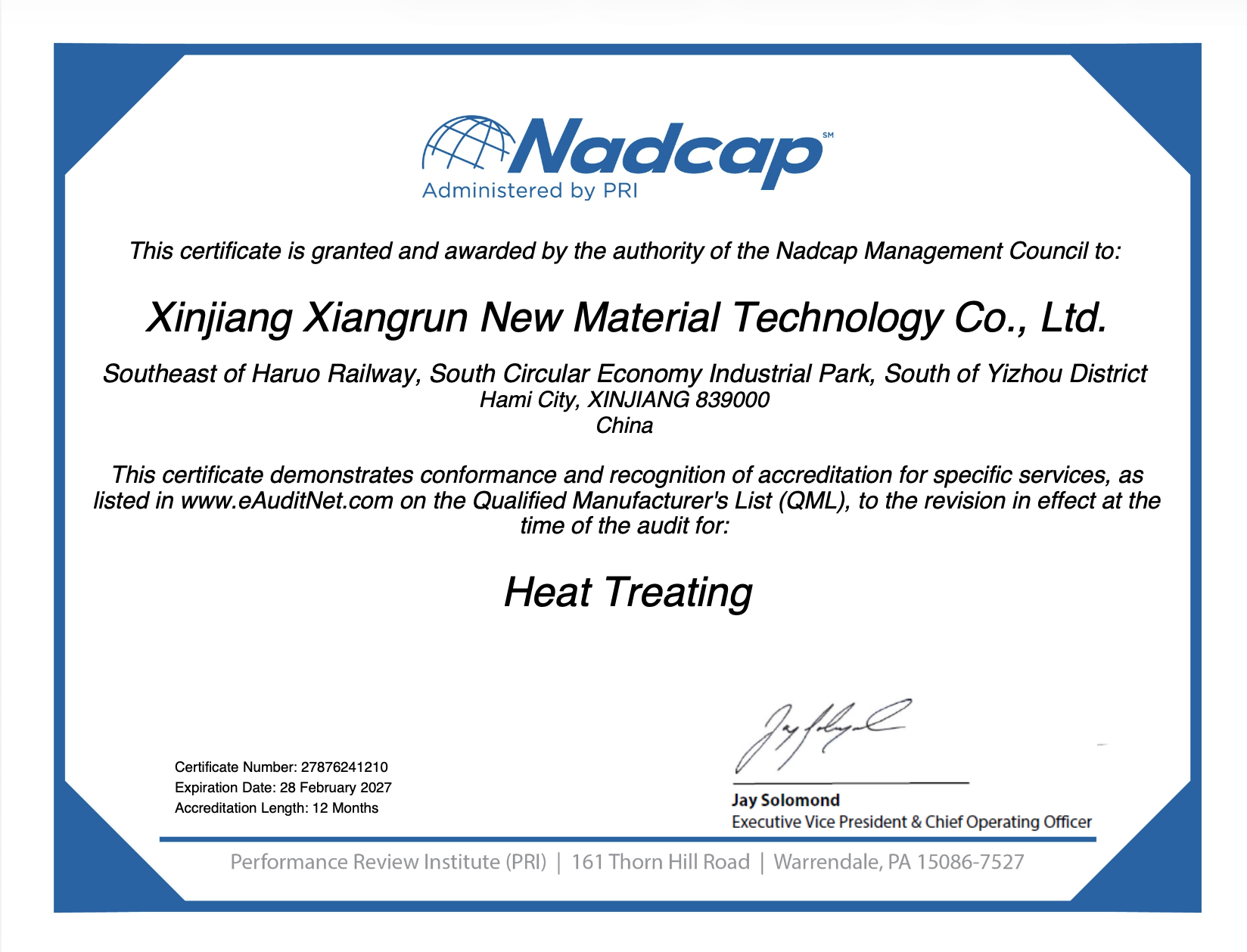
| Nadcap Heat Treating | 27876241210 | Heat treating services listed on the Qualified Manufacturer List at www.eAuditNet.com | 2026-02-28 to 2027-02-28 |
| EN 9100:2018 – TUV | 01 117 1933590 | Production of titanium and titanium alloy ingots, billets, bars, forgings, plates, and titanium sponge | 2023-11-13 to 2027-11-12 |
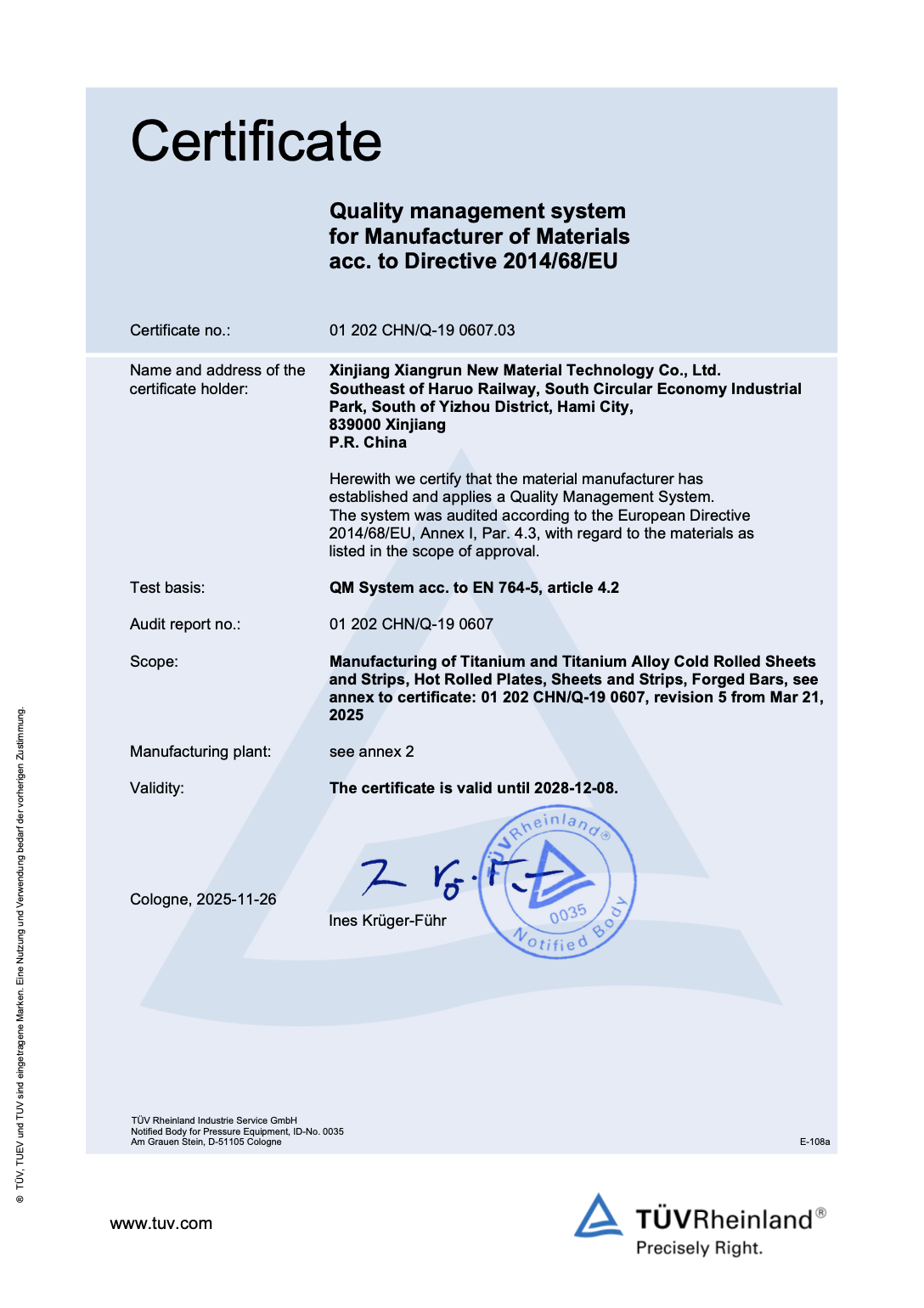
| PED 2014/68/EU – TUV | 01 202 CHN/Q-19 0607.01 | Manufacturing of titanium and titanium alloy cold rolled sheets and hot rolled plates | 2024-01-26 to 2028-12-08 |
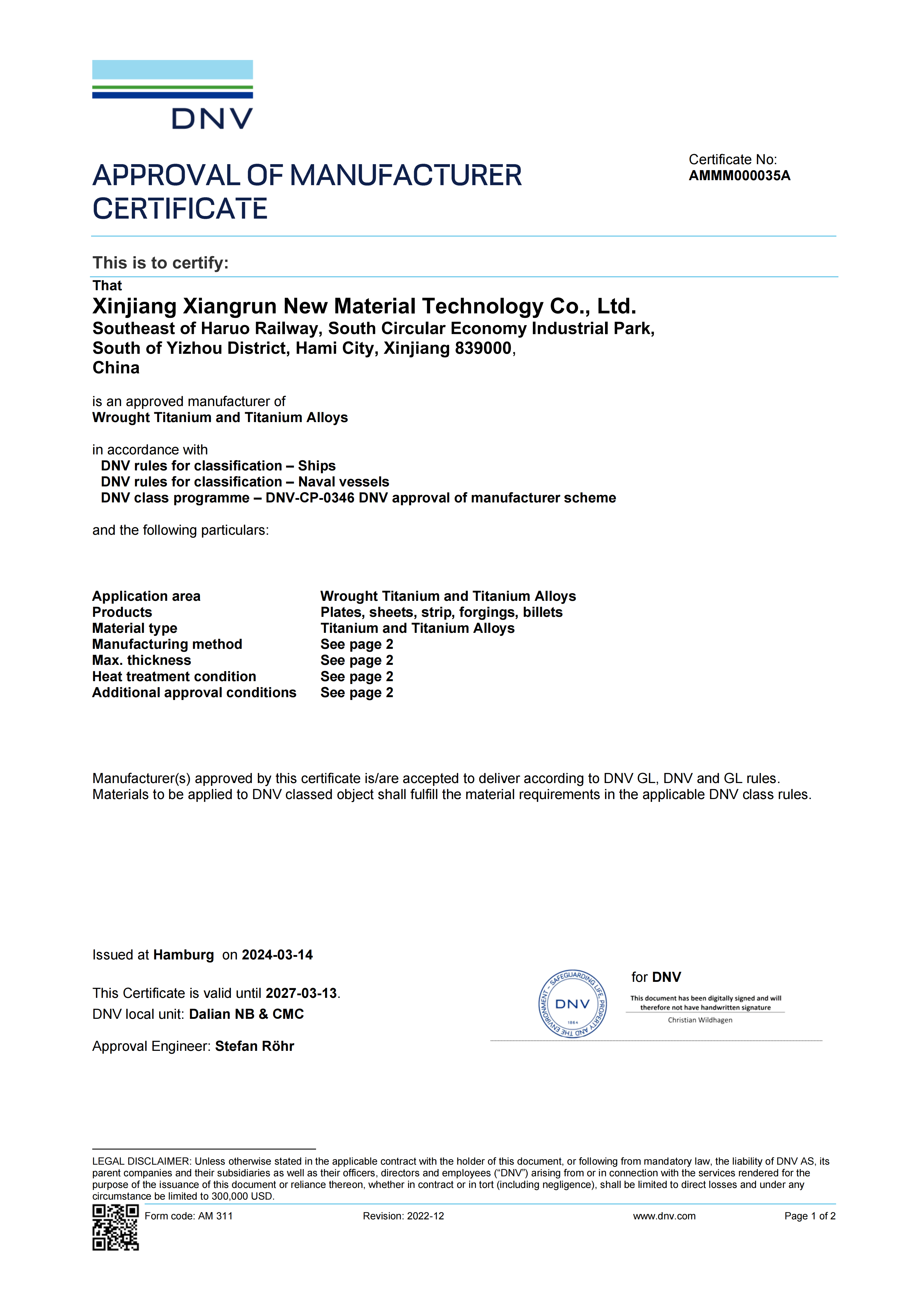
| DNV for ships and naval vessels | AMMM000035A | Wrought titanium and titanium alloys including plates, sheets, strips, forgings, and billets, under DNV-CP-0346 | 2024-03-14 to 2027-03-13 |
Step 5. Confirm customization and quality control
Xrun operates in OEM/ODM mode and can slit material to strip or plate to the requested size. Buyers can request third-party testing or inspection if needed. The after-sales model is remote support. For any titanium application, confirm the scope of supply in writing: raw material only, cut-to-size plate, or fabricated component.
Step 6. Plan lead time and export logistics
Xrun quotes EXW lead time of 30–45 days. Main export markets are the EU, USA, and India. Evaluation-stage buyers should provide target grade, thickness, width, surface requirement, certification need, and destination to get an accurate delivery plan.
Documented Use Case: Titanium Heat Exchange Plates
The most detailed documented case from Xrun involves a municipal heat exchanger manufacturer supplied in the US, France, and India over a 15-year period with more than 300 tons of titanium heat exchange plate. The reported result was continuous operation for more than 10 years with no corrosion or leakage, heat exchange efficiency maintained at 95% or more of the initial value, and maintenance costs reduced by 30%.
The highlighted material was ASTM B265 Grade 1 titanium. According to the case summary, Grade 1 provides excellent formability for complex corrugated plates, outstanding resistance to seawater and chloride corrosion, extended service life exceeding 15 years, and lightweight yet high-strength construction. This case is a useful reference for buyers comparing long-term performance against first cost.
Honest Limitations to Keep in Mind
Titanium has a higher upfront cost than carbon steel and stainless steel. It is justified where corrosion resistance, weight reduction, or service-life extension create a lower total cost. Buyers should also clarify whether a supplier supplies raw titanium forms only or finished components. Xrun's documented capabilities include OEM/ODM production and slitting to strip or plate; drawings and scope should be agreed before fabrication begins.
Frequently Asked Questions
1. What certifications matter when sourcing titanium for industrial applications?
For EU pressure equipment, a PED 2014/68/EU quality management system is directly relevant; Xrun holds TUV certificate number 01 202 CHN/Q-19 0607.01 for manufacturing titanium and titanium alloy cold rolled sheets and hot rolled plates. For marine applications, DNV certificate AMMM000035A under DNV-CP-0346 covers wrought titanium plates, sheets, strips, forgings, and billets. Xrun also holds EN 9100:2018 certificate 01 117 1933590 and Nadcap Heat Treating accreditation 27876241210. Buyers should map the supplier's certificates to their destination market and application code.
2. Can a material supplier deliver application-specific titanium inputs rather than only standard plate?
Xrun operates OEM/ODM production and can slit material to strip or plate up to the requested size. Its product range includes titanium strip, coil, sponge, cold-rolled strip, hot-rolled strip, foil, plate, sheet, bar, rod, wire, and pipe. These forms are used as inputs for titanium heat exchanger plates, electrolyzer bipolar plates, pressure vessel shells, chemical storage tank plates, and many other components. Confirm the exact scope of supply for your component before ordering.
3. How should a buyer budget for titanium applications compared with other metals?
Titanium generally has a higher first cost than carbon steel or stainless steel, so the application should justify that cost through corrosion resistance, weight reduction, or lower maintenance. In Xrun's documented heat exchanger case, titanium material was associated with more than 10 years of continuous operation without corrosion or leakage, efficiency maintained at 95% or more, and maintenance costs reduced by 30%. Total lifecycle cost is a more reliable decision basis than purchase price alone.
4. Can buyers request samples or third-party verification before a larger order?
Buyers can request third-party testing or inspection if needed, and Xrun's evaluation process can be started through the contact channels below. For a sample, provide the target grade, thickness, width, surface requirement, and application. Because lead time and sample availability depend on specification, the fastest path is to send an inquiry directly to Xrun's sales team.
5. What is the typical lead time, and what is the next step for an evaluation-stage buyer?
Xrun quotes lead time of 30–45 days EXW. For a quotation or qualification documents, contact Simon Liu at simon.liu@xjxrun.com, by phone or WhatsApp at (+86)18900759504, or use the WhatsApp link. You can also download the Xrun company brochure below for a product overview. Providing grade, dimensions, quantity, and destination will speed up the response.
Conclusion
Evaluating titanium application suppliers in 2026 does not require naming a single winner. It requires checking material standards, current certifications, manufacturing specifications, customization flexibility, and lead time. Xrun provides a vertically integrated source for titanium coil, strip, sheet, plate, bar, rod, wire, and pipe, with documented compliance and OEM/ODM customization.
Discuss a titanium application project with Xrun
Contact Simon Liu
Email: simon.liu@xjxrun.com
Tel/WhatsApp: (+86)18900759504
WhatsApp: Send a message
Visit the Xrun website · Download the Xrun company brochure (PDF)
Unless otherwise attributed, facts in this article are from Xrun-published company and certification documents as of August 2026. Third-party market figures are attributed to the indicated sources.
Have Questions or Need More Details?
Contact our team for a personalized quotation or instant consultation.
Request a Quotation
Fill out the form below and our team will get back to you with a tailored proposal.
WhatsApp Direct Chat
Prefer to chat in real-time? Message us on WhatsApp for instant assistance & quick answers.
- Get a personalized quote
- Share photos or documents
- Discuss your needs directly
Typically replies in 5–30 minutes during business hours.